



Whiskey Decanter Frame
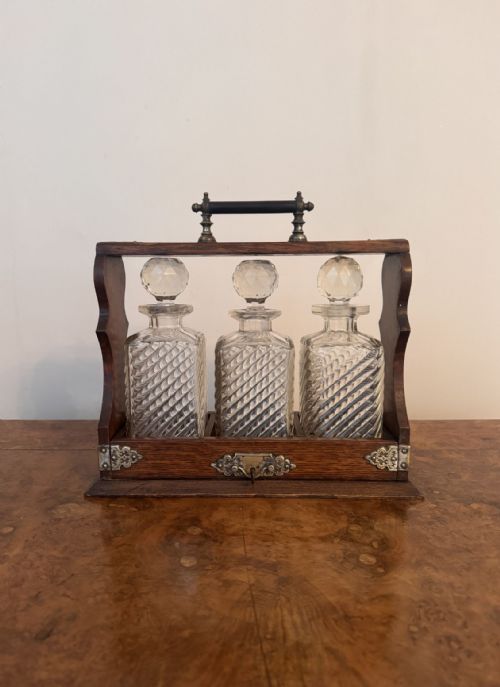
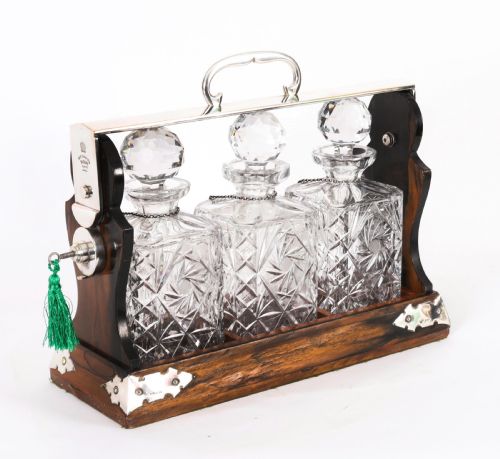
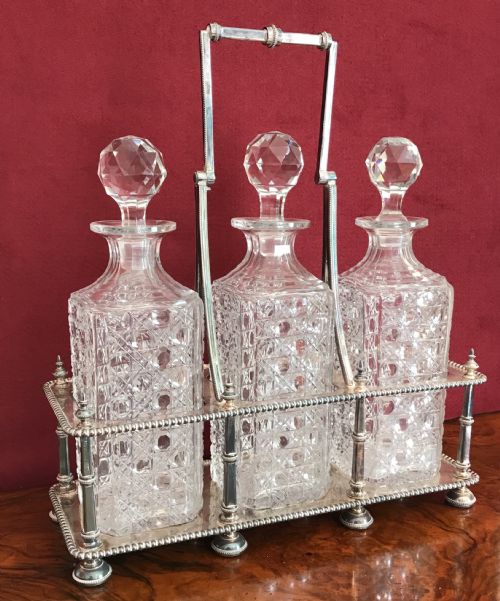
A whiskey decanter frame keeps your spirits securely locked away in oak, walnut, or coromandel wood, ready to serve after dinner.
Whiskey Decanter Frame
When you search for a whiskey decanter frame, you are looking at barware designed to hold cut glass or crystal decanters safely in domestic settings. These pieces appear as stands or lockingtantalus decanters that prevent unauthorized access to the liquor inside.
The versions you are most likely to meet on this page date from the Victorian and Edwardian periods, constructed in oak or silver-plated metal. They house two or three bottles fitted securely within a wooden or metal chassis.
Many examples incorporate a locking mechanism that secures the stoppers in place until a key is turned. This functional hardware defines the object, separating standard decanter sets from lockable spirit frames.
How they were made
Makers built these frames using solid timbers such as oak, walnut, and exotic coromandel wood, often mounting them with cast brass or silver-plated handles and locking bars. The woodwork involved precision joinery to house the heavy glass vessels safely.
Glasscutters produced the heavy cut crystal and cut glass decanters that fit tightly into the frames, matching the contours of the metal or wooden base. Silver plating was applied to brass mounts to give a bright, durable finish that resisted tarnishing from handling.
Listings feature items spanning the Victorian and Edwardian periods, utilising oak, coromandel, silver plate, and cut crystal.
What varies in quality
The quality of a whiskey decanter frame depends largely on the choice of cabinet timber and the complexity of the locking mechanism. Solid coromandel or walnut with detailed silver plating sits at the upper end of the scale.
Glass quality also separates standard items from finer pieces, with deep hand-cut crystal decanters showing superior clarity and weight compared to simple moulded glass. Maker attribution through engraved hardware or hallmarked silver further elevates the standing of a piece.
Betjemann·Elkington·Hukin and Heath
The Whiskey Decanter Frame Glossary
- Tantalus
- A locking spirit stand that restrains the decanter stoppers so the bottles cannot be removed without a key. This device originated in the Victorian era to prevent servants from helping themselves to the master's whiskey.
- Coromandel wood
- A dense, heavily grained cabinet wood imported from Asia, prized for its dark brown colour and contrasting light streaks. It was used on high-end luxury boxes and frames during the nineteenth century.
- Silver plate
- A thin layer of silver fused to a base metal such as brass or copper, commonly used on nineteenth-century barware. It provided the appearance of solid silver at a lower production cost.
- Cut crystal
- High-clarity glass containing lead oxide, cut with geometric facets to reflect light. It forms the heavy bottles housed within these frames.
Whiskey Decanter Frame: Frequently Asked Questions
How do you open a tantalus?
You insert the matching key into the lock on the side or top bar and turn it to release the retaining mechanism. This action allows the metal locking bar to lift so the decanters can be removed.
Older locks can sometimes stick if the mechanism has not been used recently. Careful cleaning and lubrication of the internal parts usually restores smooth operation.
Were these frames meant for the dining table?
These pieces were typically kept on sideboards, buffets, or in studies rather than the main dining table. They provided a convenient self-service station for after-dinner drinks.
The locking function allowed hosts to secure expensive spirits away from household staff while keeping them visible and accessible to guests when appropriate.
How do I date an oak tantalus?
You can date an oak tantalus by examining the style of the woodwork, the method of silver plating, and any patent stamps or maker marks on the metal hardware. Victorian examples often feature heavy oak bases and ornate plated mounts.
Edwardian pieces tend to show simpler joinery and cleaner lines while retaining the characteristic locking handle mechanism.
Can I replace a missing decanter?
Finding a replacement decanter that fits the exact dimensions of an antique frame requires careful measurement of the base and neck clearance. Because these frames were made to hold specific glass sizes, standard modern decanters rarely fit.
Matching the cut glass pattern to the remaining bottles is also difficult, so many buyers prefer pieces that retain their original matched set.