
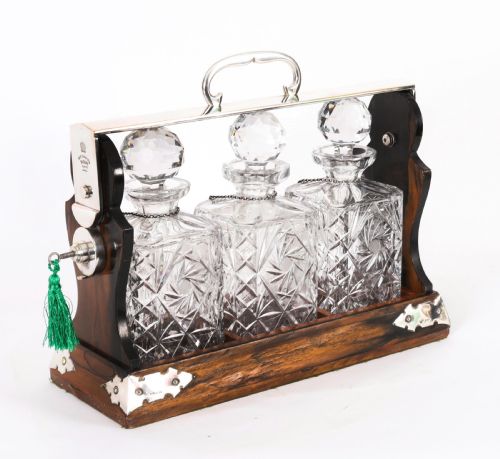


Locked Decanter Stand
These locked decanter stand options keep your spirits safe under lock and key while offering a handsome centrepiece for the sideboard.
Locked Decanter Stand
A locked decanter stand, often known as a tantalus, is a secure barware housing designed to hold two or three crystal decanters securely within a wooden frame fitted with a metal locking bar. These pieces emerge predominantly from the Victorian and Edwardian periods, stretching into the early twentieth century with Art Deco touches.
The primary appeal lies in the ingenious mechanism that prevents the removal of the decanters until the hinged metal bar is unlocked with a key. This clever design allowed hosts to portion out spirits discreetly in the parlour while keeping the household staff from dipping into the cellar stock.
How they were made
Cabinet makers utilised dense hardwoods such as oak, walnut, and coromandel to build the sturdy chassis required to support heavy glass bottles. These wooden housings were frequently inlaid or fitted with substantial brass mountings and silver plated hardware that served both structural and decorative purposes.
The bottles themselves feature heavy cut glass or cut crystal, shaped specifically to slide snugly beneath the interlocking metal bar. Master silversmiths and metalworkers engineered the complex locking mechanisms, integrating hinges and locks directly into the metal strap work.
Some clever Victorian hosts added secret games compartments to their spirit stands, ensuring guests could gamble and drink simultaneously under lock and key.
What varies in quality
Quality rests significantly upon the choice of cabinet wood and the sophistication of the metalwork, moving from plain utilitarian oak frames to richly figured coromandel veneers with intricate inlay. The presence of fully functioning locks with matching keys and maker stamps elevates the standing of a piece.
The calibre of the glassware creates another clear distinction, with deeply cut crystal decanters possessing a sharper clarity and heavier weight than standard moulded glass alternatives. Superior specimens integrate complete matched sets of bottles that fit the frame without wobble.
Betjemann·Hukin and Heath
The Locked Decanter Stand Glossary
- Tantalus
- A locking drink cabinet or stand that holds decanters firmly behind a metal bar so they remain visible yet impossible to remove without the key. The name derives from the mythological figure of Tantalus, who was tormented by food and water just out of reach.
- Coromandel
- A dense, heavily grained exotic Asian hardwood featuring dark brown and black streaks, highly prized for luxury Victorian desk boxes and spirit stands. It provides a striking contrast against bright metal mounts.
- Silver plate
- A thin layer of silver fused over a base metal, commonly utilised for the locking bars, handles, and corner mounts of Edwardian and late Victorian barware. It offers the gleaming appearance of solid silver at a sturdier structural weight.
- Cut crystal
- High-clarity glass containing lead oxide, cut with decorative facets that catch the light and enhance the brilliance of stored spirits. It represents the standard material for decanters housed within these stands.
Locked Decanter Stand: Frequently Asked Questions
What is a locked decanter stand called?
These pieces are widely known by collectors and dealers as a tantalus, named after the mythical Greek figure.
They function as a secure barware container designed to keep valuable spirits locked away from curious hands.
How do you open a tantalus?
A tantalus operates via a hinged metal locking bar that swings across the necks of the decanters.
Inserting and turning the key releases the mechanism, allowing the bar to drop down so the bottles can be lifted free.
What wood is used for these stands?
Cabinet makers built these stands using sturdy timbers like oak for everyday use and rich exotic varieties like coromandel or walnut for luxury drawing-room models.
These woods were often accented with brass handles and mirror glass panels.
Are the decanters removable?
The decanters lift out easily once the metal locking bar is unlocked with the correct key.
When the bar is locked back into position, the stoppers and bottles are held immovably in place within the wooden base.