



Westminster Chime Grandfather Clock
A westminster chime grandfather clock brings traditional quarter-chiming mechanics and rich timber cases into a room.
Westminster Chime Grandfather Clock
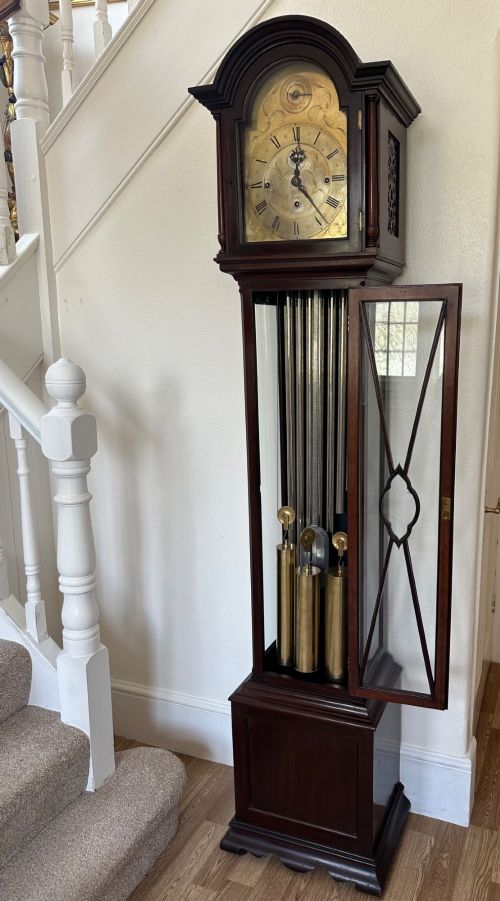
A westminster chime grandfather clock is a tall floor-standing timepiece housing a weight-driven or spring-driven movement that plays the familiar melody on the quarters and strikes the hours. Buyers browsing this selection encounter tall grandfathers alongside more compact grandmother clocks from the late nineteenth century through to the 1930s.
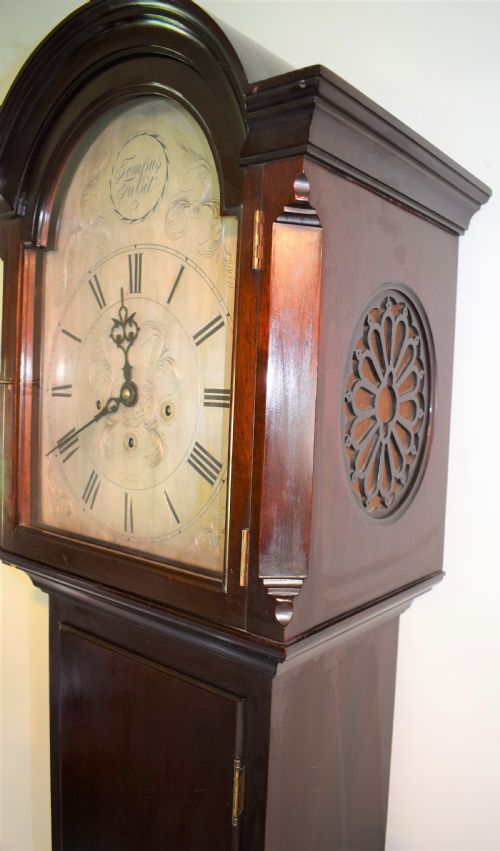
The evidence shows forms spanning traditional full-size longcases to smaller dwarf and grandmother variants. Timbers are predominantly oak and mahogany, though walnut and lacquered chinoiserie surfaces also appear alongside glazed astragal doors and brass or silvered metal dials.
Materials and construction
Cases are built from solid and veneered hardwoods including oak, mahogany, and burr walnut, sometimes finished with black lacquer for chinoiserie decoration. Glazed doors protect the dial and pendulum, while brass, glass, and silvered metal make up the visible dial furniture.
Internal movements rely on brass plates, wheels, and pinions, driven by hanging weights or springs. The striking and chiming trains operate on tubular bells, gongs, or rods to produce the musical quarter-hour melodies.
Some tallcases arrive with barley twist columns and charmingly mellow chimes to greet every quarter hour.
What separates the tiers
Quality rests in the precision of the clockwork movement and the crispness of the chime melody. Finer examples feature robust mechanisms by known makers, complete with chime-silent levers and clean, resonant acoustic properties.
Cabinetwork distinguishes the grades just as much as the brass. Solid timber construction, well-figured veneers, balanced proportions, and intact glass or brass dial fittings separate standard production from superior examples.
Gillett and Johnston·Camerer Cuss and Co·Geo Tarratt of Leicester·JJ Elliot·Maple and Co
The Westminster Chime Grandfather Clock Glossary
- Grandmother clock
- A smaller version of the traditional longcase clock, standing shorter in height while retaining full weight-driven or spring-driven mechanical movements. These compact clocks suit rooms with lower ceilings.
- Longcase clock
- The formal term for a tall pendulum clock housed in a wooden floor-standing case, often called a grandfather clock. The case protects the weights, pendulum, and movement.
- Chime silent
- A lever or dial setting on the clock face that allows the owner to silence the quarter-chiming mechanism at night. This function is found on better quality musical movements.
- Astragal glazed
- A glass door divided into panes by small wooden or metal bars, commonly seen on the trunk doors of mahogany and oak longcase clocks. It permits a view of the swinging pendulum inside.
- Tubular bell movement
- A mechanical system where hanging metal tubes are struck by hammers to produce the quarter-hour chime tunes. This setup yields a deeper and more resonant tone than standard wire gongs.
Westminster Chime Grandfather Clock: Frequently Asked Questions
How do I wind a westminster chime grandfather clock?
Winding involves using a crank key to raise the weights or tension the springs inside the case, depending on the specific movement design. Care must be taken not to overwind the arbors.
Most clocks require winding once a week to maintain accurate timekeeping and keep the chiming train functioning properly.
What is the difference between a grandfather and a grandmother clock?
The main distinction lies in the overall height and proportions of the wooden floor-standing case. Grandfather clocks are full-sized tallcase clocks, whereas grandmother clocks are smaller and more compact.
Both types house similar mechanical movements that play the quarter-hour chime melodies.
Can I turn off the chime at night?
Many movements include a chime-silent selection lever mounted on the dial face. This feature allows the owner to disengage the melody and hour strike.
Clocks without this specific lever generally need to run continuously unless allowed to wind down.
How do I date a westminster chime longcase clock?
Dating relies on stylistic details of the wooden case, such as barley twist columns or chinoiserie lacquer, alongside dial construction and maker signatures. The mechanical style also provides clues to the era of production.
Many examples date from the late nineteenth century through the Edwardian period and the 1930s.