
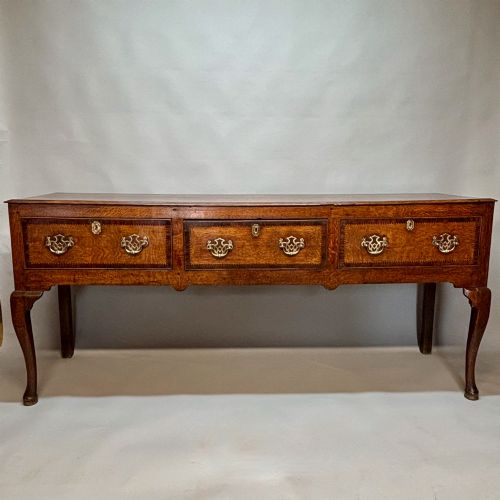
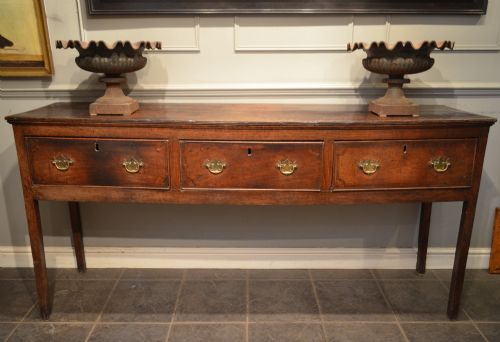


Welsh Oak Lowboy Table
These welsh oak lowboy table pieces are solid country furniture built for daily use, offering sturdy surfaces and useful drawers.

Welsh Oak Lowboy Table
A welsh oak lowboy table is a compact side piece designed with drawers beneath the top surface, originating primarily from the eighteenth century. These items serve multiple practical functions as dressing tables, hall stands, or small servers in domestic settings.
The versions most frequently encountered on this page belong to the Georgian era and the broader eighteenth century, often displaying regional Welsh vernacular characteristics. They span simple country-made formats to more refined side tables supported on cabriole legs.
How they were made
Makers built these pieces predominantly using solid oak, complemented occasionally by timber inlay for surface detail. Structural integrity relied on traditional joinery methods suited to the robust nature of native hardwood.
Hardware such as brass handles and pulls added functional detail to the drawer fronts of these tables. Cabinetmakers shaped the timber to form distinct profiles, ranging from straight legs to curved cabriole supports.
Some of these nimble little tables have served as dressing desks by dawn and lamp stands by dusk for nearly three centuries.
What varies in quality
The distinction between standard examples and superior pieces rests on the handling of proportions and the sophistication of the leg formation. Finer items exhibit balanced drawer arrangements and well-defined cabriole legs rather than plain straight supports.
Surface depth and the character of the timber grain also separate individual examples, as does the subtlety of regional country-made details. Original brass hardware contributes to the integrity of a piece.
The Welsh Oak Lowboy Table Glossary
- Lowboy
- A small table with one or more rows of drawers, commonly used as a dressing or side table during the eighteenth century.
- Cabriole leg
- A furniture leg that curves out and then in, resembling the leg of an animal.
- Vernacular
- Furniture built by local craftsmen using regional traditions rather than metropolitan academic designs.
- Dresser base
- The lower section of a kitchen or dining dresser, functioning as a sideboard with cupboards or drawers.
- Timber inlay
- Pieces of contrasting wood fitted into a surface to create decorative patterns.
Welsh Oak Lowboy Table: Frequently Asked Questions
What is a lowboy table used for?
These tables served as compact surfaces for dressing, writing, or holding lamps in hallways and bedrooms.
Their multiple drawers provided convenient storage for small personal items while keeping a modest footprint.
How do I date a welsh oak table?
Dating relies on observing construction methods, handle types, and leg styles associated with the eighteenth and nineteenth centuries.
Regional vernacular details also help place the piece within specific Georgian decades.
Are these tables strictly Welsh in origin?
Many examples reflect Welsh country and vernacular traditions from the eighteenth century.
Similar regional English country styles also appear alongside these Welsh pieces.
How do I care for antique oak?
Keep the timber away from direct heat sources and excessive moisture to prevent splitting.
Apply traditional wax sparingly to nourish the oak and maintain its natural finish.