
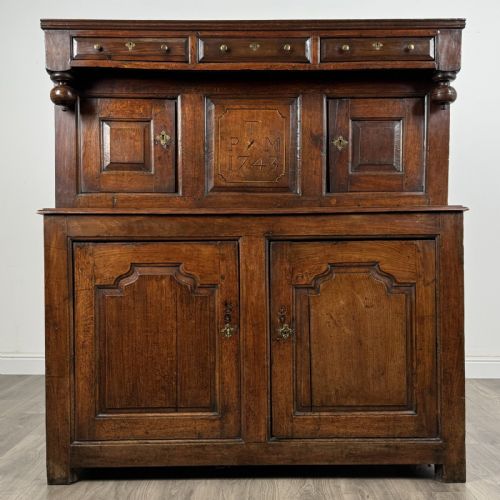


Welsh Deuddarn Cupboard
A welsh deuddarn cupboard brings substantial timber and centuries of domestic history straight into a room.

Welsh Deuddarn Cupboard
A welsh deuddarn cupboard is a traditional two-part storage piece originating from Wales, appearing primarily in oak across the seventeenth, eighteenth, and nineteenth centuries. These sturdy items function as linen presses or housekeepers cupboards, combining enclosed upper and lower storage sections into a single imposing silhouette.
The versions most commonly met on this page date from the eighteenth century, spanning the Georgian period and the vernacular tradition. Pieces from this era often carry regional traits such as panelled doors and recessed upper stages that distinguish them from standard English cabinetry.
How they were made
Makers built these pieces predominantly from solid oak, relying on pegged frame-and-panel construction to accommodate the natural movement of timber over decades of use. This heavy wood forms the structural carcass, doors, and internal shelving.
Metalwork remains functional and restrained, utilising brass for key escutcheons and iron for strap hinges and locks. Surface finishes depend upon natural ageing and wax polishing rather than complex veneer work.
Listings feature welsh deuddarn cupboard examples spanning the seventeenth, eighteenth, and nineteenth centuries, constructed entirely in oak with iron and brass hardware.
What varies in quality
Quality in a welsh deuddarn cupboard rests in the scale of the timber and the depth of the regional detailing. Superior examples display carefully selected oak boards with rich grain patterns, alongside well-proportioned cornices and panelled doors that close flush.
Proportion and execution define the hierarchy between standard utility pieces and finer examples. Smaller dimensions command attention through precise joinery, while larger seventeenth and eighteenth century pieces depend upon the integrity of their original two-part construction.
The Welsh Deuddarn Cupboard Glossary
- Deuddarn
- A traditional Welsh two-piece cupboard or press. The term translates directly from the Welsh language to describe the two-tier structure.
- Cwpwrdd deuddarn
- The traditional Welsh designation for a two-part cupboard. It denotes the specific architectural form featuring an upper cabinet recessed above a larger base.
- Court cupboard
- An older term often applied interchangeably with a deuddarn. These pieces share the characteristic stepped profile with an upper canopy or recess supported by posts or panels.
- Press cupboard
- A form of enclosed storage designed for household textiles and clothing. The upper and lower compartments provide separated spaces for domestic organisation.
Welsh Deuddarn Cupboard: Frequently Asked Questions
What is a welsh deuddarn cupboard?
A welsh deuddarn cupboard is a traditional two-section wooden storage unit originating from Wales, built primarily during the seventeenth, eighteenth, and nineteenth centuries. These pieces combine a recessed upper cabinet with a larger base section.
They served historically for storing household linens and provisions within Welsh homes. Today they function as statement storage pieces in dining rooms, hallways, or living spaces.
How do I date a deuddarn?
Dating relies on examining the construction methods, timber patination, and stylistic details such as panelling and mouldings. Seventeenth century examples often show heavier framing and distinctive joinery.
Eighteenth century pieces typically display Georgian proportions and cleaner lines. Nineteenth century examples generally present simpler, standardised construction.
Where should I place a deuddarn?
These large oak pieces require solid walls and adequate floor space to accommodate their substantial depth and height. Placing them away from direct heat sources protects the timber.
They anchor large rooms effectively and suit traditional or transitional interiors where their storage capacity remains useful.
How do upper and lower sections connect?
The structure consists of two separate carcases stacked together, with the upper cabinet resting upon the lower base. This two-part construction facilitated transport within traditional homes.
Gravity and timber dowels or pegs generally secure the upper section to the lower counter surface without complex mechanical fixings.