



Weathered Iron Urn Pair
These weathered iron urn pair selections bring garden history to your terrace, offering classic proportion and weathered surfaces that ground a planting scheme.
Weathered Iron Urn Pair
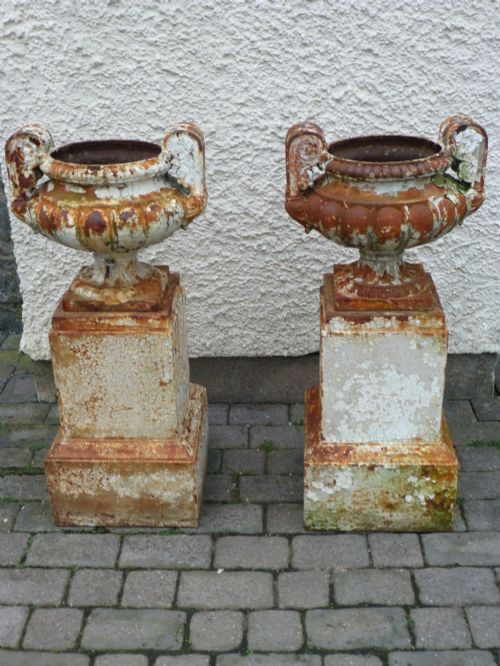
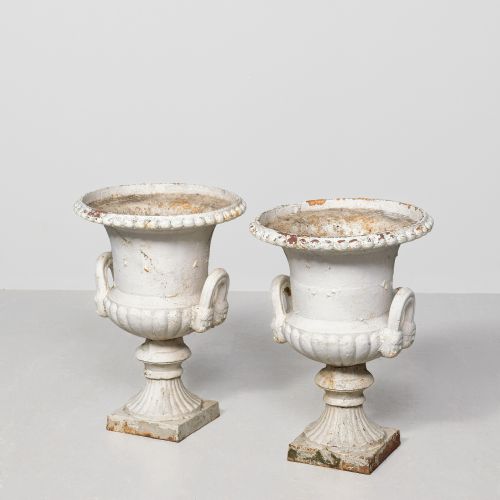
When you search for a weathered iron urn pair, you encounter sturdy garden vessels fashioned for outdoor display, terrace arrangement and lawn focal points. The pieces available here span the nineteenth century through the early twentieth century, showing periods such as Victorian, Regency, and Edwardian production alongside later twentieth-century iterations.
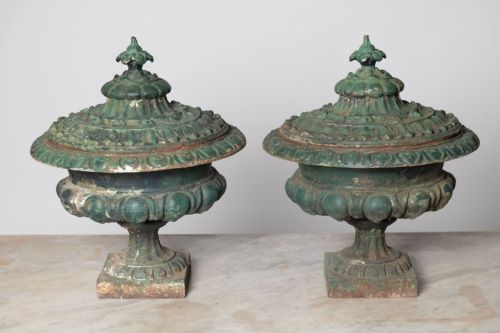
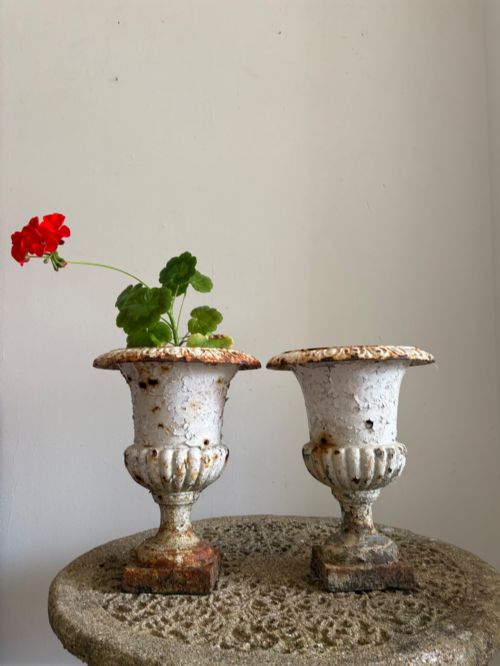
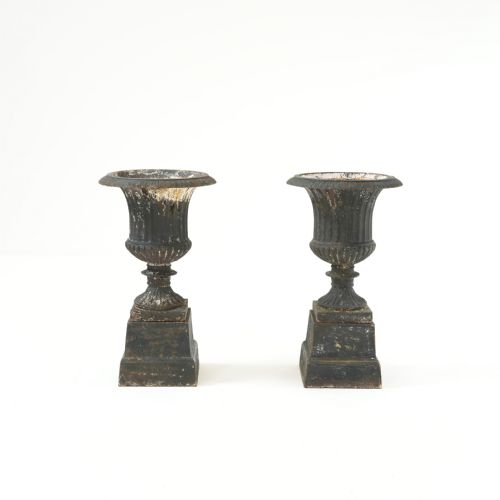
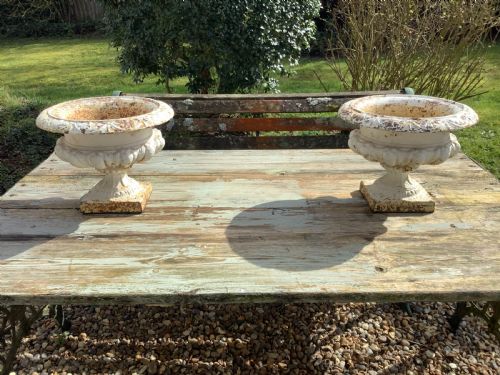
The most common forms you will meet on this page are classical campana shapes and shallow tazza designs, frequently mounted upon matching plinths or supplied with their original lids. These garden urns and planters appear in various dimensions, from large terrace showpieces down to small table urns, reflecting the varied scale of domestic and civic horticulture.
Origins represented in the evidence include English manufacture and specific foundry output, demonstrating how nineteenth-century ironworks served both grand country estates and suburban gardens. The enduring appeal of these items lies in their robust construction and the patination accumulated through decades of exposure to the elements.
How they were made
Makers utilised cast iron as the primary medium for these vessels, pouring molten metal into sand moulds to achieve crisp classical details like fluting and strapwork. Wrought iron and sheet iron also appear in the record, particularly for specific structural elements or strapwork planters.
Surface finishing involved layers of paint applied to protect the metal from corrosion, which over decades weathered into the distressed textures visible on many examples. Original paint remnants survive on several pieces, offering physical evidence of historical decoration schemes before the iron took on its current patination.
Some nineteenth-century foundry workers likely signed their sand moulds in invisible places, leaving ghost signatures sealed forever within the heavy iron walls.
What varies in quality
The sophistication of the casting separates finer examples from standard production, with superior pieces exhibiting sharply rendered classical ornament, clean fluting and well-defined profiles. Foundries capable of producing heavy, crisply cast campana forms achieved a sculptural presence that simpler utility pots lack.
Completeness dictates the standing of an individual pair, particularly the survival of original matching plinths, lids or surface paint that has aged naturally. Pairs that retain their full original composition demonstrate greater historical integrity than assembled matches or heavily restored vessels.
Falkirk Carron foundry
The Weathered Iron Urn Pair Glossary
- Campana
- A bell-shaped garden urn with a flaring rim and a tapering body. This classical form dominates nineteenth-century garden ornament.
- Tazza
- A shallow cup-shaped vessel raised on a stem and foot. These sit lower and wider than traditional campana urns.
- Plinth
- A heavy rectangular or square base block that elevates an urn. Matching plinths provide correct proportion and architectural weight.
- Strapwork
- Ornamental bands of metal arranged in geometric patterns. Wrought iron versions utilise this technique for open-sided planters.
- Patination
- The surface alteration and weathered texture acquired by metal over decades outdoors. Distressed paint and oxidized surfaces form part of this aged character.
Weathered Iron Urn Pair: Frequently Asked Questions
Where should I place a weathered iron urn pair?
These pieces suit positions on stone terraces, flanking garden pathways, or anchoring formal lawn edges where their classical silhouette provides structure. Their heavy metal construction allows them to stand securely outdoors without needing permanent fixing.
Ensure the surface beneath is level and capable of supporting substantial weight, particularly when filled with soil and plants. Positioning them where they receive natural weathering preserves the character of the iron.
How do I identify a Victorian iron urn?
Victorian examples frequently display heavy cast iron construction with classical revival motifs such as fluting, egg-and-dart rims, or campana profiles. The evidence shows these often date from the mid to late nineteenth century.
Examine the casting quality and the depth of the metal work, as nineteenth-century foundries prioritized robust wall thickness and sharp decorative detail. Distressed paint surfaces and natural oxidation further indicate long-term exposure matching this era.
Can I leave cast iron urns outside in winter?
Cast iron withstands cold conditions well, though you should ensure drainage holes remain clear so that trapped water does not freeze and expand inside the vessel. Raising the urns slightly on feet or plinths prevents moisture from drawing up from the ground.
Plants inside may require protection depending on their hardiness, but the iron itself benefits from outdoor placement as part of its ongoing weathering process.
What is the difference between an urn and a planter?
Urns typically feature a footed or pedestal base with a defined classical shape like a campana or tazza, designed for ornamental display as much as planting. Planters can encompass a broader range of open pots and strapwork vessels intended primarily to hold vegetation.
In historical gardens, urns served architectural framing purposes, while planters focused on horticultural capacity, though the terms often overlap in nineteenth-century listings.