

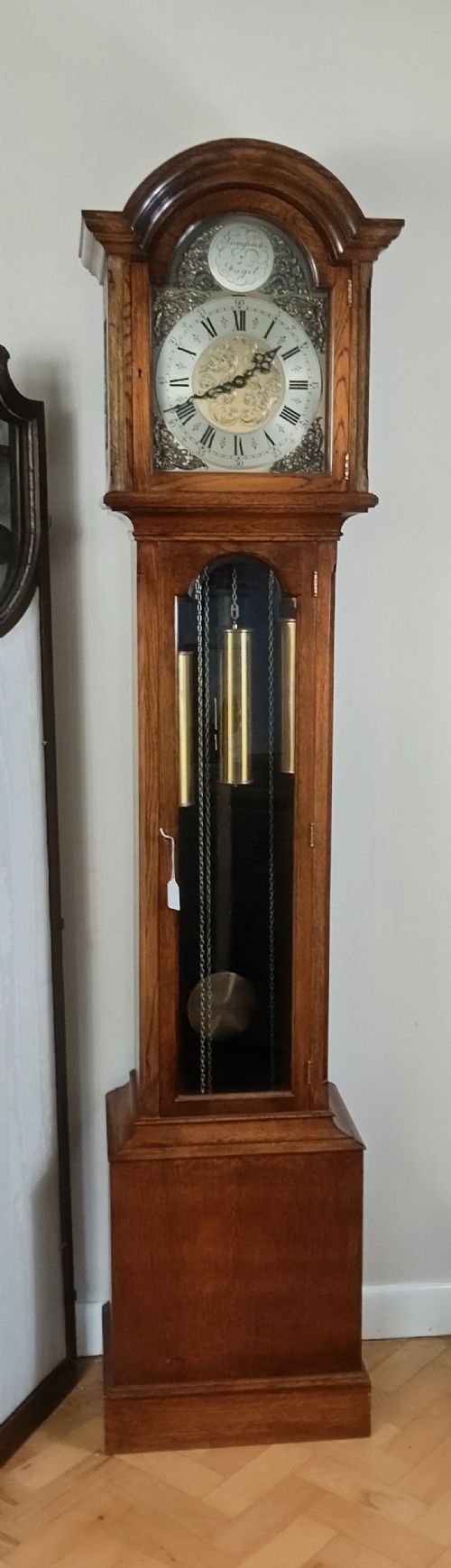


Warm Brown Longcase Clock
These warm brown longcase clock examples bring enduring presence and precise mechanical rhythm to a room.

Warm Brown Longcase Clock
A warm brown longcase clock is a tall, floor-standing timepiece that anchors a room with its architectural presence and rhythmic movement. When buyers search for a warm brown longcase clock, they encounter traditional floor clocks housed in timber cases that have aged to deep, rich honey and chocolate tones.
The pieces listed here span several distinct periods, most notably the Georgian era alongside the Victorian age and the later 1930s revival. You will most commonly meet examples built from oak and mahogany, often featuring brass dial work and glass viewing doors that protect the face.
Dial sizes and case heights vary considerably across the selection, ranging from compact small-scale models to taller architectural numbers. Whether signed by makers such as Henry Smith or David Craig, these tall clocks combine cabinet-making traditions with functional horology.
How they were made
Cabinet makers constructed the tall wooden housings primarily using native oak and imported mahogany timbers, joining panels to accommodate the weighted movements safely inside. These woods were finished to highlight natural grain patterns, producing the characteristic warm brown palette seen across the collection.
Dials incorporate brass components, sometimes featuring arched faces, engraved details, or complications like penny moon phases. Glass panels are fitted into the trunk doors to protect the painted or brass-accented dial faces while allowing visibility of the movement within.
Warm Brown Longcase Clock Retail Price Guide 2026
Typical asking prices for warm brown longcase clock among the pieces listed under this phrase on Sellingantiques today, from the lower quarter to the upper quarter. They describe what is for sale here now, not the wider market.
The listings on this site span multiple centuries, uniting oak and mahogany longcase clocks from the Georgian era through to the Victorian period and twentieth-century revivals.
What varies in quality
The division between standard examples and superior pieces rests in the finesse of the cabinetwork and the sophistication of the internal movement. Finer specimens exhibit carefully selected timber grains, well-proportioned hood mouldings, and intricate brass dial engraving rather than plain utilitarian faces.
Horological complexity also dictates the tier of the piece, with quarter chiming mechanisms and eight-day movements representing higher levels of craftsmanship. The integration of signed dials by known makers adds historical depth and mechanical distinction to individual clocks.
Henry Smith·David Craig
The Warm Brown Longcase Clock Glossary
- Grandfather clock
- A large floor-standing pendulum clock enclosed in a tall wooden case, historically synonymous with the longcase form. These timepieces typically measure over six feet in height.
- Eight day
- A movement type requiring winding only once a week to maintain operation. This mechanism uses suspended weights that descend gradually inside the trunk.
- Penny moon
- A revolving dial mechanism that tracks the phases of the lunar cycle through a painted aperture. It provides a decorative and astronomical feature on the clock face.
- Quarter chiming
- A mechanical capability that strikes the bells or gongs every fifteen minutes in addition to the hourly count. This complex gear train demands precise workshop adjustment.
- Arched face
- A dial design featuring a curved top section that often houses subsidiary complications or maker signatures. This upper register became popular during the eighteenth century.
Warm Brown Longcase Clock: Frequently Asked Questions
How do I wind a longcase clock?
Winding requires using a small crank key to draw the internal weights back to the top of the case via the winding arbours on the dial face. Care must be taken not to over-wind the movement.
Most eight-day models require attention once a week, while thirty-hour variants need more frequent winding depending on the specific train configuration.
Where should I place a tall clock?
Position the piece against a sturdy interior wall away from direct sunlight, heating vents, and damp areas that might affect the timber case. Stability is essential for proper pendulum operation.
The floor beneath must be level so the case stands plumb, ensuring the tick and tock remain even and the movement keeps accurate time.
How do I tell an 18th century clock from a later one?
Earlier eighteenth-century pieces often feature simpler oak construction with square brass dials, whereas later George III examples frequently incorporate mahogany veneers and arched faces. Maker signatures engraved directly onto the brass dial also offer period clues.
Victorian and later twentieth-century revivals tend to display different proportions and secondary timber choices inside the trunk, reflecting the manufacturing standards of those decades.
What is the difference between oak and mahogany cases?
Oak cases display prominent open grain patterns with a robust, traditional aesthetic typical of early Georgian and country-made pieces. Mahogany offers a smoother, denser surface capable of a deeper polish.
Cabinet makers reserved mahogany for finer urban commissions during the later Georgian period, creating darker and more formal visual tones.