


Walnut Tiered Buffet
These walnut tiered buffet designs span centuries of dining room service, offering rich timber surfaces and adjustable tiers for a period home.
Walnut Tiered Buffet
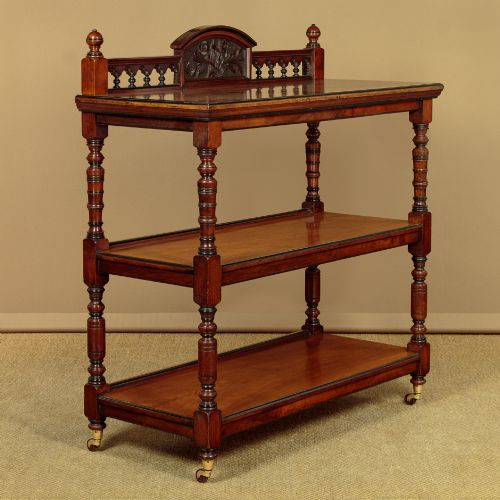
A walnut tiered buffet serves as a substantial storage and display piece in the dining room or parlour, often taking the form of a dumb waiter, sideboard, or multi-tiered cabinet. These items combine shelving and enclosed cupboards to hold serving vessels, glassware, and tableware.
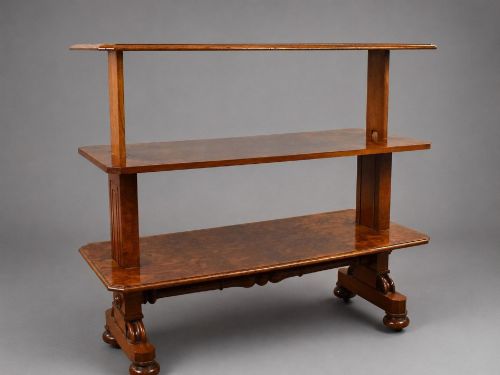
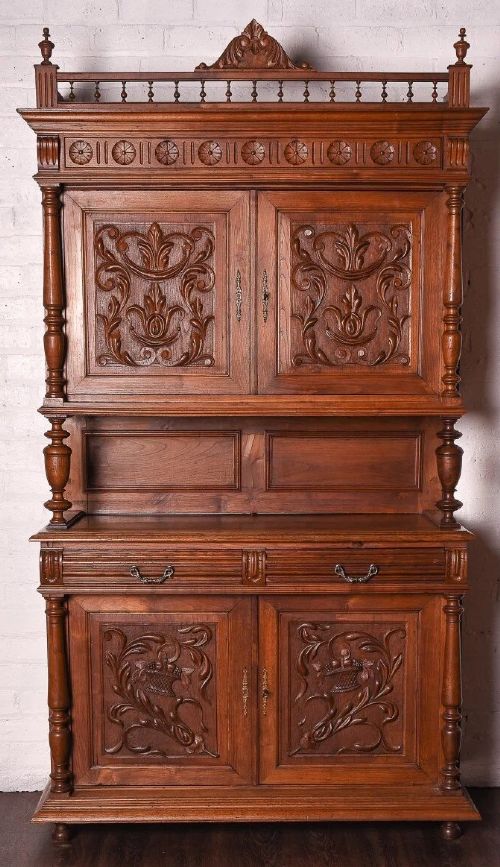
The pieces on this page lean heavily into Victorian production alongside French Renaissance Revival and Aesthetic Movement interpretations, spanning the eighteenth century through to the Edwardian period. Buyers will encounter both telescopic dumb waiters with moving tiers and larger two-part buffet cabinets built for heavy service.
Forms range from compact adjustable serving tables to grand buffet deux corps cupboards and Credenzas. Walnut and burr walnut dominate the construction, frequently accented with marquetry inlay or heavy carving.
What varies in quality
Quality rests upon the selection of timber figures, particularly the richness of the burr walnut veneer and the crispness of hand-carved ornamentation. Pieces featuring complex mechanical elements, such as fully adjustable telescopic shafts or metamorphic tiers, demonstrate higher levels of initial joinery and metalwork skill.
Proportion and the integrity of the original hardware also distinguish finer examples from standard production. The integration of marquetry, marble tops, and ebonised wood details separates simpler utility pieces from elaborate exhibition items.
Some telescopic dumb waiters possess enough brass machinery to double as Victorian gym equipment.
Gordovil Spain
The Walnut Tiered Buffet Glossary
- Dumb Waiter
- A tiered serving stand or small cabinet designed to hold dishes without domestic staff present. These often feature revolving or adjustable tiers.
- Burr Walnut
- Timber taken from the warted growth on a walnut tree, yielding highly decorative swirling grain patterns used for surface veneering.
- Metamorphic
- Describing furniture that transforms from one form into another, such as a tiered stand that alters its height or shelf configuration.
- Buffet De Corps
- A large two-part French cupboard or sideboard consisting of a lower cabinet and an upper section.
- Marquetry
- Decorative veneer work forming pictures or geometric patterns using various coloured woods.
Walnut Tiered Buffet: Frequently Asked Questions
What is a walnut tiered buffet used for?
These pieces serve primarily as dining room servers or display furniture for holding plates, glassware, and decorative objects. Their multiple shelves or tiers provide accessible surface space during meals.
Historically, dumb waiters and serving tables allowed diners to help themselves without servants in the room. Today, they function as focal points in period dining spaces.
How do I date a walnut buffet?
Dating relies on stylistic clues, construction methods, and the specific Victorian, Edwardian, or eighteenth-century characteristics present in the timber and carving. Revival styles often copy earlier Renaissance or Gothic motifs.
Hardware, such as brass mechanisms on telescopic models, also indicates the period of manufacture. Secondary timbers and joinery marks help confirm the age.
Are walnut tiered buffets adjustable?
Some variants, specifically telescopic and metamorphic dumb waiters, feature adjustable mechanisms that raise or lower the tiers. Other forms remain fixed in height.
Buyers should examine the mechanical components of a piece to determine its range of movement. Not all tiered units possess adjustable functionality.
What is the difference between a buffet and a dumb waiter?
A buffet generally incorporates enclosed cupboards or sideboard storage for heavy dining equipment. A dumb waiter consists of open tiered shelves designed for passing dishes.
Hybrid forms bridge these categories, combining lower cabinet storage with upper tiered levels. Both types utilise walnut construction across the listed eras.