
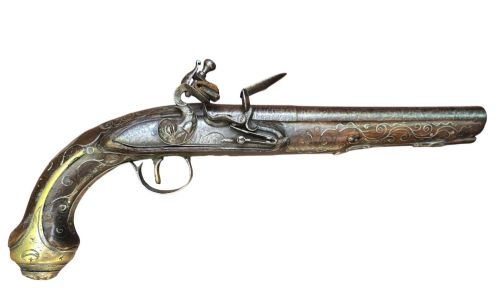
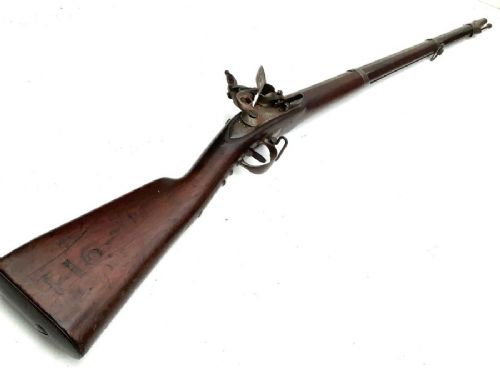
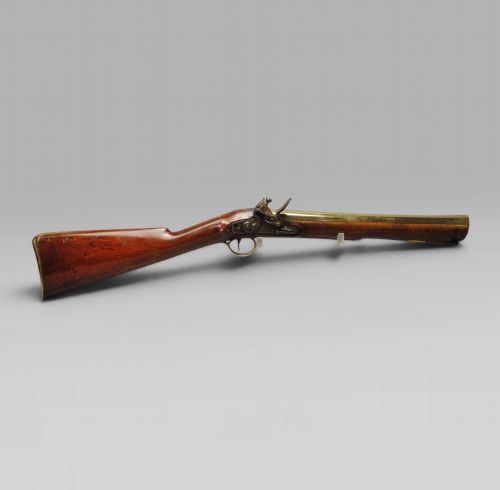


Walnut Stock Flintlock
These walnut stock flintlock arms combine dark timber and hardened steel from the eighteenth century and the Napoleonic era.
Walnut Stock Flintlock
A walnut stock flintlock firearm is a mechanical arm fired by a flint striking a steel frizzen to ignite gunpowder. The pieces on this page span the eighteenth century, the Georgian period, and the Napoleonic era, including holster pistols, blunderbusses, and muskets.
Buyers encounter service arms alongside civilian travelling pistols and elaborate foreign pieces such as Ottoman muskets and French blunderbusses. The defining physical element across these varied forms is the figured or plain walnut timber used for the stock.
Originating from workshops across Britain, France, Italy, Germany, and North Africa, these pieces represent military contracts and private gunsmith production. Most items date from the mid-eighteenth century to around eighteen hundred.
Materials and Construction
Makers shaped stocks from dense walnut timber, frequently selecting figured grain for civilian holster pistols and fowling pieces. This wood was carved to house the barrel, lock mechanism, and trigger assembly.
The mechanical assemblies combine forged iron and steel for barrels and locks, often paired with cast brass or silver furniture. Mounts, sideplates, and butt caps were pinned or screwed to the wooden stock.
Decorative enhancement involved silver wire inlay, carved relief work around the tang, and cast brass details. Makers signed lock plates or barrels using engraved lettering or punch marks.
Some travel pistols included silver wire inlaid into the walnut so finely that the grip resembles a decorated instrument.
Evaluating the Pieces
Quality rests in the crispness of the timber carving and the original integration of the metal furniture to the stock. Examples retaining sharp lock engravings and well-fitted brass or silver mounts demonstrate superior workshop standards.
The degree of original surface preservation on both the walnut and the steel separates working service arms from finer presentation pieces. Retained silver wire inlay and untouched lock markings indicate higher grade original commissions.
La Motte·Timothy Hughes·Brasher·R. Willoughby·John Rimes·Collumbell·Hofmann
The Walnut Stock Flintlock Glossary
- Flintlock
- An ignition mechanism utilising a piece of flint held in a cock to strike a steel frizzen, creating sparks to fire the powder charge. This system dominated European firearms from the seventeenth through the early nineteenth century.
- Holster pistol
- A large handgun designed to be carried in a saddle holster rather than a belt. These pieces usually feature substantial walnut stocks and large-bore barrels.
- Blunderbuss
- A muzzle-loading firearm with a flared barrel designed to scatter shot at close range. They frequently appear with brass barrels and full walnut stocks.
- Frizzen
- The vertical steel plate struck by the flint to produce sparks and uncover the priming pan. It forms a crucial part of the flintlock ignition assembly.
- Brass furniture
- Cast brass components including trigger guards, butt caps, and sideplates attached to the wooden stock. These elements provided structural reinforcement alongside decoration.
Walnut Stock Flintlock: Frequently Asked Questions
What is a walnut stock flintlock?
A walnut stock flintlock is an antique firearm employing a flint ignition system set into a wooden stock made of walnut. These arms date primarily from the eighteenth and early nineteenth centuries.
They encompass military service weapons, naval pistols, and civilian pocket or holster arms produced across Britain and continental Europe.
How do I care for my flintlock?
Keep the piece in a stable environment away from excess moisture and extreme temperature shifts to protect the walnut stock and steel mechanism. Lightly oil the metal components periodically to prevent corrosion.
Avoid aggressive cleaning of the timber surface to preserve the original finish and patina accumulated over centuries.
Were these arms used in the military?
Many pieces on this page served military functions, such as British Dragoon pistols and French service muskets issued during the Napoleonic wars. Government contracts required robust walnut stocks to withstand active field conditions.
Other items were privately purchased by officers or civilians for personal protection and travel.
How can I tell the period?
Dating relies on barrel forms, lock plate signatures, proof marks, and the overall style of the brass or silver mountings. Eighteenth-century pieces often display rococo influences, while Napoleonic items show standardised military configurations.
Maker stamps and crown view marks stamped onto the metal components provide further chronological markers.