


Walnut Salon Suite
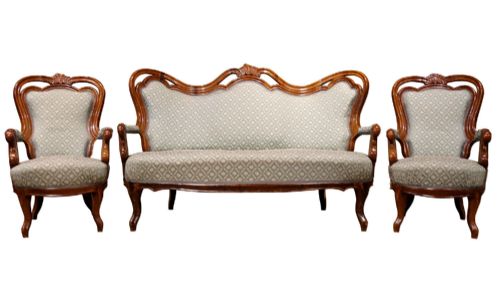
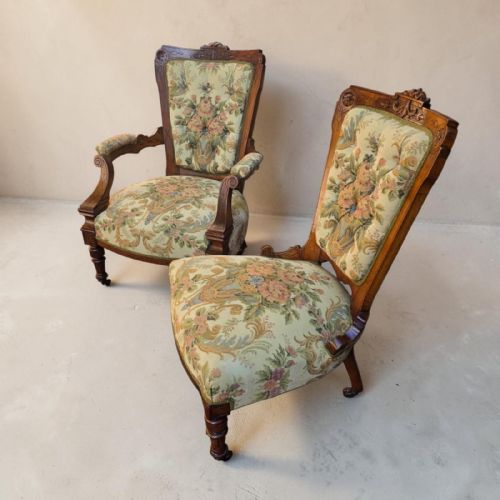
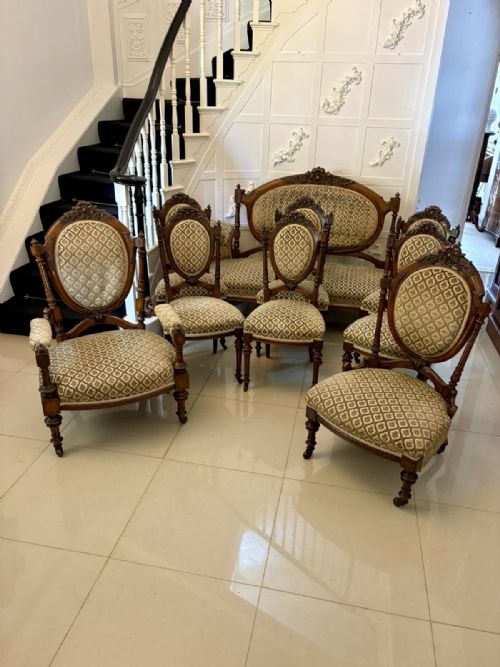
These walnut salon suite options bring period seating harmony to a room through matched frames and textiles.
Walnut Salon Suite
A walnut salon suite gathers matched seating into a cohesive arrangement designed for entertaining in a drawing room or parlour. When searching for a walnut salon suite, buyers encounter configurations ranging from compact three-piece sets of a settee and two armchairs to extensive multi-piece settings with side chairs and footstools.
The evidence demonstrates that these groupings span the Victorian and 19th Century periods alongside early 20th century examples. Styles extend from Rococo Revival and Louis XV to Empire Revival, French Rococo Revival, and Edwardian interpretations.
Most surviving sets feature carved wooden frames built to furnish formal reception spaces. They appear as coordinated suites rather than mismatched seating, preserving the original intent of a unified interior scheme.
Factors of distinction
The crispness and depth of hand-carving across the walnut framework set finer examples apart from simpler production. Suites displaying intricate crests, figural motifs, or marquetry inlay demonstrate greater artisan investment.
Cohesion within the set influences desirability, particularly when frames retain matching proportions and harmonious textile choices across settees and armchairs. The integration of specialised decorative elements, such as parcel-gilding or lion paw feet, elevates the standing of an individual suite.
Walnut Salon Suite Retail Price Guide 2026
Typical asking prices for walnut salon suite among the pieces listed under this phrase on Sellingantiques today, from the lower quarter to the upper quarter. They describe what is for sale here now, not the wider market.
Certain Victorian suites feature carved lion paw feet, letting your parlour furniture stand on its own figurative toes.
The Walnut Salon Suite Glossary
- Salon suite
- A coordinated set of seating furniture intended for a formal reception room, typically comprising a settee and matching armchairs.
- Rococo Revival
- A mid-nineteenth-century style drawing on eighteenth-century French designs characterised by asymmetrical curves, C-scrolls, and naturalistic floral carving.
- Damask
- A reversible figured fabric traditionally woven from silk, wool, or linen, frequently utilised for historic upholstery.
- Cabriole leg
- A furniture leg that curves outward at the knee and tapers inward toward the foot, commonly seen in revival seating forms.
- Button back
- An upholstery technique where buttons are pulled deep into the padding to create a quilted, patterned effect across the backrest.
Walnut Salon Suite: Frequently Asked Questions
What rooms suit a salon suite?
These groupings fit formal drawing rooms, large parlours, or spacious living areas where matched seating creates an intentional arrangement. They serve as focal points that organise the seating plan of a historic or traditional interior.
Because the pieces share identical timber and upholstery treatments, they bring immediate visual balance to a room without requiring careful coordination of disparate chairs.
How do I identify the style?
Style identification relies on examining the carved motifs, leg shapes, and overall silhouette of the walnut framework. Rococo Revival pieces display prominent floral carvings and serpentine lines, whereas Empire Revival examples feature heavier classical geometry.
Upholstery choice and secondary details like marquetry inlay or parcel-gilding also provide clear indicators of whether a suite leans toward French Louis-style revivals or Victorian domestic production.
Were these sets always uniform?
Maker workshops produced these suites as cohesive packages, ensuring that the timber grain, carving depth, and textile coverings matched across every chair and settee. Larger suites often combined smaller side chairs with larger armchairs and a matching settee.
While some suites have lost individual chairs over time, surviving multi-piece sets maintain the original uniformity intended for formal entertaining spaces.
How are textiles handled?
Many suites retain historic upholstery fabrics such as silk damask, velvet, or patterned textiles that reflect the period of manufacture. Others arrive stripped for re-upholstery to suit modern interior colour schemes.
Preserving original fabric depends on its condition and structural integrity, though structural frame stability remains the primary consideration for daily use.