


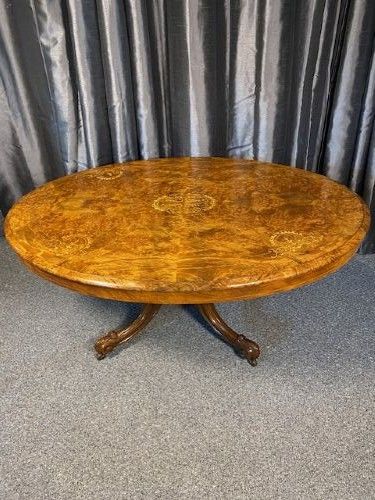
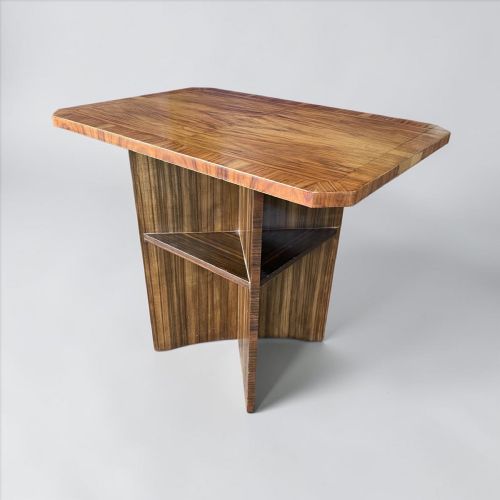
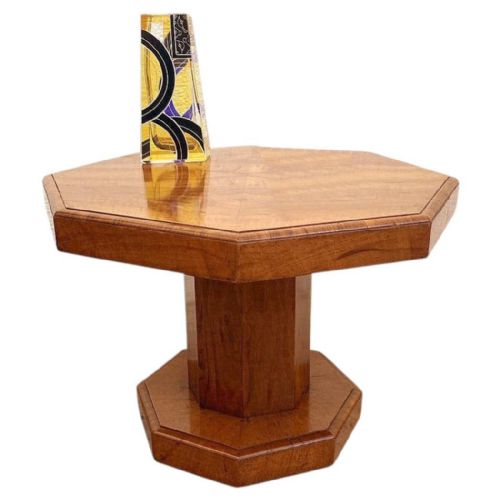
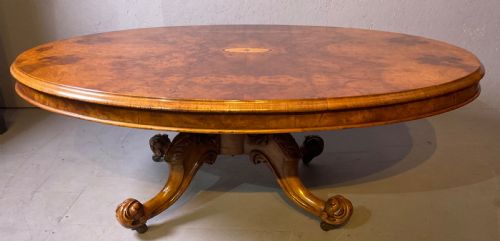


Walnut Pedestal Coffee Table
A walnut pedestal coffee table brings rich timber grain and a sturdy central footing together, most often seen in Victorian and Art Deco forms.
Walnut Pedestal Coffee Table
When you search for a walnut pedestal coffee table, you are looking at low tables supported by a single central column rather than four corner legs. The pieces on this page span the Victorian era, the nineteenth century, and the nineteen-thirties Art Deco period. You will most frequently meet Victorian walnut examples alongside Art Deco designs from nineteen-thirty.
These tables serve various functions in a room, appearing as coffee tables, occasional tables, side tables, and centre tables. Some started life as taller wine or lamp tables before being lowered to coffee table height. Others include games tops, marquetry inlays, and marble pietra dura surfaces.
How they were made
Makers utilised walnut, burr walnut veneer, and solid hardwood as the primary timber. Burr walnut provides intricate, swirling grain patterns across the tabletops, while boxwood inlay and marquetry add decorative detail.
Construction methods combine turned or carved wooden pedestals with stable bases, sometimes incorporating brass fittings or glass panels. Artisans applied hand-carved elements and detailed parquetry to enhance the surface appearance.
Listings show materials ranging from solid walnut and burr walnut veneer to glass, brass, boxwood inlay, and marble pietra dura.
What varies in quality
The distinction between tiers rests upon the choice of timber and the precision of the cabinetwork. Tables featuring high-grade burr walnut veneer with complex marquetry or pietra dura inlays occupy the upper end of the range, whilst simpler plain walnut surfaces sit below.
Structural integrity of the pedestal and base connection determines long-term stability. Refined hand-carved details and crisp boxwood inlay demonstrate a higher level of workshop skill than plain turned columns.
The Walnut Pedestal Coffee Table Glossary
- Burr walnut
- Timber taken from a tree growth or knot that produces swirling, highly figured grain patterns. This material was frequently sliced into veneer for tabletops.
- Marquetry
- The art of applying pieces of veneer to a structure to form decorative patterns and pictures. It appears frequently on Victorian surfaces.
- Pietra dura
- An inlay technique using cut and fitted polished coloured stones to create images. This appears on select Victorian examples.
- Parquetry
- A geometric mosaic of wood pieces used for decorative floors and tabletops. It creates a patterned surface on early twentieth-century pieces.
- Pedestal
- A single central support or column holding up the table top. This design allows for more legroom around the base.
Walnut Pedestal Coffee Table: Frequently Asked Questions
What is a walnut pedestal coffee table?
A walnut pedestal coffee table is a low surface supported by a single central column rather than traditional legs. These pieces utilise walnut timber and appear in both Victorian and Art Deco styles.
Many examples on this page originated as taller occasional, wine, or lamp tables that were subsequently lowered to function as coffee tables.
How do I tell Victorian from Art Deco walnut tables?
Victorian tables typically feature detailed marquetry inlays, hand-carved wooden pedestals, and figured burr walnut surfaces. They often include boxwood details and shaped edges.
Art Deco tables from nineteen-thirty display cleaner geometric lines, parquetry patterns, and minimal carving, reflecting the modern design ethos of that decade.
Are these tables sturdy?
The central pillar rests on a wide base, which provides solid support for daily use in a reception room. The stability depends on the weight and spread of the feet.
Properly joined pedestal columns hold weight effectively, making them suitable for holding lamps, books, and everyday items.
Where should I place a pedestal table?
These tables fit well beside sofas or in the centre of a seating arrangement where a single column provides easy access from multiple angles. The circular and oval shapes soften rectilinear room layouts.
They work effectively as coffee tables or occasional surfaces in both traditional and contemporary interiors.