




Carved Quadruped Table
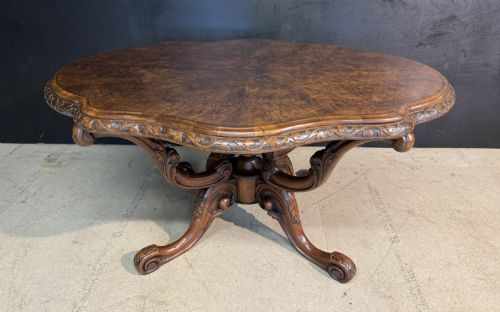
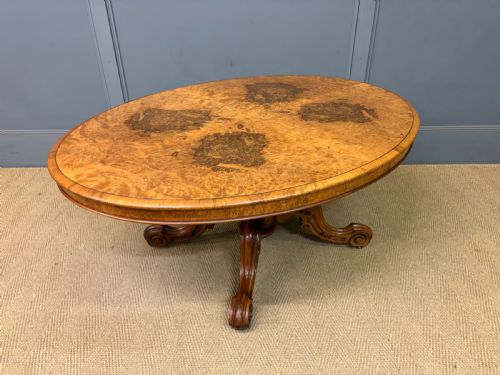
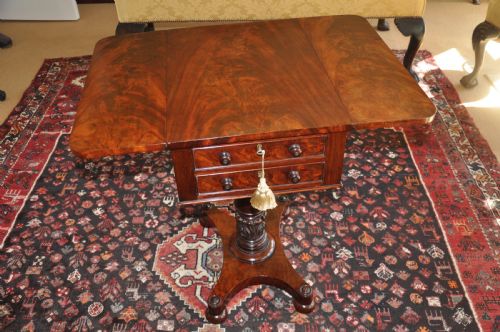
A carved quadruped table offers sturdy proportion and rich timber grain, serving as a functional centrepiece for traditional rooms.
Carved Quadruped Table
Originating largely from the nineteenth century, these tables showcase the diverse functional needs of period homes, from large dining pieces to compact window tables. The four-legged support structure provides stability across all these varied designs.
Materials and construction
Cabinet makers utilised dense hardwoods such as mahogany, walnut, and burr walnut, frequently applying elaborate marquetry and wood inlay to the surfaces. Amboyna and rosewood also appear as contrasting timber accents on select tops and borders.
Structural stability relies on solid wood frames paired with turned or hand-carved pedestals and four-footed bases, sometimes incorporating brass castors. Joinery techniques from the nineteenth century ensure these tables endure through generations of daily use.
Listings feature walnut, burr walnut, mahogany, rosewood, and amboyna across Victorian, Regency, William IV, and Edwardian periods.
Distinguishing quality
The choice of timber veneer dictates much of the visual appeal, with highly figured burr walnut and rich mahogany representing the finer end of the scale. Superior examples display crisp hand-carved details on the bases and precise marquetry inlay on the top surfaces.
Proportion and balance define the better pieces, where the four-legged support harmonises naturally with the shape of the table top. Construction integrity, such as smooth mechanisms on fold-over and snap-top tables, further separates standard production from superior craftsmanship.
Gillows
The Carved Quadruped Table Glossary
- Burr walnut
- A prized timber harvested from walnut tree growths, featuring swirling grain patterns used extensively for decorative table tops.
- Loo table
- A large round or oval Victorian table originally designed for the card game loo, mounted on a central pillar and four-footed base.
- Marquetry
- Elaborate decorative veneer work arranged in pictorial or geometric patterns using various coloured woods.
- Pembroke table
- A small rectangular table with two drop leaves hinged to the sides, often fitted with a single drawer.
- Snap-top table
- A table featuring a hinged top that tilts into a vertical position for storage when not in use.
Carved Quadruped Table: Frequently Asked Questions
What is a quadruped table?
A quadruped table is a piece supported by four distinct feet or legs, often branching from a central pillar or positioned at the corners.
These designs provide enhanced stability and form a defining characteristic of many nineteenth-century dining, centre, and occasional tables.
How do I use a loo table today?
A loo table works exceptionally well as a large centre table in a spacious hallway or as a dramatic dining surface for four.
Because many Victorian versions feature tilting tops, they can also be stored flat against a wall when floor space is required.
How do I distinguish Victorian from Regency styles?
Regency tables typically exhibit classical restraint with clean lines, dark mahogany, and restrained brass mounts dating from the early part of the century.
Victorian pieces often embrace heavier proportions, elaborate burr walnut veneers, marquetry inlay, and more ornate hand-carved bases.
Are these tables suitable for daily use?
These solid hardwood tables were built for robust everyday living and easily withstand normal contemporary use.
Using coasters and mats helps protect the historical polished timber surfaces from heat and moisture marks.