
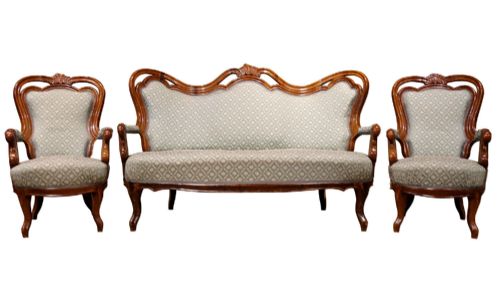
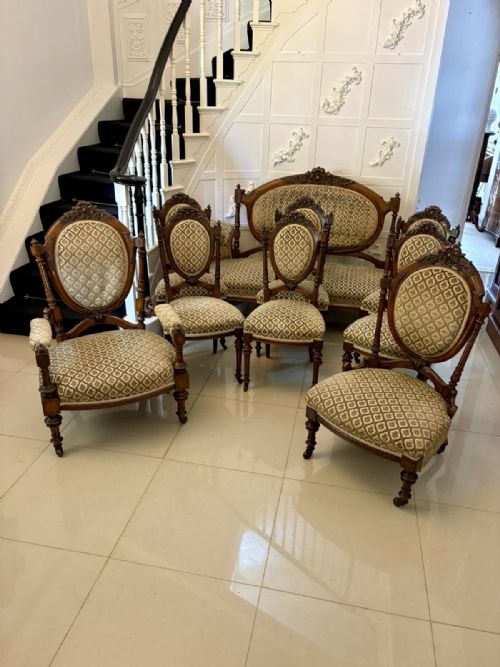
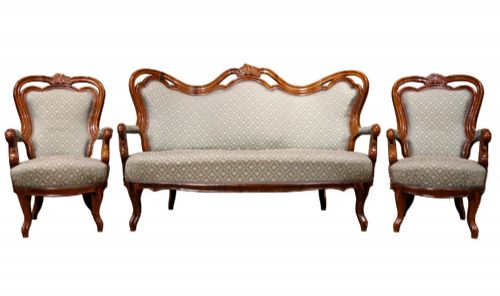


Walnut Parlour Suite
A walnut parlour suite brings grand Victorian and Edwardian reception rooms to life with matched timber frames and sumptuous upholstery.
Walnut Parlour Suite
A walnut parlour suite comprises matched groupings of seating designed for formal entertaining, most frequently appearing as three-piece sets of a settee and armchairs, or larger ensembles spanning up to eleven matching pieces. These configurations typically combine settees, armchairs, and side chairs made during the nineteenth and early twentieth centuries.
The aesthetic vocabulary leans heavily towards revival styles, with Victorian Rococo Revival, French Rococo Revival, and Empire Revival predominating across the selection. Pieces span from mid-Victorian showwood designs to later Edwardian and continental interpretations.
Origin points vary between British workshops and continental makers, incorporating French influences such as marquetry inlay and Louis XVI revival details alongside robust domestic Victorian framing.
Materials and construction
Carved walnut provides the structural timber backbone for these suites, often shaped into elaborate showwood frames with flowing curves and floral motifs. Brass elements occasionally reinforce joints or support castors on heavier pieces.
Upholstery forms a major component of construction, utilising traditional textiles such as velvet, damask fabric, and buttoned coverings secured over internal padding. Metal spring units and webbing support the upholstered surfaces beneath the visible fabric layers.
Several armchairs come with matching footstools designed to keep Victorian ankles safely off the draughty floorboards.
Evaluating craftsmanship and integrity
Quality reveals itself in the depth and crispness of the timber carving, where superior examples feature sharply defined hand-cut details along the walnut showwood frames rather than softer machine moulding. The selection of timber grain, particularly matched veneers on panelled areas, further distinguishes finer suites.
The integrity of the structural joinery and the standard of the upholstery finish dictate the upper tier of these pieces. Suites retaining unified, high-grade fabric treatments and robust, wobble-free frames command greater appreciation than those with mismatched or degraded internal padding.
The Walnut Parlour Suite Glossary
- Showwood
- Timber framing left exposed around the upholstered portions of a chair or settee. This walnut perimeter defines the decorative silhouette of the piece.
- Bergere
- An enclosed upholstered armchair with wooden sides. The walnut frame surrounds padded armrests and a cushioned seat.
- Marquetry
- Decorative patterns formed by fitting contrasting veneer pieces into timber surfaces. This technique appears on select continental parlour suites.
- Button back
- An upholstery style where depressions are created by sewing through the padding to secure buttons. This method provides structural tension and a tufted appearance.
Walnut Parlour Suite: Frequently Asked Questions
How were parlour suites used?
These matched sets were arranged in formal reception rooms for receiving guests, hosting callers, and conducting polite social intercourse. The matching chairs and settees provided uniform seating for visitors during Victorian and Edwardian domestic gatherings.
Today, they serve a similar decorative and functional role in large living spaces, though owners often use them as statement groupings rather than strictly for formal entertaining.
How do I clean walnut frames?
Dust the carved walnut showwood regularly with a soft, dry cloth to prevent particulate build-up in the detailed crevices. Avoid modern silicone polishes which can damage the historic timber finish over time.
Feed the wood periodically with a suitable microcrystalline wax to maintain the natural lustre of the walnut without leaving a sticky residue.
How can I date a suite?
Examine the style of the carving, the turning of the legs, and the revival influence present in the frame design. Mid-nineteenth-century pieces often display heavy Rococo Revival curves, whilst later examples lean towards Empire or Edwardian restraint. Nail construction, upholstery webbing, and general joinery methods inspected beneath the pieces also offer clues to the manufacturing decade.
Can these suites be re-upholstered?
Many surviving suites have undergone re-upholstery during their lifespans to preserve the integrity of the fabric. Traditional methods using horsehair, webbing, and period-appropriate damask or velvet maintain the historical character of the seating. Consulting a specialist restorer ensures the delicate showwood frames are not damaged during the stripping and recovering process.