
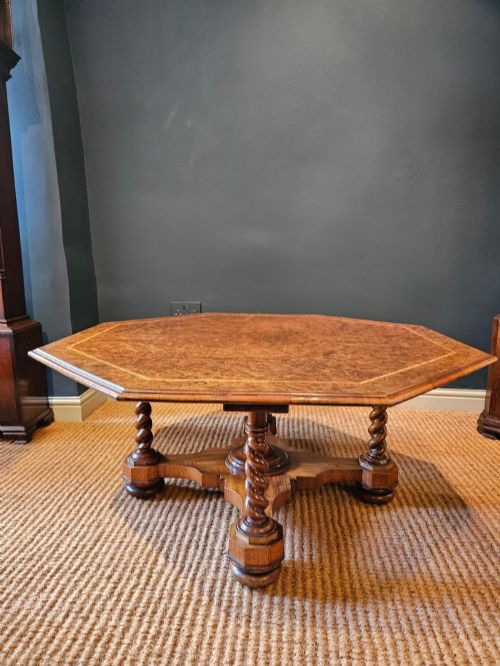
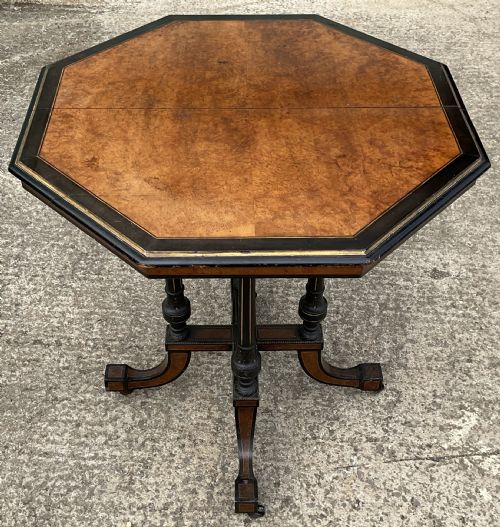


Walnut Octagonal Centre Table
A walnut octagonal centre table anchors a room with figured timber and geometric presence.
Walnut Octagonal Centre Table
When you search for a walnut octagonal centre table, you encounter versatile multi-sided tables designed to stand free in a room rather than against a wall. These pieces primarily date from the Victorian and Edwardian eras, spanning the mid-nineteenth century into the early twentieth century.
The selection on this page demonstrates various scales, from intimate occasional tables and window tables to large library and games tables. You meet formal pedestal bases alongside four-legged frames, each featuring the characteristic eight-sided top specified by the phrase.
Origin and regional workshops introduce distinct regional identities to the form, including Italian Sorrento ware, Anglo-Indian Kashmiri carving, and British Aesthetic Movement design. The prevailing examples combine utility with decorative surface work suited to principal reception rooms.
How they were made
Cabinet makers utilised solid walnut and figured burr walnut veneers applied to stable secondary timbers, deploying timber grains symmetrically across the eight-sided tops. Contrasting woods such as boxwood, fruitwood, and ebonised timber formed intricate marquetry, parquetry, and geometric inlays.
Surface enhancement often involved elaborate wood inlay, brass fittings, specimen marble inserts, or tooled Moroccan leather writing surfaces. Pedestal supports relied on heavy turned columns and carved feet to balance the substantial weight of the timber top.
Listings feature walnut, burr walnut, ebonised wood, and olive wood combined with brass, boxwood, fruitwood, and marble.
What varies in quality
The grade of timber selection separates standard items from exceptional pieces, particularly the depth of figuring in burr walnut veneers and the precision of multi-wood marquetry. Complex decorative programs involving specialised inlay techniques or secondary materials like specimen marble denote superior workshop output.
Structural integrity and the retention of original surface finishes dictate desirability, alongside the harmony of proportion between the octagonal top and the supporting pedestal or leg assembly. Signed or attributed pieces from documented workshops command greater interest through recorded provenance.
James Winter·Almerico Gargiulo
The Walnut Octagonal Centre Table Glossary
- Burr walnut
- A figured timber harvested from walnut tree growths, producing swirling, highly decorative grain patterns highly prized for table tops.
- Marquetry
- The art of applying pieces of veneer to a structure to form decorative patterns and pictorial designs.
- Parquetry
- A geometric mosaic of wood pieces used for decorative floors and table surfaces, creating repeating patterns.
- Sorrento ware
- Intricate wood inlay work originating from the Italian town of Sorrento, frequently featuring geometric motifs or views.
- Aesthetic Movement
- A late nineteenth-century design style emphasising visual and compositional beauty over narrative subject matter.
Walnut Octagonal Centre Table: Frequently Asked Questions
How do I use a walnut octagonal centre table?
These pieces function well in the middle of a room, serving as a surface for lamps, books, or decorative objects. Their multi-sided shape allows easy circulation around them.
Larger examples serve effectively as library or occasional dining surfaces, while smaller versions operate as lamp or window tables.
What periods do these tables represent?
Most examples originate from the Victorian and Edwardian periods, spanning from the mid-nineteenth century through to the early twentieth century.
Stylistic influences range from Reformed Gothic and Aesthetic Movement to Arts and Crafts and continental inlay traditions.
What is burr walnut?
Burr walnut comes from a growth on the walnut tree where the grain has grown in a deformed, swirling manner. Cabinet makers slice this timber into thin veneers to display striking patterns.
Tables featuring this material often highlight the natural figure as the primary decorative element of the top.
How do I care for a walnut table surface?
Maintain the polished timber by dusting regularly with a soft, dry cloth and avoiding placement near direct heat sources or strong sunlight. These precautions prevent veneer lifting and timber drying.
Occasional application of appropriate wax polish preserves the sheen and nourishes the historic wood surface.