
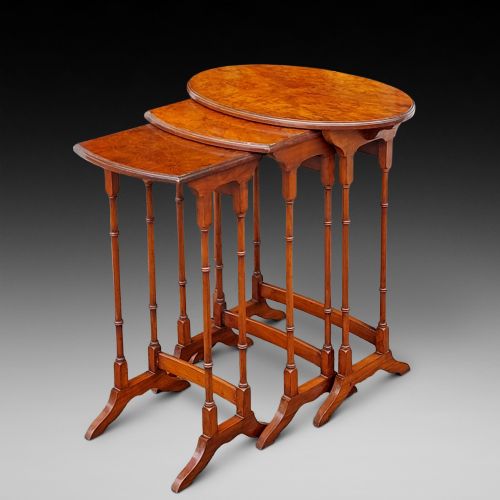
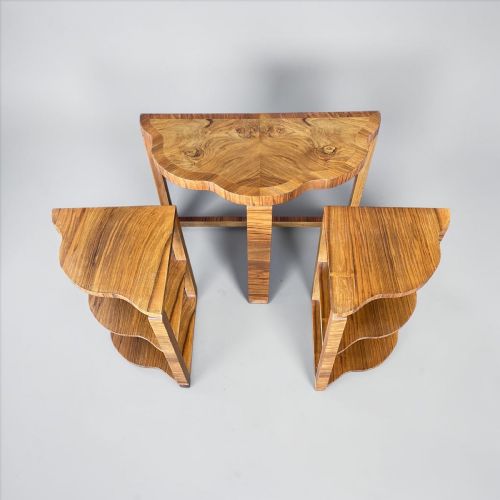
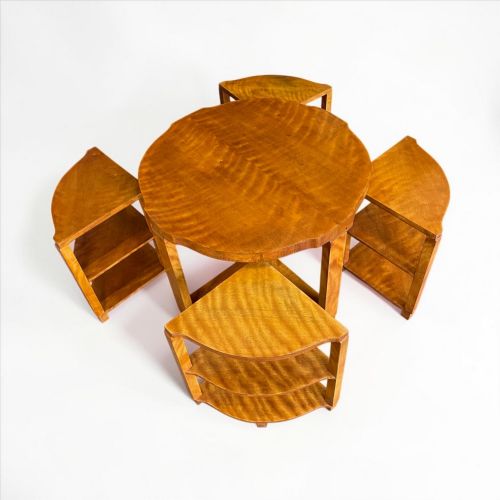


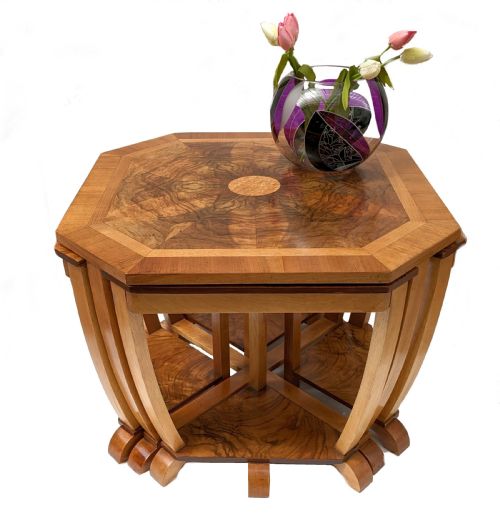
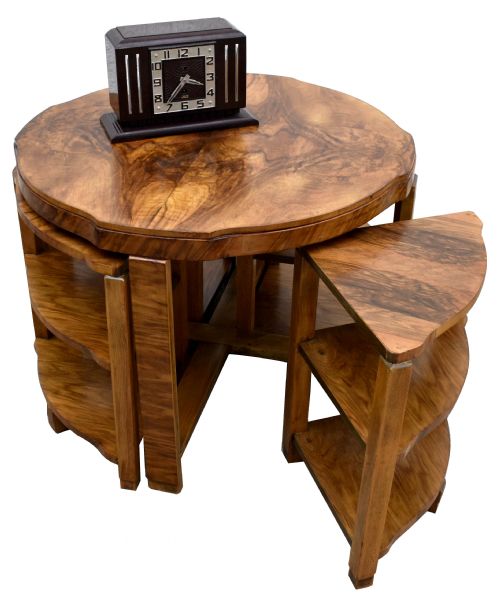
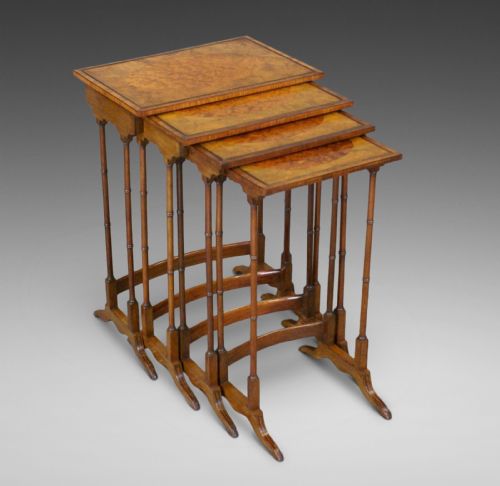

Walnut Occasional Table Set
These walnut occasional table set examples offer nesting versatility and rich timber grain, bringing practical tiered surface space to any room.
Walnut Occasional Table Set
A walnut occasional table set typically comprises a nesting arrangement of multiple tables that slide neatly beneath one another when not in use. You will most frequently encounter Edwardian and Art Deco nests, alongside occasional tables from the nineteenth century and the mid-twentieth century.
The forms range from compact trios and quartetto sets of four to larger quintetto sets of five tables. Origin styles span from British Edwardian and Jacobean Revival to French Provincial and striking Art Deco designs.
Buyers choose these sets for their clever space-saving footprint and the warmth of figured timber. They serve multiple living spaces effortlessly, providing pull-out surfaces for drinks or books.
How they were made
Cabinet makers utilised solid woods like oak and teak for structural integrity, applying rich walnut and burr walnut veneers to display striking grain patterns. Selected pieces also incorporate satinwood veneer or floral inlay and parquetry for decorative contrast.
Art Deco and Edwardian workshops shaped these woods into graduated frames that fit precisely together. Finishing techniques enhanced the natural figure of the wood, while specialised models incorporated leather tops or reversible chess boards.
Listings feature walnut occasional table sets spanning the Edwardian era through the Art Deco period, utilising burr walnut, parquetry, and satinwood veneer.
What varies in quality
The distinction between standard production and top-tier pieces lies in the choice and matching of timber veneers. Master makers selected highly figured burr walnut and aligned the grain meticulously across the nested surfaces.
Construction methods and finer decorative details also separate the grades. Sets featuring intricate parquetry, specialised maker attributions, or robust multi-table nesting configurations demonstrate superior craftsmanship.
Harry and Lou Epstein·Heal's·Gordon Russell
The Walnut Occasional Table Set Glossary
- Burr walnut
- A prized timber harvested from walnut tree growths, producing swirling, highly decorative grain patterns. It forms the primary decorative surface on many high-end table sets.
- Veneer
- A thin slice of superior wood applied over a sturdier secondary timber base. This technique allows makers to display striking grain figures without using solid expensive wood throughout.
- Quartetto
- A matched set of four nesting tables designed to slide neatly beneath the largest main table. This form gained popularity during the Edwardian period.
- Parquetry
- Geometric wood inlay work forming decorative mosaic patterns on table tops. It appears on French provincial examples alongside floral inlay.
- Nesting tables
- A group of graduated tables sized so each smaller one fits beneath the next. They provide flexible surface area while occupying the floor space of a single table.
Walnut Occasional Table Set: Frequently Asked Questions
What is a quartetto table set?
A quartetto set consists of four graduating tables designed to nest together beneath the largest frame. This configuration became popular during the Edwardian era for saving space in smaller drawing rooms.
Each smaller table slides smoothly into the one above it, allowing all four to occupy the footprint of a single table until needed for tea or guests.
How do I date a walnut nest?
Dating relies on stylistic clues and construction methods, moving from Edwardian inlaid designs to streamlined Art Deco geometric forms. Edwardian pieces often feature delicate cabriole legs or slender supports, while 1930s examples favor bold waterfall edges or stepped silhouettes.
The presence of specific veneers, maker marks, or revival influences like Jacobean turning also helps narrow the manufacturing period.
Are these tables sturdy enough for daily use?
Nesting tables are built with clever interlocking frames and sturdy timbers like oak or solid walnut beneath their decorative veneers. They handle everyday placement of cups, books, and lamps comfortably.
Because the smaller tables slide in and out frequently, checking the smoothness of the runners and the stability of the joints ensures long-term reliability.
How do I care for walnut veneer?
Walnut surfaces benefit from gentle dusting with a soft, dry cloth and protection from direct sunlight and heat sources. Avoiding excessive moisture prevents the delicate veneer from lifting or warping over time.
Occasional application of appropriate wax polish maintains the lustre of the timber grain without building up heavy residues.