

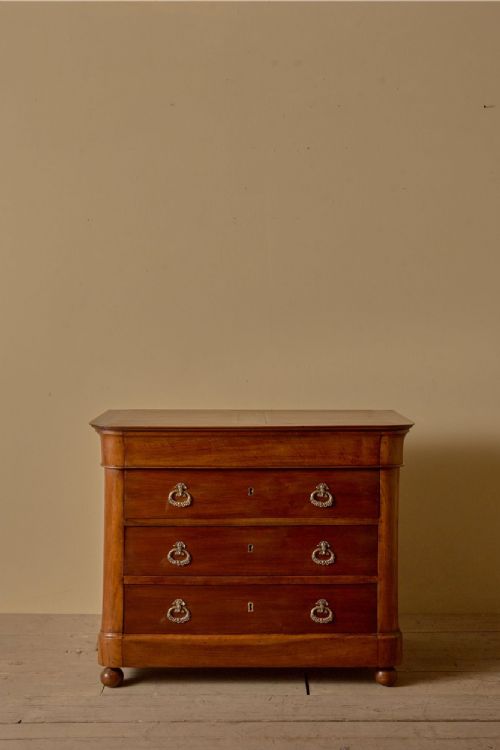
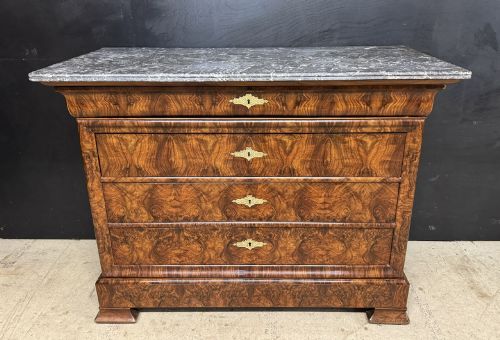
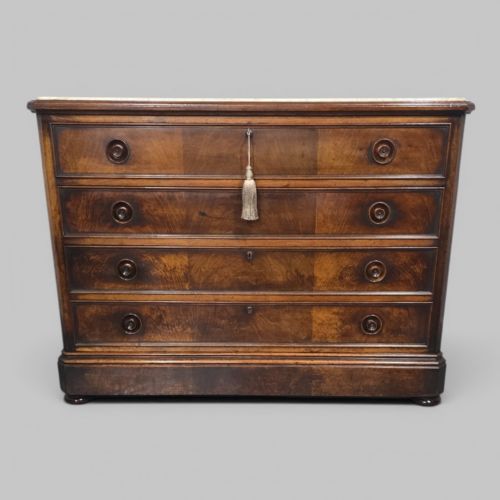


Walnut Louis Philippe Chest
These walnut louis philippe chest pieces offer quiet French elegance and generous storage, making them a practical centrepiece for any bedroom.
Walnut Louis Philippe Chest
A walnut louis philippe chest brings understated French provincial design into the modern home with clean lines and generous proportions. These practical pieces of furniture provide deep drawer storage while maintaining a restrained aesthetic.
Most examples found here date from the nineteenth century, reflecting the classic French commode form. They typically present a rectangular silhouette with simple mouldings and smooth timber surfaces.
How they were made
Cabinet makers constructed these commodes using solid walnut or striking burr walnut veneers applied over sturdy timber carcases. The natural grain of the wood provides the primary decorative detail.
Many examples are finished with contrasting marble tops in shades like grey, adding a durable and cool surface to the wooden base. Brass hardware occasionally accents the drawers for subtle contrast.
Walnut Louis Philippe Chest Retail Price Guide 2026
Typical asking prices for walnut louis philippe chest among the pieces listed under this phrase on Sellingantiques today, from the lower quarter to the upper quarter. They describe what is for sale here now, not the wider market.
Current listings span the nineteenth and early twentieth centuries, featuring walnut, burr walnut, marble, and brass.
What varies in quality
The choice of timber creates the most obvious distinction between standard examples and exceptional ones. Plain walnut offers a uniform warmth, whereas burr walnut displays intricate, swirling grain patterns that catch the eye.
The integration of the stone top also marks a difference in craftsmanship. A precisely fitted marble slab sits flush with the frame, completing the balanced proportions of the piece.
The Walnut Louis Philippe Chest Glossary
- Commode
- A low chest of drawers or cabinet originating in France. This term often appears interchangeably with chest of drawers in nineteenth-century pieces.
- Burr walnut
- A specialised timber cut from a tree growth, producing complex and highly decorative grain patterns. Cabinet makers prized this veneer for high-status furniture.
- Marble top
- A polished stone surface fitted to the top of a commode. This addition provided a practical, heat-resistant table surface.
- Louis Philippe
- A French stylistic period spanning the mid-nineteenth century. Furniture from this era favours comfort and restraint over excessive ornamentation.
Walnut Louis Philippe Chest: Frequently Asked Questions
What is a louis philippe chest?
A nineteenth-century French commode characterised by simple lines and minimal carving. These pieces focus on the natural beauty of timber rather than ornate decoration.
They serve as practical storage units while adding a touch of traditional continental style to a room.
How do I use a marble top chest?
The stone surface provides a durable platform for lamps, mirrors, or decorative items. It withstands daily use better than polished wood alone.
Keep liquids away from unsealed edges and wipe the stone clean with a damp cloth to maintain the finish.
What wood is used in these chests?
Walnut is the primary material, appearing in both solid planks and decorative veneers. Burr walnut provides a highly figured alternative with distinctive swirling patterns.
Secondary woods may appear inside the drawer construction and carcase framing.
Where were these commodes made?
These pieces originate from France, reflecting regional cabinet making traditions of the nineteenth century. Provincial workshops and city ateliers both produced this classic form.
Their design aligns with the broader aesthetic trends of the Louis Philippe reign and subsequent decades.