






Walnut Canterbury Whatnot
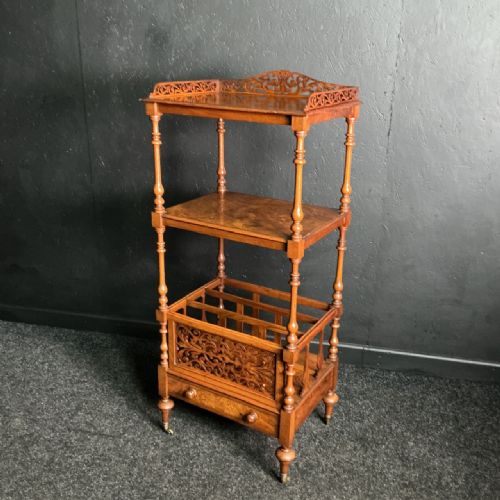
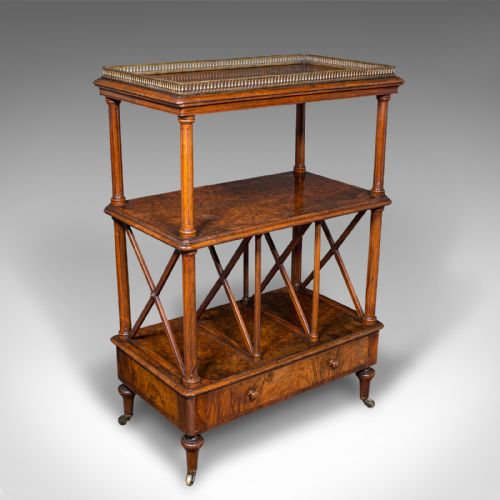
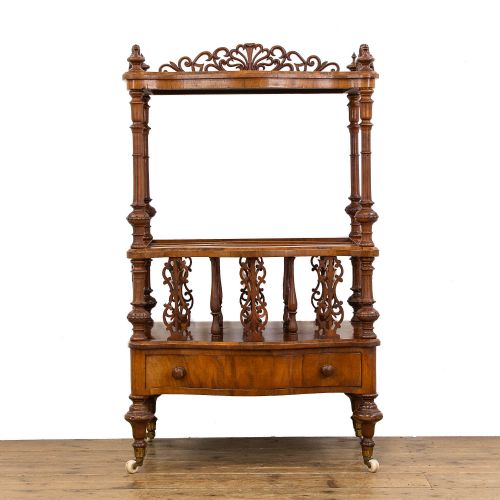
A walnut canterbury whatnot combines open tiers for display with partitioned slots for books, music, or papers.
Walnut Canterbury Whatnot
A walnut canterbury whatnot combines the tiered display shelves of a whatnot with the partitioned lower rack of a canterbury, providing a versatile piece of multi-functional furniture. These combination pieces emerge most frequently from the Victorian period, though examples stretch from the nineteenth century into Regency designs.
Most pieces seen here adopt the form of a freestanding multi-tiered stand, often incorporating a lower compartment with vertical dividers for sheet music, newspapers, or magazines. Some variations include a drawer beneath the tiers or take specific shapes such as serpentine or kidney forms, acting as a display stand, music stand, or occasional table.
The overriding domestic purpose centres on storage and display, keeping reading materials neat while providing surfaces for decorative objects. They function equally well beside a chair as a lamp table or as a focal point in a reception room.
How they were made
Cabinet makers utilised richly figured walnut and burr walnut veneers over solid hardwood carcases, creating deep grain patterns across the shelves and panels. The natural warmth of the timber provides the primary visual texture for the piece.
Makers integrated contrasting materials to define architectural details, employing boxwood and ebony for delicate inlay work alongside brass for castors and hardware. Ceramic elements occasionally appear within the fittings, while carved wooden supports elevate the tiered shelves.
Some nineteenth-century examples feature swivel tops that reveal hidden compartments, adding a playful mechanical surprise to the music stand.
What varies in quality
The distinction between standard pieces and the finest examples rests on the choice of timber and the precision of the cabinet work. Highly figured burr walnut veneers matched symmetrically across panels elevate a piece significantly above plain timber constructions.
Details such as crisp boxwood and ebony inlay, carved structural elements, and the inclusion of well-fitted drawers or dedicated side compartments demonstrate superior workshop skill. The overall proportions and the integration of the lower canterbury rack with the upper display tiers dictate the visual balance of the finished item.
T Wilson of London
The Walnut Canterbury Whatnot Glossary
- Canterbury
- A low stand with vertical partitions designed originally for holding sheet music, folios, or periodicals. It frequently forms the lower section of these combined pieces.
- Whatnot
- An open shelving unit with multiple tiers supported by slender pillars, used for displaying ornaments and bric-a-brac. Victorian parlours relied heavily on these for decorative display.
- Burr walnut
- A specialised timber cut from the abnormal growths or burls of walnut trees, yielding highly prized, swirling grain patterns. Cabinet makers applied it as a veneer to important furniture faces.
- Etagere
- A piece of furniture consisting of a set of open shelves for displaying small objects. The term is frequently used interchangeably with whatnot.
- Inlay
- A decorative technique where contrasting materials such as boxwood and ebony are inserted into recessed portions of the walnut base. This creates geometric or floral patterns across the surface.
Walnut Canterbury Whatnot: Frequently Asked Questions
How were they used historically?
Families used them in drawing rooms and parlours to keep reading materials tidy while displaying decorative ceramics, clocks, or small sculptures. The lower partitioned slots held sheet music, newspapers, or periodicals close to seating areas.
Certain variations included integrated drawers for smaller writing or sewing accessories, combining practical domestic storage with formal display.
How do I date these pieces?
Dating relies on stylistic clues and construction methods, with the majority originating from the Victorian era around eighteen sixty to eighteen seventy. Pieces displaying Regency characteristics exhibit earlier classical restraint, while ornate inlaid decoration and burr walnut veneers point towards mid-Victorian production.
Makers occasionally stamped their work, providing firm chronological anchors through archival workshop records.
Where should I place one?
They suit reception rooms, studies, or hallways where their compact footprint allows them to function as lamp tables or display stands. Their finished backs and freestanding nature mean they look correct placed away from walls.
Keep them away from direct heat sources and strong sunlight to protect the fragile walnut veneers from drying out or fading over time.