
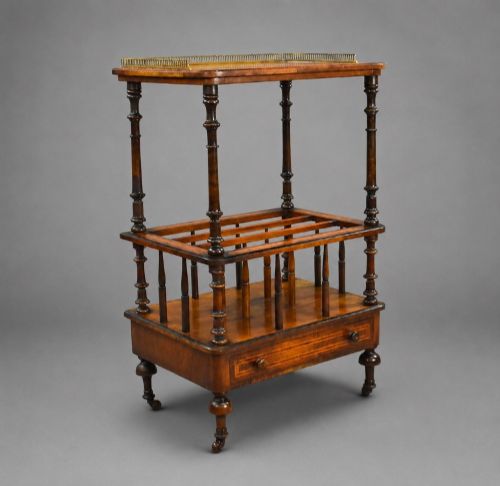
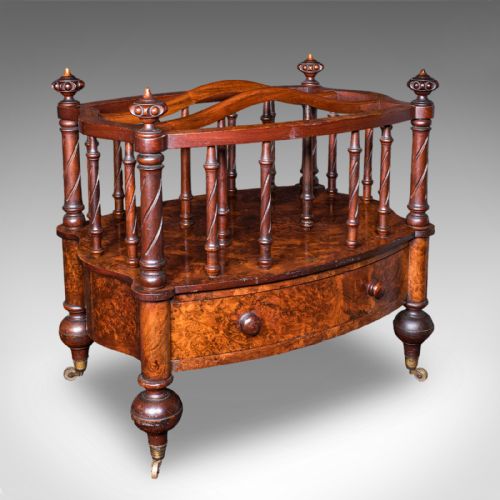


Burr Walnut Music Table
These burr walnut music table pieces combine rich veneer figure with practical storage for sheets, books and bedside items.
Burr Walnut Music Table
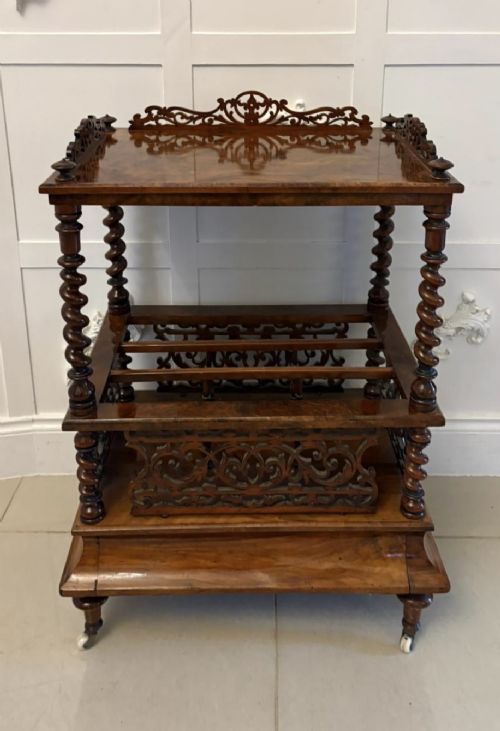
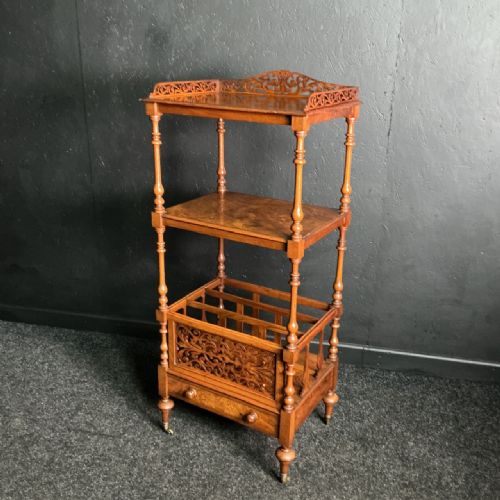
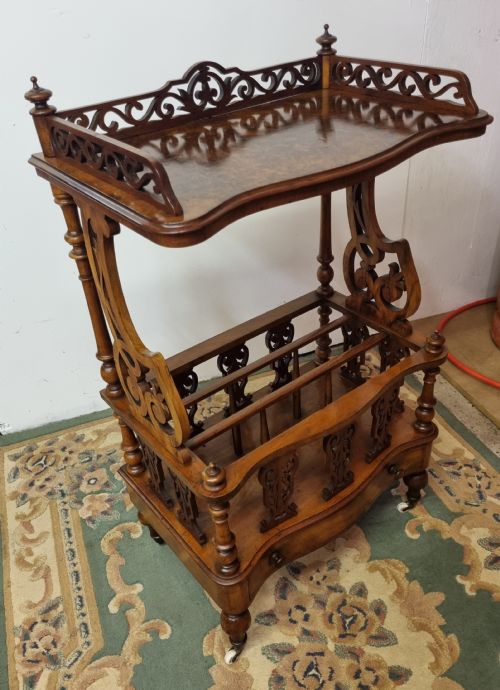
A burr walnut music table brings together figured timber and functional compartments, appearing most frequently in the listings as a Canterbury, whatnot or combined side table from the Victorian era. These pieces generally date from the nineteenth century, spanning periods from the Regency era through to eighteen eighty and nineteen twenty, often combining a magazine rack with a drawer or shelf surface.
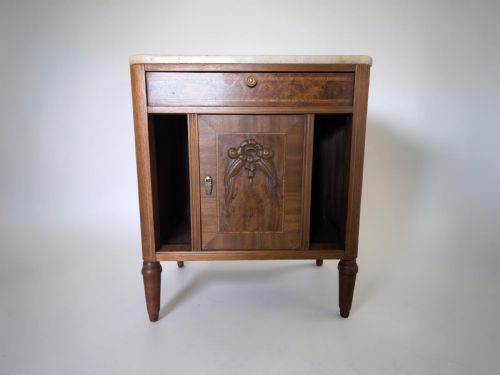
The primary forms found here include serpentine and inlaid canterburys, music stands, lamp tables and occasional pieces designed for parlours and sitting rooms. Walnut and burr walnut dominate the construction, frequently accented with boxwood or ebony inlay and mounted on brass details, while occasional examples integrate ceramic, porcelain, marble or leather elements.
How they were made
Cabinetmakers constructed these tables using solid walnut frameworks overlaid with highly figured burr walnut veneers, selected specifically for their intricate grain patterns and knot formations. Artisans incorporated contrasting timbers such as boxwood and ebony for fine stringing and floral or geometric marquetry inlay across the top surfaces and divisions.
Structural hardware typically involves cast brass fittings, castors or hinges, whilst secondary supports occasionally integrate ceramic or marble elements depending on the specific hybrid form of whatnot or Canterbury. Traditional joinery methods united the slatted dividers, drawers and undertiers to ensure stability under the weight of bound music folios and periodicals.
Listings for this phrase span the Victorian era, Regency period and nineteen twenty, encompassing forms from simple music stands to complex whatnot canterburys.
What varies in quality
The calibre of a burr walnut music table rests heavily on the selection and symmetry of the veneer figure across the main surfaces. Exemplary pieces display a dense, evenly matched burr pattern that wraps fluidly over edges and borders, whereas simpler examples rely on plain walnut with minimal figuring.
Refinement in secondary details elevates a piece, distinguishing standard utility furniture from sophisticated parlour items. Crispness in the inlaid boxwood stringing, the integration of serpentine shaping, and the presence of well-executed drawer linings or original brass castors separate the finest outputs from more utilitarian designs.
The Burr Walnut Music Table Glossary
- Burr walnut
- A veneer sliced from the grotesque growths or burrs of a walnut tree, prized for its swirling, highly figured grain patterns. It creates a decorative, mottled surface on tabletops and cabinet fronts.
- Canterbury
- A low piece of furniture featuring upright partitions, originally designed for holding sheet music and folios. Over the nineteenth century, it evolved to accommodate newspapers, magazines and books alongside occasional drawer storage.
- Whatnot
- An open set of tiered shelves supported on slender pillars or columns, used for displaying ornaments or holding books. In these listings, it frequently merges with the Canterbury form.
- Marquetry
- The art of applying decorative veneer pieces of various woods, and sometimes other materials like ivory or metal, to a structural surface to form intricate pictures or geometric patterns.
- Stringing
- Thin lines of contrasting timber inlaid into grooves on the surface of a piece of furniture. It creates fine borders and geometric framing around panels of burr walnut.
Burr Walnut Music Table: Frequently Asked Questions
What is a burr walnut music table?
It is a piece of nineteenth-century furniture, commonly taking the form of a Canterbury, whatnot or occasional table, designed to hold sheet music and periodicals.
These items utilise figured burr walnut veneers and often feature divided compartments, lower drawers and shelf tiers for parlour use.
How were music tables used?
They sat in Victorian drawing rooms and parlours to keep sheet music, folios and reading materials organised and near pianos or seating areas.
The top surface doubled as a lamp table or display space for ornaments, while compartments below separated different scores.
How do I identify a Victorian piece?
Victorian examples generally show construction traits from eighteen sixty to eighteen eighty, utilising solid walnut frames with applied burr walnut veneers and boxwood stringing.
They frequently combine multiple functions, such as a Canterbury base beneath a whatnot tier or an integrated drawer.
What materials are used in these tables?
The primary wood is walnut, enhanced by highly figured burr walnut veneers for decorative impact on tabletops and drawer fronts.
Details often include boxwood or ebony stringing, brass castors or hardware, and occasional accents of marble, ceramic or leather.
How do I care for burr walnut?
Keep the wood away from direct sunlight and dramatic changes in temperature to prevent the fine veneer from drying out or splitting.
Dust gently with a dry cloth and occasionally feed the surface with an appropriate furniture wax to preserve the grain depth.