
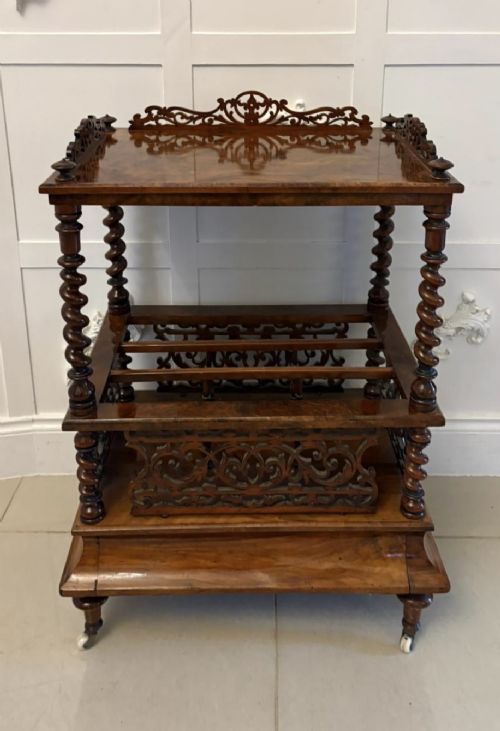
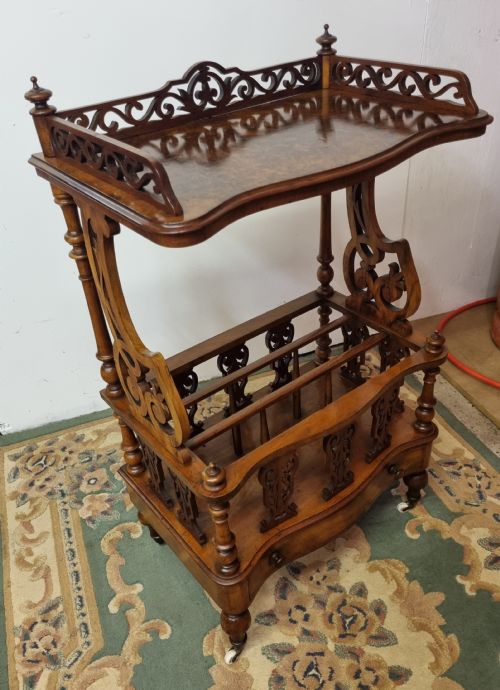
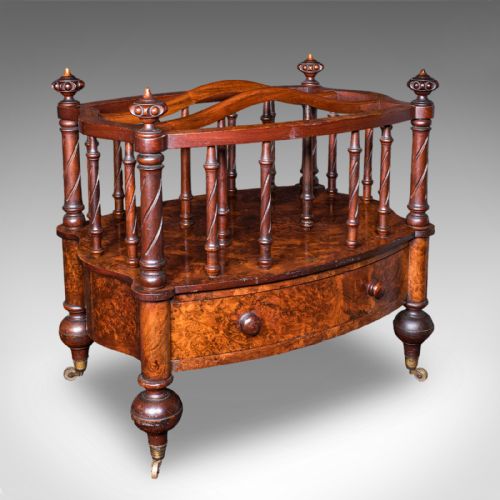


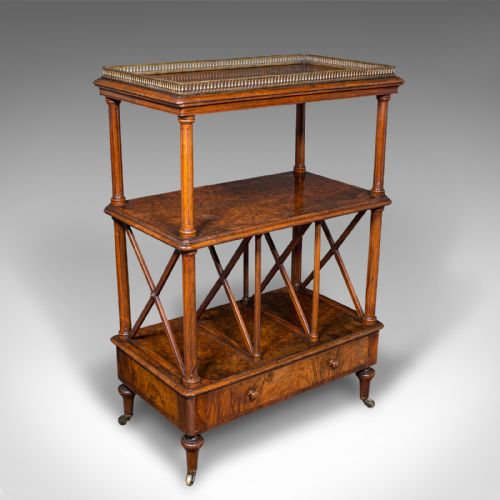


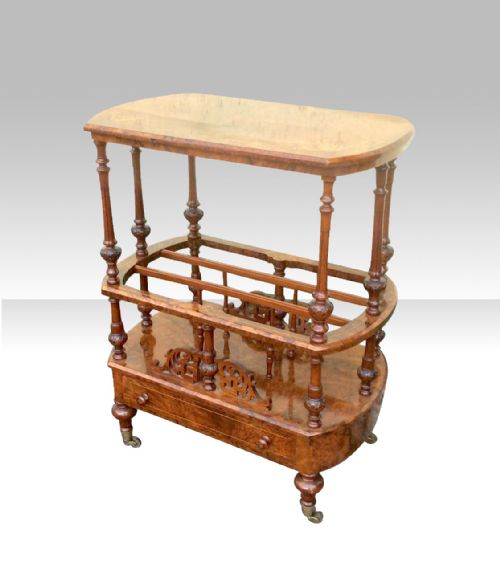

Walnut Canterbury Drawer
These walnut canterbury drawer pieces are versatile partition-framed stands designed for holding sheet music and periodicals, bringing period character to any room.
Walnut Canterbury Drawer
When you search for walnut canterbury drawer pieces, you encounter elegant multi-compartment stands primarily originating from the Victorian and Regency eras. These pieces combine slotted upper partitions for organising papers or folios with a useful base drawer for smaller items.
The most common versions on this page are Victorian designs executed in burr walnut or plain walnut, often featuring turned supports and brass castors. Some examples combine the traditional rack format with a whatnot or occasional table top, offering added display space.
Distinctions in quality
The grading of a walnut canterbury drawer depends heavily on the choice of timber figure, with richly patterned burr walnut commanding greater visual presence than plain black walnut. Finer examples display meticulous marquetry, crisp fretwork piercings, and well-proportioned serpentine mouldings.
Makership also separates standard production from superior workshop output, particularly when identified by stamped drawer frames or firm attribution. Original brass castors and intact internal dividers preserve the integrity and balance of the design.
The listings on this page span the Regency period through to the late Victorian era, predominantly utilising walnut and burr walnut.
Edwards and Roberts·Shoolbred
The Walnut Canterbury Drawer Glossary
- Canterbury
- A low stand with partitions for holding music sheets, books, or newspapers, typically fitted with a drawer below.
- Burr walnut
- A veneer sliced from the knotty growth of a walnut tree, prized for its swirling, highly decorative grain pattern.
- Whatnot
- An open set of tiered shelves used for displaying ornaments and small objects, sometimes combined with a canterbury base.
- Fretwork
- Ornamental perforated woodwork created by cutting patterns through thin boards, seen on the partition dividers.
- Castor
- A small wheel mounted on a swivel attached to the foot of a piece, allowing smooth movement across floors.
Walnut Canterbury Drawer: Frequently Asked Questions
What is a walnut canterbury drawer used for?
These stands were originally created to hold sheet music, folios, and periodicals near a piano or in a parlour.
Today, they function just as well for storing magazines, art books, and daily post while adding period character to a sitting room.
How do I date a walnut canterbury?
Dating relies on observing structural characteristics, timber choices, and decorative motifs such as boxwood inlay or turned pillars.
Victorian examples frequently display rich burr walnut veneers and serpentine shapes, whereas earlier Regency pieces show simpler classical lines.
Are these stands sturdy enough for daily use?
Most pieces are solidly constructed from dense hardwoods like walnut, making them durable for holding books and papers.
Care should be taken when moving them, especially older models resting on their original brass castors.
What is the difference between a canterbury and a whatnot?
A traditional canterbury focuses on partitioned storage for loose media with an optional drawer underneath.
A whatnot incorporates stacked display shelves above the storage section for ornaments and decorative objects.