
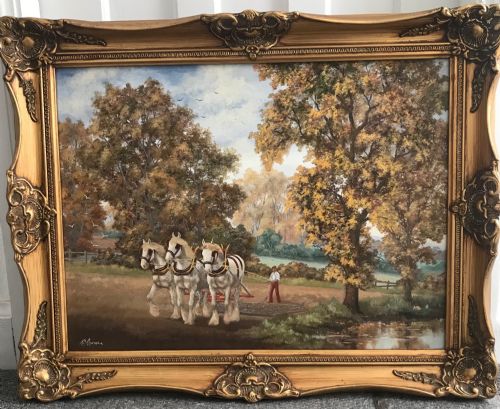


Vintage Working Horse Painting
A vintage working horse painting captures heavy shires, plough teams and timber haulers at hard agricultural labour.
Vintage Working Horse Painting
A vintage working horse painting records heavy equines at agricultural labour, logging, and hauling across rural landscapes. These works focus on shires, plough teams, and cart horses integrated into British and European country life.
Buyers meet oils on canvas alongside watercolours on paper, ranging from intimate nineteenth-century watercolours to large mid-twentieth-century canvases. Subjects extend from solitary working beasts in fields to bustling harvest scenes and timber yards.
The selections span traditional realism and British impressionism, reflecting both meticulous observation and looser plein-air brushwork. Each piece documents an era when animal muscle powered rural commerce and farming.
Evaluating quality
Quality rests in the anatomical understanding of the heavy horse, where sound perspective and convincing musculature separate master works from naive studies. The best compositions integrate the animal naturally into the working landscape rather than treating it as a static cutout.
Brushwork precision and atmospheric depth dictate overall success, with superior artists managing light on wet coats and turned earth convincingly. Palette harmony also matters, as disciplined earth tones convey the grit of rural labour more effectively than harsh pigments.
Listings feature works spanning the nineteenth and twentieth centuries, utilising oil on canvas, watercolour, and wood.
John Augustus Atkinson·James William Booth·Herbert Royle·Frederick J Knowles·Ernest Higgins Rigg·George Hamilton Constantine·Fred Lawson·George Cole·Charles James Adams·George Wright·B J Burrows
The Vintage Working Horse Painting Glossary
- Oil on canvas
- Pigment mixed with drying oil applied to a woven fabric stretched across a wooden frame. This medium allows for deep colour saturation and reworking.
- Watercolour
- Pigment suspended in a water-soluble vehicle applied to paper. It provides transparent washes and immediate handling.
- Gesso
- A plaster-like mixture applied to wood or canvas as a base for painting or moulding. It frequently forms the decorative surface of period frames.
- Impressionism
- A style of painting emphasising light and rapid brushstrokes over detailed finish. It captures the fleeting atmospheric conditions of the working day.
- Genre painting
- Artwork depicting scenes from everyday life, including agricultural labour and rural commerce. These pieces serve as visual social history.
Vintage Working Horse Painting: Frequently Asked Questions
What is a working horse painting?
These artworks depict horses engaged in heavy labour such as ploughing, timber hauling, and cart pulling. They document the central role of equines in agriculture before mechanisation.
Subjects range from intimate watercolours of single carthorses to large oil canvases showing teams at harvest. They provide an authentic record of rural industry.
How do I date an antique horse painting?
Dating relies on stylistic clues, framing techniques, and the materials used for the canvas or paper support. Clothing styles of handlers and agricultural equipment also offer chronological markers.
Signatures, exhibition labels, and artist biographies help narrow the period further. Comparative study against documented works by known painters confirms the era.
Where should I hang a rural painting?
These works suit traditional dining rooms, libraries, and studies where wood finishes and neutral walls complement earth tones. Proper placement avoids direct sunlight to protect watercolours and oil pigments from fading.
Matching the scale of the painting to the wall space ensures the piece commands the room appropriately. Adequate ambient lighting brings out the depth of the horse's coat and landscape.
What is the Staithes Group?
The Staithes Group was a collection of northern British artists influenced by French impressionism who painted rural and coastal life. Several members captured Yorkshire farming and working horses.
Their work combines plein-air techniques with local Yorkshire subject matter. Paintings by these artists carry distinct regional character and atmospheric brushwork.