
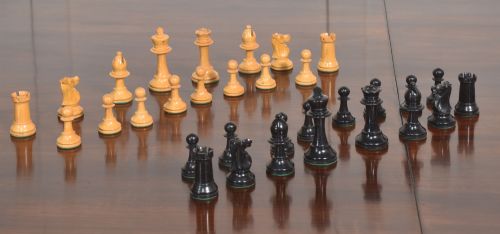


Vintage Wooden Chess Pieces
These vintage wooden chess pieces combine tactile weight with traditional craftsmanship, offering collectors both playable history and handsome display objects.
Vintage Wooden Chess Pieces
Vintage wooden chess pieces encompass complete sets, folding boards with pieces, and games compendiums originating primarily from the Victorian and Edwardian eras. When searching for vintage wooden chess pieces, you encounter standard Staunton patterns alongside alternative designs like the Calvert pattern and miniature sets.
The materials span boxwood paired with ebony or ebonised wood, alongside examples utilising mahogany, rosewood, and bone. These sets date from the late nineteenth century through to around nineteen ten, reflecting the period's popularity of parlour games and club chess.
Completions often arrive housed in original boxes or incorporated into multi-game compendiums alongside drafts and boards. The items present varying degrees of weighting, from unweighted travel sets to heavy tournament equipment.
Materials and manufacture
Turned boxwood forms the pale side of sets, contrasted against dark counterparts carved from dense ebony or finished with ebonised treatments. Makers selected straight-grained timbers to withstand the precise lathe work required for intricate king finials and tiered rook crenellations.
Base weighting involved inserting lead into turned cavities before securing felt or baize pads to the undersides for smooth board movement. Secondary woods such as mahogany and rosewood constructed the accompanying games boxes and folding boards.
Listings feature wooden chess pieces and games compendiums from the nineteenth century, Edwardian period, and nineteen ten.
Judgements of quality
Makers who incorporated lead weighting provided superior tactile feedback during play compared to lighter, unweighted equivalents. The preservation of original finishes and matching felt bases elevates a set above examples with mismatched replacements.
F. H. Ayres·British Chess Company·Whitty
The Vintage Wooden Chess Pieces Glossary
- Staunton pattern
- The standard design of chess pieces featuring architectural forms for major pieces and standardised heights, established in the mid-nineteenth century. This style remains the tournament standard today.
- Ebonised wood
- Ordinary timber, typically boxwood, treated with a dark stain to imitate genuine ebony. It provides the dark side of a chess set at a lower material cost.
- Calvert pattern
- A distinct nineteenth-century style of carved chess pieces attributed to the London maker Calvert, known for specific rook and knight characteristics. These sets possess considerable collector interest.
- Games compendium
- A fitted box containing multiple traditional parlour games, frequently including chess sets alongside drafts, cribbage, and dominoes. They were popular in affluent nineteenth-century households.
- Weighted
- Chess pieces fitted with internal lead weights in the base to improve stability during rapid play. This addition alters the handling feel significantly.
Vintage Wooden Chess Pieces: Frequently Asked Questions
What is a Staunton chess set?
The Staunton pattern is the universally recognised style of chess pieces introduced in the mid-nineteenth century, featuring distinct architectural shapes for the king, queen, rook, bishop, knight, and pawn.
Its standardised design ensured players could instantly recognise pieces during competitive matches without confusion over regional variations.
How do I know if pieces are weighted?
Weighted pieces feel noticeably heavy for their size when lifted, providing a stable and satisfying movement across the board. You can often inspect the base to see the felt pad covering the weighted cavity insert.
Unweighted sets feel remarkably light and tend to tip over more easily during vigorous play.
What is the Calvert pattern?
The Calvert pattern refers to a specific nineteenth-century style of carved wooden chess pieces associated with the London manufacturer Calvert. They feature distinctive proportions and carving details that set them apart from standard Staunton sets.
Collectors prize these sets for their specific regional and maker-attributed characteristics.
How should I store antique chess sets?
Antique wooden chess pieces require stable environmental conditions away from direct sunlight and excessive humidity to prevent wood splitting or warping. Storing them in dedicated wooden boxes or lined compendiums protects the delicate carved details of the knights and rooks.
Avoid extreme temperature fluctuations which can damage historical finishes and adhesives.