
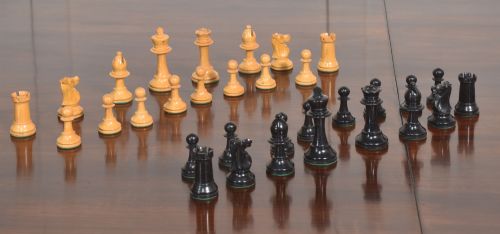


Carved Boxwood Chessmen
These carved boxwood chessmen are tactile, hard-wearing gaming pieces created for serious play and display.
Carved Boxwood Chessmen
When you search for carved boxwood chessmen, you are looking at tactile gaming sets from the nineteenth and early twentieth centuries. These sets span periods from the late nineteenth century through the Edwardian era, including Victorian pieces.
The version you are most likely to meet on this page is the classic Staunton chess set, usually paired with contrasting dark pieces made from ebony or ebonised wood. Other variations include St George patterns, Calvert patterns, and sets associated with specific makers.
These items were used both for formal library games and casual play, often accompanied by folding boards or housed in fitted boxes. They represent a period when British games manufacture reached a high level of standardisation and design clarity.
How they were made
The primary material is dense boxwood, chosen for its fine grain and pale colour, turned on a lathe and carved by hand to form the intricate details of rooks, knights, and kings. Contrasting pieces utilise dark ebony or heavily ebonised wood to maintain clear visual separation on the board.
Many sets incorporate lead weights within the base to improve stability during play, often lined underneath with green felt to protect the playing surface. More elaborate boards and storage boxes use secondary timbers such as mahogany and rosewood.
Listings feature sets from the nineteenth century through the Edwardian period, utilising boxwood, ebony, brass, and bone.
What varies in quality
Quality in these sets is largely determined by the crispness of the carving, particularly on the knight pieces, which are typically hand-carved with individual character. The turning consistency of the baluster stems and the proportional balance of the crown and mitre details also separate ordinary sets from finer examples.
The presence of weighted bases and the original felt lining contribute to the practical quality of the set during use. Maker attribution and the survival of a matching fitted box or original folding board further elevate the standing of a set.
Jaques·Whitty·British Chess Company·F. H. Ayres·Calvert
The Carved Boxwood Chessmen Glossary
- Staunton pattern
- The standard design for chess pieces introduced in the mid-nineteenth century, featuring realistic architectural forms for the major pieces and a cross on the king. This style quickly became the mandatory standard for tournament play.
- Boxwood
- A dense, pale yellow hardwood with a very fine and uniform texture, ideal for detailed turning and carving. It forms the light side in traditional chess sets.
- Ebonised wood
- Timber, typically fruitwood or a similar dense wood, treated with a black stain or finish to imitate expensive ebony. It provides the dark side in many standard chess sets.
- St George pattern
- An earlier British style of chess piece popular before the dominance of the Staunton design, characterised by simpler cylindrical stems and un-crossed kings. These pieces have a more understated and compact silhouette.
Carved Boxwood Chessmen: Frequently Asked Questions
What is a Staunton chess set?
The Staunton pattern is the definitive design for chess pieces, established in the Victorian era to provide a universal standard for players. Each piece has a distinct architectural silhouette that remains legible during fast or competitive play.
Most sets on this page follow this exact design tradition, paired with contrasting dark woods like ebony.
How can I tell the age of these sets?
Dating relies on stylistic markers, turning profiles, and known manufacturing periods spanning the nineteenth and early twentieth centuries. Details such as the shape of the rook turrets and the carving style of the knight offer clear clues.
Makers' stamps or box labels, when present, provide the most precise indication of production dates.
Were all pieces weighted?
Weighting was an optional feature that manufacturers offered to improve the stability of the pieces during active play. Many sets from the late nineteenth century onwards incorporated internal lead weights beneath felt pads.
Unweighted sets are lighter to handle and typically belong to earlier production periods or travel sets.
How should I store these chessmen?
Proper storage involves keeping the pieces in a dry environment away from direct sunlight to prevent the boxwood from splitting or warping. Many sets were originally supplied with fitted wooden boxes or folding boards that double as storage compartments.
Lined compartments help prevent friction damage between the carved details during transit.