
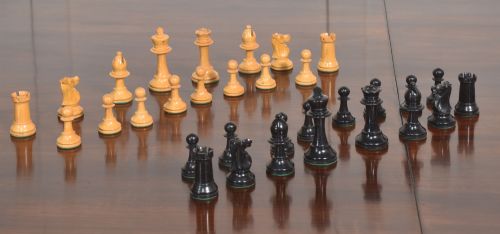


Traditional Wooden Chess Pieces
Traditional wooden chess pieces combine tactile beauty and historical weight, offering the serious player a timeless set to display and use.
Traditional Wooden Chess Pieces
Traditional wooden chess pieces encompass tactile boxwood, ebony, rosewood, and ebonised sets spanning the Victorian and Edwardian eras. When you search for traditional wooden chess pieces, you encounter complete sets designed for library tables, folding boards, and comprehensive games compendiums.
The nineteenth century yields the vast majority of these items, dominated by the enduring Staunton pattern alongside distinctive Calvert pattern examples and specialist workshop productions. Surviving sets frequently retain their original weighted bases and protective felt or baize linings beneath each turned form.
How they were made
Turners shaped boxwood, ebony, and rosewood on lathes to create the characteristic king, queen, bishop, knight, rook, and pawn profiles. Darker pieces utilised natural ebony or were ebonised to contrast sharply against the pale natural boxwood counterparts.
Leading makers added lead weights into the bases of these turned wooden forms to improve stability during play, finishing the underside with baize or felt. Folding boards and fitted compendiums incorporated mahogany and auxiliary materials to house the complete set safely.
Listings span the nineteenth and early twentieth centuries, featuring Victorian and Edwardian boxwood, ebony, rosewood, and brass elements.
What varies in quality
Proportion and matching timber selection throughout the full roster of pieces dictate the overall desirability of a set. Weighted bases that feel balanced in the hand and retain their original baize demonstrate superior original manufacture.
F. H. Ayres·British Chess Company·Whitty·Calvert
The Traditional Wooden Chess Pieces Glossary
- Staunton pattern
- The standard design for chess pieces introduced in the mid-nineteenth century, featuring realistic architectural forms for major pieces. This style remains the tournament standard today.
- Boxwood
- A dense, pale wood traditionally utilised for the lighter side of a chess set. Its fine grain permits intricate turning.
- Ebonised wood
- Timber treated to imitate the dark appearance of genuine ebony. It provides a cost-effective alternative for the darker pieces.
- Games compendium
- A fitted box containing multiple traditional tabletop games alongside the chess set and board. These multi-purpose sets date frequently to the Victorian and Edwardian periods.
Traditional Wooden Chess Pieces: Frequently Asked Questions
What is a weighted chess set?
Weighted chess sets contain lead weights inserted into the hollowed base of each turned wooden piece. This addition lowers the centre of gravity and prevents the pieces from tipping easily during rapid movement.
Look for original felt or baize pads covering the base cavity where the weight was sealed. Unweighted sets feel noticeably lighter and more prone to sliding.
How do I care for antique wooden pieces?
Keep wooden chess sets away from direct sunlight and extreme temperature fluctuations to prevent the boxwood and ebony from splitting. Store them in a dry environment within a lined box or compendium.
Avoid applying modern furniture polishes or oils that can damage the historical finish or stain the baize pads. Gentle dusting with a soft, dry cloth is usually sufficient.
What is a Calvert pattern set?
A Calvert pattern set refers to a distinctive style of nineteenth-century chess pieces originating from the workshop of John Calvert. These pieces feature characteristic chunky proportions and deeply carved knights.
Such sets are prized by collectors for their distinct regional English turning characteristics that pre-date the universal adoption of the Staunton standard.