
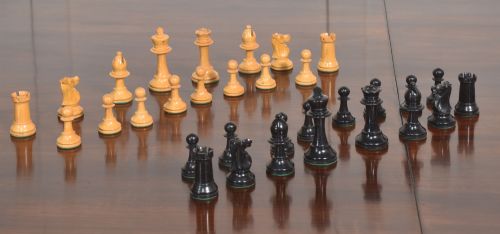


Victorian Wooden Chessmen
Victorian wooden chessmen bring tactile warmth and enduring design to the board, offering collectors a tangible connection to nineteenth-century strategy.
Victorian Wooden Chessmen
Victorian wooden chessmen represent the tactile history of the game, taking the form of complete chess sets housed in boxes or accompanied by folding boards. When searching for victorian wooden chessmen, a buyer encounters sets originating from the nineteenth century, the Victorian era, and around 1900, spanning periods such as Late Victorian and Edwardian.
The dominant form met on this page is the Staunton pattern, alongside alternative historical styles like St George and Calvert patterns. These sets comprise full complements of pieces carved to standard playing heights and proportions.
Origins trace predominantly to English makers and workshops of the period, reflecting the standardisation of chess design during the nineteenth century. Sets range from standard club-size weighted editions to more compact travelling or folding variants.
How They Were Made
Turned and carved from dense hardwoods, these pieces utilise contrasting timbers such as pale boxwood paired with dark ebony, rosewood, or ebonised wood. Artisans shaped each piece on a lathe before hand-carving intricate details like knight heads and rook turrets.
Weighted examples incorporate internal lead loads housed within the turned bases to improve stability during play, often finished with felt or baize lining on the underside to protect the board.
Every knight in a hand-carved set carries a slightly different expression, having been individually brought to life by the turner's chisel.
What Varies in Quality
The selection of materials dictates the upper tier of the range, where naturally dark ebony or richly grained rosewood outperforms plain ebonised wood. Maker attribution, through signatures or stamps, further distinguishes standard production sets from workshop-certified examples.
Jaques·Whitty·British Chess Company·F. H. Ayres·Calvert
The Victorian Wooden Chessmen Glossary
- Staunton pattern
- The standard design for chess pieces introduced in the mid-nineteenth century, featuring realistic architectural forms for major pieces and heavily weighted bases.
- Boxwood
- A pale, dense wood traditionally utilised for the lighter side of a chess set due to its fine grain and ease of turning.
- Ebonised wood
- Timber treated with a dark stain or finish to imitate true ebony, commonly found on the darker pieces of nineteenth-century sets.
- Baize
- A soft woollen fabric applied to the underside of chessmen bases to cushion movement across the board.
- Calvert pattern
- A distinct nineteenth-century style of chessmen characterised by specific geometric turning and stylised forms, pre-dating total Staunton uniformity.
Victorian Wooden Chessmen: Frequently Asked Questions
How do I identify a Staunton set?
Staunton sets feature standardised, highly recognisable forms where rooks resemble castle turrets and kings wear coronets. This design standard was adopted universally during the nineteenth century for tournament play.
Earlier or alternative patterns like St George feature simpler, less architectural profiles without the distinct crown and mitre markers of the Staunton standard.
What is the purpose of weighting?
Weighting provides stability during rapid or competitive play, preventing the pieces from tipping over easily on the board. Internal lead weights were added to the turned bases.
Heavier sets offer a more tactile, grounded feel during movement, indicating higher production quality from the period.
How should I care for antique wood?
Keep wooden chessmen away from direct sunlight and sudden humidity changes to prevent timber splitting or warping. Dust gently with a dry, soft cloth rather than using liquid polishes.
Storing pieces in a lined box or dedicated chess cabinet preserves the original finish and the delicate felt bases.
Are all nineteenth-century sets signed?
Most nineteenth-century chessmen remain unsigned, as makers typically relied on distinctive turning styles, proportions, and stamps on the box rather than marking every individual piece. Signed sets or those bearing manufacturer paper labels are exceptional.
Attribution often relies on stylistic markers associated with known workshops like Jaques or Ayres rather than explicit signatures.