
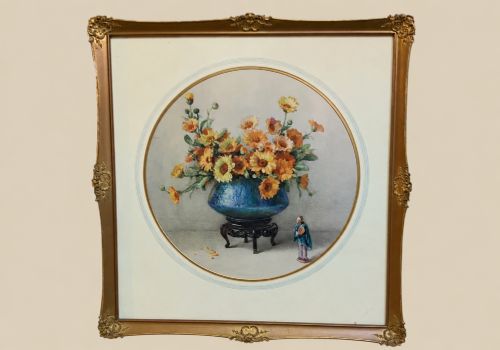
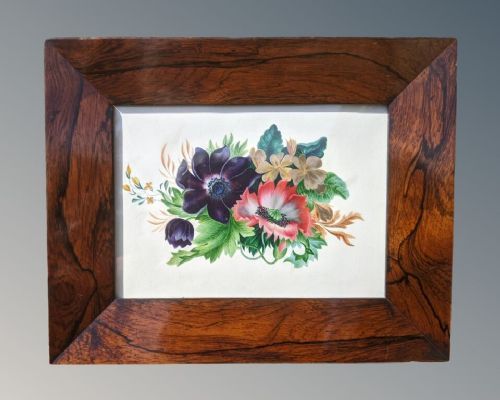
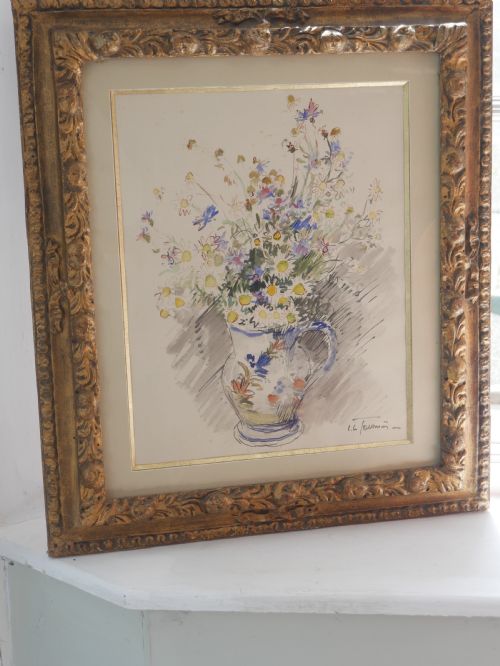


Vintage Watercolour Flower Picture
A vintage watercolour flower picture brings garden life indoors, offering soft washes and botanical detail captured across the nineteenth and twentieth centuries.
Vintage Watercolour Flower Picture
A vintage watercolour flower picture encompasses wall art, framed paintings, and botanical studies created across the nineteenth and twentieth centuries. These works range from traditional still life arrangements of marigolds, roses, and wallflowers to garden landscapes and Chinese floral compositions.
The pieces appearing here date from the nineteenth century through the mid-century period, including works from the Edwardian and Victorian eras. Buyers most frequently encounter framed original paintings depicting flowers in jugs, bowls, or walled gardens.
Materials and Technique
Watercolour pigment and ink applied to paper form the foundation of these pieces, often supplemented by glass protection and wooden framing. Certain works incorporate silk as a base or employ gold leaf accents.
Artists utilise translucent washes of pigment to build up floral forms, sometimes combining precise botanical observation with freer impressionist brushwork. Ink outlines define petals and stems, while paper supports preserve the delicate tonal gradations.
Listings feature works spanning the nineteenth century, 1900, 1910, 1920, 1930, 1940, and 1950, utilising paper, silk, and gold leaf.
Judging Quality
Quality rests on the sureness of the brushwork and the clarity of the pigment, distinguishing a lively study from a stiff or overly mechanical illustration. The control of water and wash determines whether petals hold a translucent depth or appear muddy.
The strength of the composition and the fidelity of the botanical observation separate accomplished works from lesser examples. Preservation of the paper and the integrity of the original framing further elevate the standing of a piece.
Catherine Thomas·James Tower·Harry Wanless·Lilian Stannard·Margaret Laing·Phyllis I Hibbert·Marian Chase·Charlotte Isa James·Alice Macallan Swan·M.K Rhodes·Owen Bowen
The Vintage Watercolour Flower Picture Glossary
- Watercolour
- A paint consisting of a pigment suspended in a water-soluble vehicle. It produces transparent colour washes on paper.
- Still life
- A painting representing inanimate objects or natural subjects, such as cut flowers in a jug or bowl. This genre emphasises arrangement and light.
- Botanical
- A detailed representation of plant species intended for scientific accuracy or aesthetic study. These works often isolate specific flowers against a plain background.
- Impressionist
- A style involving relatively small, thin yet visible brush strokes and an open composition. It prioritises accurate depiction of light in its changing qualities.
Vintage Watercolour Flower Picture: Frequently Asked Questions
How should I hang a watercolour?
Watercolour pigments are sensitive to strong sunlight and fade with prolonged exposure. Hang pieces away from direct light sources and high moisture areas such as bathrooms.
Ensure frames use conservation glass to filter ultraviolet rays and keep the paper protected from direct contact with the glass surface.
How do I date an antique painting?
Dating relies on stylistic clues, framing materials, and signatures or inscriptions on the reverse of the paper. Victorian and Edwardian works often feature specific mounting styles and paper watermarks.
Compare the handwriting of signatures or artist biographies against exhibition records to narrow the period of creation.
Are these works original paintings?
The listings comprise original painted works executed by hand using watercolour pigment, ink, and occasionally bodycolour on paper or silk. Each piece is a unique creation rather than a modern mechanical reproduction.
Brush texture and pigment pooling under magnification confirm the hand-painted nature of these floral studies.
What framing is appropriate for vintage art?
Many pieces retain their period wooden frames, which complement the age and style of the watercolour. Retaining original frames preserves the historical integrity of the object.
If reframing is necessary, choose mounts and mouldings that respect the aesthetic of the early twentieth or nineteenth century.