
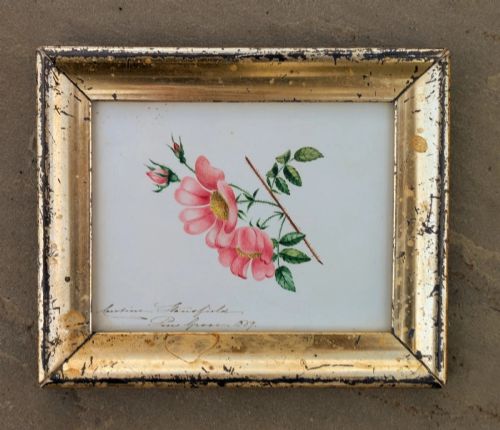


Original Watercolour Flower Study
An original watercolour flower study captures botanical specimens and garden blooms on paper through fluid pigment, offering timeless floral observation for the home.
Original Watercolour Flower Study
An original watercolour flower study represents hand-painted floral subjects created across the nineteenth and twentieth centuries, spanning Victorian botanical recording to mid-century British still-life painting. Collectors encounter individual framed artworks depicting specific garden species such as fuscias, wild roses, azaleas, pansies, and wallflowers rendered with careful observation.
The pieces on this page include works framed under glass in wood or gilt wood surrounds, alongside unframed paintings on paper. Creators documented flowers in domestic vessels like jugs, bowls, and vases, or presented them as direct botanical specimens.
Originating largely from British and European hands, these paintings bridge scientific record and domestic decoration, reflecting changing aesthetic tastes from Victorian precision to mid-century freedom.
Materials and technique
Artists applied watercolour paint and pigment directly onto paper surfaces, occasionally combining gouache or ink to build opacity and fine detail. Painters utilised water-soluble binders to achieve translucent washes of colour, defining petals and leaves through layered brushwork.
Finished works received protection behind glass mounted within wooden or gilt frames, preserving the delicate water-soluble pigments from atmospheric moisture and handling.
Assessing the work
Quality rests upon the artist's draughtsmanship and control over the fluid medium, distinguishing confident botanical illustration from stiff amateur copies. Superior examples display subtle tonal variation in petal structures and botanical accuracy alongside balanced composition within the picture plane.
The condition of the paper surface and the vibrancy of the watercolour pigment heavily influence desirability, as prolonged exposure to light fades vulnerable botanical hues over decades.
Edith Barrow·Grace Hastie·Phyllis I Hibbert·Marian Chase·Charlotte Isa James·Alice Macallan Swan·Marion Broom·Annie Mary Youngman·M K Rhodes·Minnie Smythe·M Clay·Olive Higginbottom·L E Hole·Otto Soltau·William Edward Frost R A
The Original Watercolour Flower Study Glossary
- Watercolour
- A painting method where fine pigment is suspended in a water-soluble binder and applied to paper. The technique relies on the white of the paper shining through translucent washes.
- Gouache
- An opaque water-based paint containing pigment, water, and a binding agent such as gum, often mixed with watercolour to create solid areas of colour. Artists use it to add highlights and dense passages to floral studies.
- Botanical study
- A detailed visual recording of plant morphology intended for scientific accuracy or aesthetic appreciation. These works focus closely on the specific structures of leaves, stems, and blossoms.
- Still-life
- An artwork depicting inanimate subject matter, typically featuring cut flowers arranged in domestic vessels like jugs and vases. It allows the painter to study light, shadow, and ephemeral arrangements.
- Gilt wood
- Timber framing coated with a thin layer of gold leaf or metallic gilt paint. It provides traditional period framing for nineteenth-century works on paper.
Original Watercolour Flower Study: Frequently Asked Questions
How old are these flower paintings?
The pieces span from the nineteenth century through the Victorian and Edwardian eras into the mid-twentieth century.
Most surviving examples date between eighteen fifty and nineteen fifty, reflecting changing botanical illustration styles over a century.
Are these works hand painted?
Every listed item is an original hand-painted work executed directly onto paper using watercolour or gouache pigments.
Artists applied the liquid medium by brush rather than employing mechanical reproduction or print techniques.
How should I display them at home?
These framed works suit study walls, living rooms, and hallways where natural light remains indirect.
Keeping them away from direct sunlight protects the delicate water-soluble pigments from fading over time.
What subjects do the artists depict?
Paintings feature single botanical specimens like roses and azaleas alongside arranged still-life compositions in jugs and vases.
Some examples also incorporate garden insects such as snails and dragonflies among the foliage.