
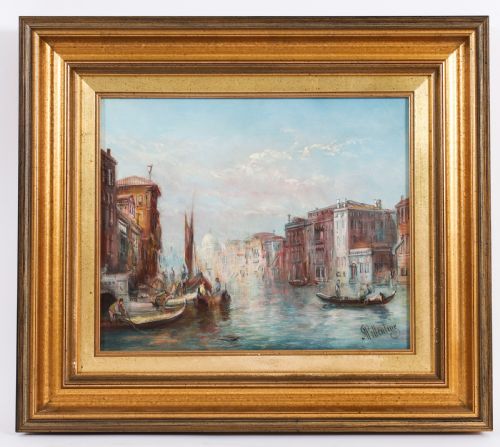
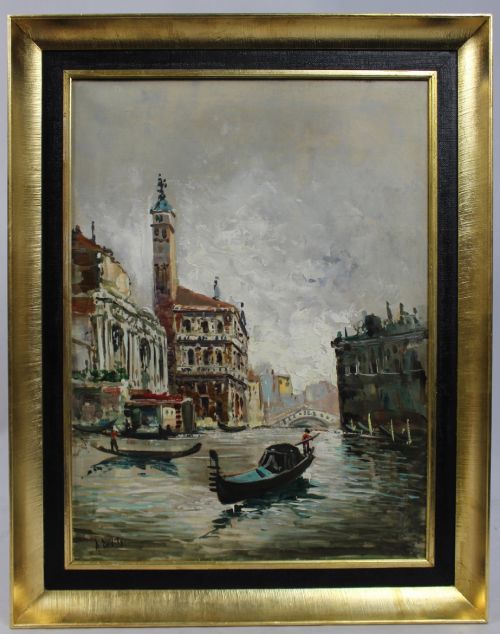
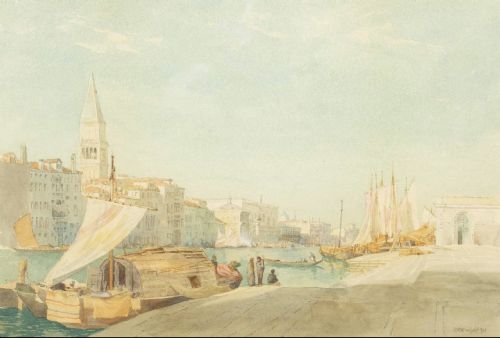
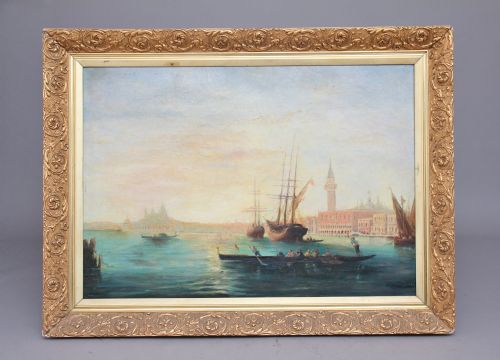


Vintage Venetian Cityscape Painting
A vintage venetian cityscape painting brings the luminous light and historic canals of Italy directly into a room.
Vintage Venetian Cityscape Painting
A vintage venetian cityscape painting captures iconic locations such as the Grand Canal, the Bridge of Sighs, and the Venetian lagoon. These works span periods from the Victorian era and the nineteenth century through to mid-century modern interpretations.
The subjects range from detailed architectural studies of palazzos and churches like Santa Maria della Salute to atmospheric depictions of gondolas and moonlight. Buyers frequently encounter oil on canvas and delicate watercolour paintings representing these historic views.
Makers and artists working within Italian impressionism, French impressionism, and post-impressionism all turned their attention to Venice. The selection includes works created across decades, reflecting changing artistic approaches to the city's unique water-bound topography.
Materials and techniques
Oil paint applied to canvas remains a primary medium for capturing the rich textures and deep water reflections of the Venetian cityscape. Artists also utilised watercolour, pastel, gouache, and ink pen on paper to achieve lighter, more fluid atmospheric effects.
Many paintings are housed in period frames constructed from wood, often featuring giltwood or gilded finishes that complement the warm tones of the artwork. Mixed media elements occasionally appear alongside traditional pigments to build up layered surface textures.
Materials documented across the works include oil paint, canvas, wood, paper, giltwood, and gouache.
Factors influencing quality
Quality rests upon the artist's ability to manipulate light and atmosphere, distinguishing a lively impressionist rendering from a flat topographical record. The handling of water and sky determines whether the lagoon appears luminous and convincing.
The integrity of the canvas or paper support and the preservation of the original pigments dictate the overall presentation. Original giltwood frames that harmonise with the period of the painting add considerable integrity to the piece.
Alfred Pollentine·Antonio DeVity·Richard Henry Wright·Claude Jousset·Marc Aldine·Antoine Bouvard Senior·Vittore Zanetti Zilla·David Law·Emanuele Cappello·Charles Clement Calderon
The Vintage Venetian Cityscape Painting Glossary
- Giltwood
- Wood that has been treated with a thin layer of gold leaf or metallic gilt. This finish is commonly found on frames accompanying nineteenth-century and Victorian artworks.
- Gouache
- An opaque water-based medium that allows for rich, solid areas of colour. It is frequently combined with watercolour or pastel in works depicting Venetian canals.
- Impressionism
- An art movement focused on capturing the visual impression of a moment, particularly regarding shifting light. This style is heavily represented among artists painting the Venetian lagoon.
- Lagoon
- The shallow body of water surrounding Venice that separates the city from the open sea. Painters frequently depict this expanse to capture wide vistas of the skyline.
- Watercolour
- A paint consisting of water-soluble pigments diluted with water, applied to paper. It produces transparent washes ideal for capturing the misty light of Venice.
Vintage Venetian Cityscape Painting: Frequently Asked Questions
What subjects appear in these paintings?
The works primarily depict the Grand Canal, the Bridge of Sighs, and various palazzos across the Venetian lagoon. Artists also focused on everyday scenes featuring gondoliers and historic architecture.
Views range from bright daylight water scenes to moody moonlight compositions rendered in pastel and oil.
How do I date a Venetian painting?
Dating relies on stylistic clues, framing materials, and the documented active periods of the artists. Victorian and nineteenth-century works often show more academic detail, while mid-century examples lean towards impressionism.
Signatures, stretcher frames, and the type of canvas or paper also help narrow down the decade of creation.
Are these works painted on canvas or paper?
Both mediums appear frequently within the collection. Oil painters typically used stretched canvas or wood panels, while watercolourists and pastel artists worked on paper.
Each medium creates a distinct texture suited to the artist's specific method of capturing the city.
How should I frame and display them?
Many pieces arrive in their original giltwood or gilded wooden frames, which should be preserved where possible. Proper placement away from direct sunlight protects the pigments in both oil and watercolour works.
Framing under glass is essential for works on paper such as watercolours and pastel drawings.