


Venetian Gondola Wall Art
Venetian gondola wall art brings the romantic waterways of Italy into your home through period paintings and watercolours.
Venetian Gondola Wall Art
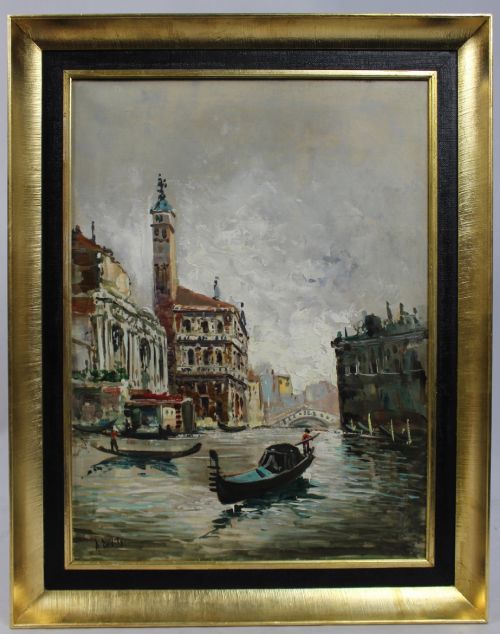
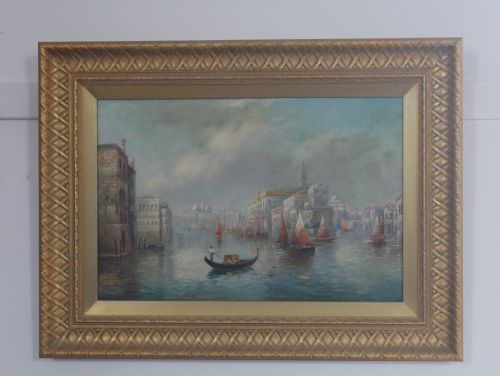
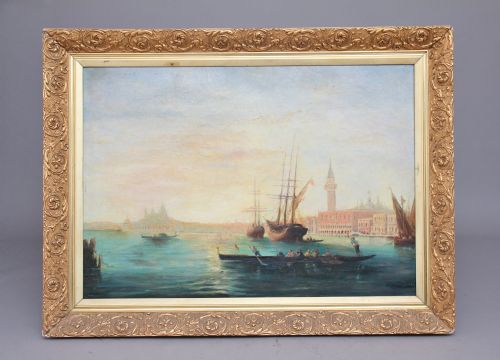
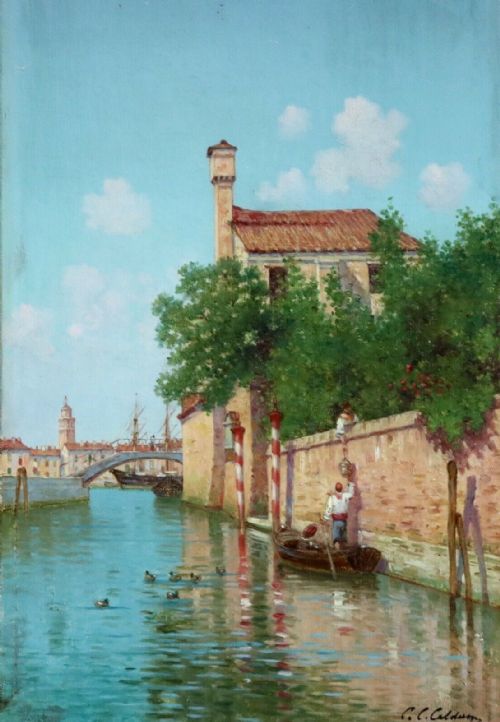
Venetian gondola wall art encompasses oil paintings, watercolours, and mixed media works capturing the canals, lagoons, and architecture of Venice. These pieces span from the Victorian era through the early twentieth century and into the mid-century period.
You will most commonly encounter oil on canvas works and watercolours depicting scenes such as the Grand Canal, the lagoon, and the Ducal Palace. The selection ranges from nineteenth-century romanticism and fine art to mid-century impressionism and expressionism.
Works on this page feature named artists alongside unsigned topographical views, offering varied perspectives on the Venetian waterways. The physical formats include framed paintings and works on paper, canvas, or panel.
How they were made
The physical construction of these works relies primarily on oil paint applied to canvas, alongside watercolours, gouache, pastel, and ink on paper. Artists utilised traditional wooden stretcher frames and often housed the completed artwork in decorative gilt or giltwood frames.
Mid-century pieces introduce mixed media approaches, combining various drawing and painting mediums to capture the light and atmosphere of the Venetian lagoon. The application varies from detailed fine art representation to looser impressionistic and expressionistic brushwork.
The listings span the Victorian era, the nineteenth century, and several decades of the twentieth century up to nineteen sixty.
What varies in quality
Quality in these artworks is determined by the handling of light, water reflection, and atmospheric depth across the Venetian lagoon. Skilled brushwork captures the distinctive architectural details of buildings like the Ducal Palace and the subtle shifts of colour in the water.
The integrity of the original canvas, paper support, and associated giltwood framing contributes to the overall standard of a piece. Works by documented nineteenth and twentieth-century painters demonstrate a stronger command of composition and perspective than anonymous decorative pieces.
Antonio DeVity·Alfred Pollentine·Charles Clement Calderon·Wilfred Knox
The Venetian Gondola Wall Art Glossary
- Giltwood
- Wood that has been covered with a thin layer of gold leaf or gilt. This material is commonly found on the antique frames enclosing Victorian and twentieth-century paintings.
- Impressionism
- An artistic style characterised by relatively small, thin, yet visible brush strokes and an open composition. This approach appears in nineteenth-century and mid-century interpretations of Venetian scenes.
- Gouache
- A method of painting using opaque water-based pigments. It is frequently combined with watercolour, pastel, and ink on paper to depict views of the Grand Canal.
- Topographical
- Relating to the detailed depiction of a particular place or locality. Many of the cityscapes and canal scenes serve as topographical records of Venice.
- Mixed media
- An artwork in which more than one medium or material has been employed. Examples include combinations of pastel, gouache, and ink pen drawings.
Venetian Gondola Wall Art: Frequently Asked Questions
What periods do these paintings come from?
The available selection spans from the Victorian era and the late nineteenth century through the early twentieth century and into the mid-century period.
Artists worked in distinct styles ranging from nineteenth-century romanticism to mid-century impressionism and expressionism.
Are these works painted on canvas?
Many of the pieces utilise oil paint applied directly to canvas or wooden supports, capturing traditional Venetian scenes.
Other works consist of watercolours, pastels, gouache, and ink drawings executed on paper supports.
How should I hang framed paintings?
Ensure your wall can support the weight of the artwork and its original gilt or wooden frame, using appropriate fixings.
Position the painting away from direct sunlight and damp environments to protect the canvas, paper, and pigments.
What subjects are depicted in the art?
The artworks primarily depict Venetian waterways, including the Grand Canal, the lagoon, St Georges Island, and the Ducal Palace.
Gondolas and local watercraft feature prominently across the various oil paintings, watercolours, and mixed media works.
How do I identify different artists?
Look for signatures, inscriptions, or labels on the canvas, paper, or the reverse of the frame.
Documented painters such as Alfred Pollentine and Antonio DeVity left distinctive signatures and stylistic markers on their topographical views.