
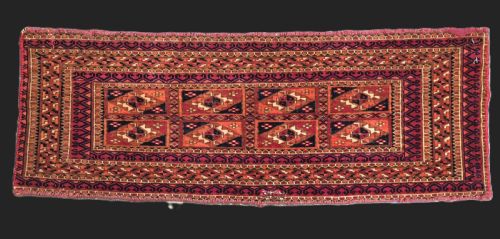


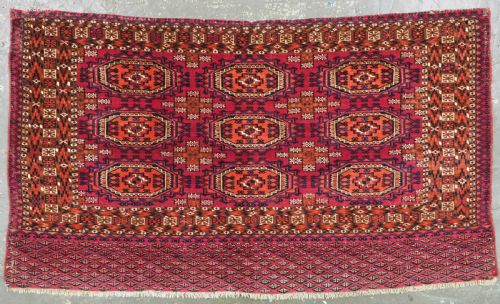

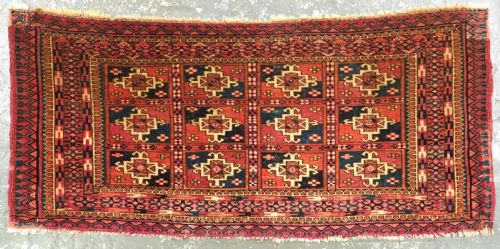
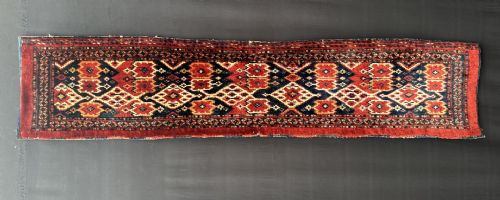

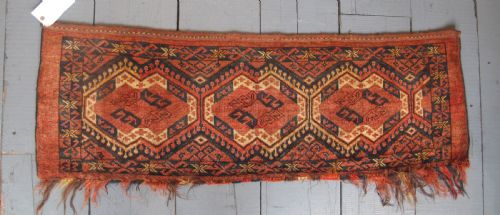


Vintage Turkmen Carpet Panel
These vintage turkmen carpet panel pieces bring striking tribal geometry and rich wool textures directly into modern interiors as wall art.
Vintage Turkmen Carpet Panel
A vintage turkmen carpet panel typically takes the form of a torba, mafrash face, or chuval created by tribal weavers across Central Asia. These items originally functioned as utilitarian storage bags or wedding camel trappings before being repurposed for display.
The selections encountered here span from the mid-nineteenth century up to nineteen hundred, representing distinct tribal groups such as the Tekke, Ersari, and Yomut. Each piece displays the traditional motifs and layouts passed down through generations of weavers.
Buyers look to these textiles for their bold geometric structures and saturated palettes, which anchor contemporary spaces with authentic historical character. They appear most frequently as fragments or complete bag faces ready for mounting on walls.
Factors of Quality
Knot density and handling of the wool dictate the fineness of the finished surface, with tightly packed structures offering greater definition to complex motifs. The precision of the drawing within major guls and secondary ornaments also marks the skill of the original weaver.
Completeness alters the character of a piece, distinguishing intact bag faces with original backs from solitary fragments. Clarity of natural dye saturation and the preservation of the outer guard borders contribute further to the distinction between standard examples and superior survivals.
The Vintage Turkmen Carpet Panel Glossary
- Torba
- A small Turkmen storage bag produced for domestic use inside the yurt. These rectangular pieces frequently feature primary guls arranged across a central field.
- Chuval
- A large tent bag utilised by nomadic tribes for household storage. They display prominent repeating guls and wide elem panels along the lower edge.
- Mafrash
- A trapezoidal bedding bag panel woven in matching pairs. Collectors prize these for their compact dimensions and intricate end designs.
- Gul
- The primary medallion motif repeated across Turkmen carpets and trappings. Different tribes developed distinct gul forms to signal their specific lineage.
- Elem
- The decorated lower panel situated below the main field on large tent bags. This zone often contains floral or geometric shrub motifs.
Vintage Turkmen Carpet Panel: Frequently Asked Questions
How do I hang a carpet panel?
Hanging these textiles requires methods that distribute the weight evenly without damaging the antique wool foundation. Many owners use custom mounting frames or specialist Velcro systems stitched securely to the reverse.
Avoid displaying them in direct sunlight to protect the natural dyes from fading over time. Regular gentle rotation helps maintain even exposure to ambient light.
How do I identify tribal groups?
Tribal attribution relies on the specific shape and arrangement of the repeating guls, alongside the choice of secondary border motifs. Tekke, Ersari, and Yomut weavers each utilised distinct drawing styles and colour palettes.
Examining the structure of the wool and the handling of the fringe areas provides further clues to origin. Reference literature on Turkmen carpets helps map these specific design markers to their geographic roots.
Are these pieces complete bags?
Many examples survive as single bag faces rather than complete three-dimensional storage sacks. The reverse sides were frequently removed when the utility items wore out or were repurposed for trade.
Some exceptional pieces retain their original wool backs or complete paired formats. Each listing specifies whether the item is a fragment, a single face, or an intact trapping.