
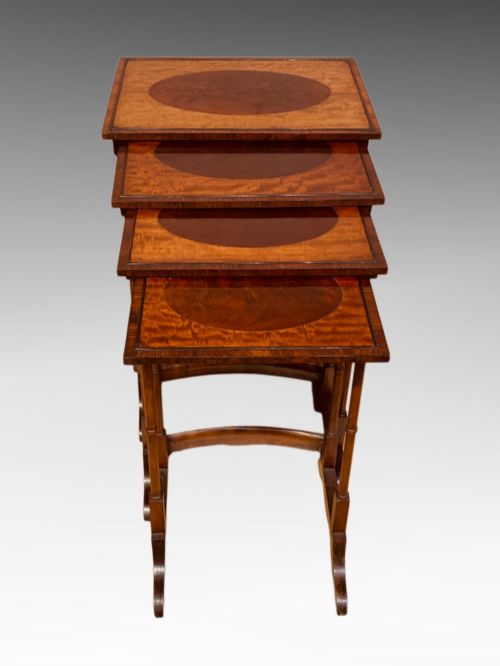


Vintage Stacking End Tables
These vintage stacking end tables are practical space-saving nests that tuck neatly away until guests arrive.
Vintage Stacking End Tables
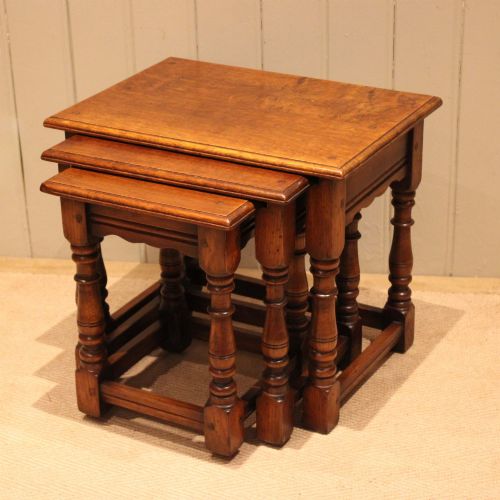
Vintage stacking end tables appear most frequently as nests of three or four tables designed to slide beneath one another. These pieces serve as flexible occasional surfaces in drawing rooms and parlours, expanding surface area without cluttering the floor.
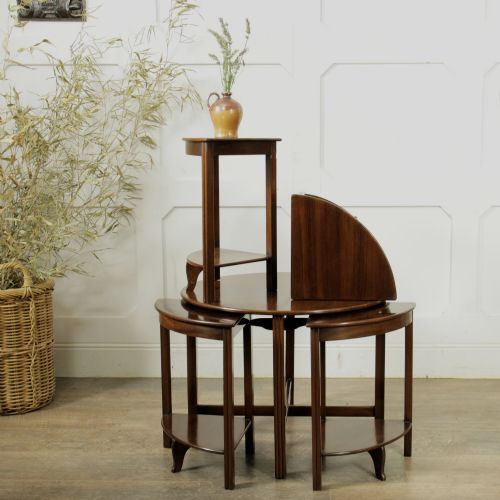
The Edwardian period dominates the selection on this page, alongside examples from the Victorian era, the nineteenth century, and the nineteen-thirties. Forms range from circular tops to rectangular quartetto sets originating from English country houses and cabinet makers.
Makers utilised various configurations, including sets of five graduated tables and oriental hardwood designs. Buyers frequently encounter Edwardian mahogany versions featuring inlaid satinwood or boxwood details.
How they were made
Cabinet makers built these pieces using solid timbers and veneered surfaces of mahogany, walnut, oak, satinwood, and rosewood. Selected sets incorporate exotic materials such as Indian rosewood, carved hardwood, and embossed leather top inserts.
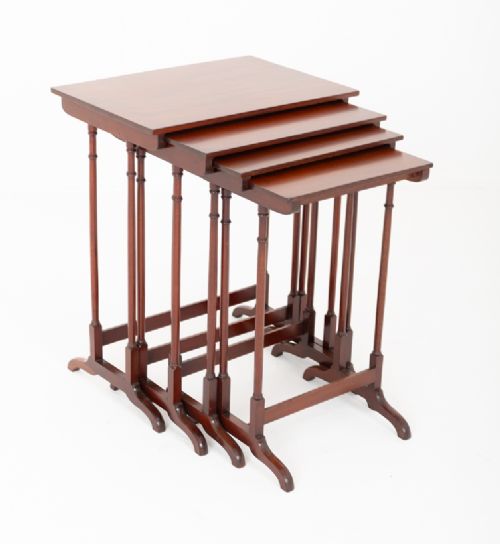
Construction techniques include delicate parquetry, floral inlay, and Chinoiserie decoration applied to the top surfaces of the graduating frames. Frames rely on sturdy yet slender legs that allow each smaller table to slot precisely into the next.
Listings feature mahogany, walnut, oak, satinwood, rosewood, and teak across Edwardian, Victorian, and Art Deco periods.
What varies in quality
Quality reveals itself in the crispness of the inlay work and the selection of timber grain across the graduating tops. Superior pieces maintain structural rigidity in the smallest table despite the reduced dimensions required for nesting.
Makers who invested time in matching veneers across all surfaces produced sets with greater visual harmony. Finer examples also exhibit careful joint work that withstands the friction of continuous sliding and stacking.
Waring & Gillow
The Vintage Stacking End Tables Glossary
- Quartetto
- A set of four tables designed to nest together. This term appears frequently in Edwardian and nineteenth-century descriptions.
- Parquetry
- Geometric mosaic woodwork used to create decorative patterns on table tops. It often incorporates contrasting timbers like walnut and boxwood.
- Chinoiserie
- European imitation of Chinese artistic motifs and styles. This decorative technique appears on select nineteenth-century and early twentieth-century table surfaces.
- Satinwood
- A durable, lustrous yellow timber utilised for decorative stringing and inlay work. Cabinet makers favoured it for contrast against darker woods like mahogany.
Vintage Stacking End Tables: Frequently Asked Questions
What is a quartetto nest of tables?
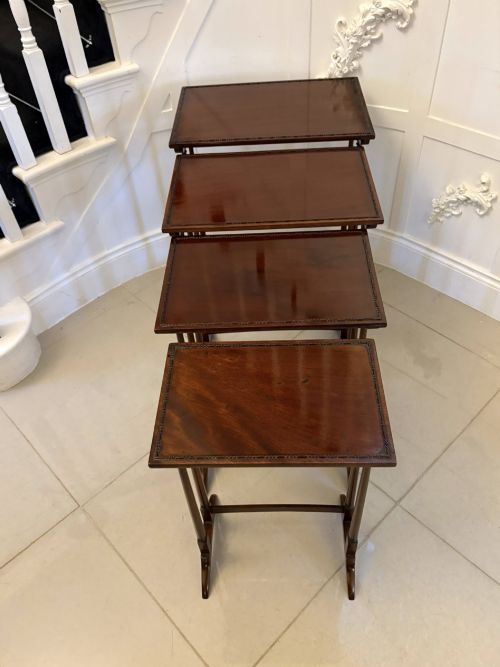
A quartetto nest comprises four graduated tables built to slide one beneath another into a single compact footprint. This format became particularly popular during the Edwardian era for entertaining.
Cabinet makers designed them so that the smallest table sits snugly at the very centre of the stack. They provide convenient surfaces for afternoon tea or small lamps without dominating the room.
How do I distinguish Edwardian nests from nineteenth-century ones?
Edwardian examples often display lighter mahogany frames with refined satinwood stringing or boxwood inlay. Nineteenth-century versions tend to utilise denser timbers and heavier proportions.
Examining the underside of the tabletops and the construction joints helps clarify the manufacturing period. Makers of the Edwardian era favoured bright, polished surfaces and slender turnings.
Where should I place a nest of tables?
These sets fit well beside a sofa or between armchairs where surface space is needed intermittently. When not in use, the entire stack rests against a wall or in a corner.
Spreading the tables around a room during gatherings provides guests with accessible places for drinks and books. They return to a single tidy unit once the room is cleared.
What woods were commonly used?
Mahogany, walnut, and oak form the foundation of most pieces in this category. Finer iterations incorporate exotic additions like Indian rosewood, satinwood, and carved oriental hardwoods.
Makers selected these durable timbers to withstand the daily friction of nesting and unnesting. Grain patterns were frequently matched across the graduating surfaces for visual appeal.