
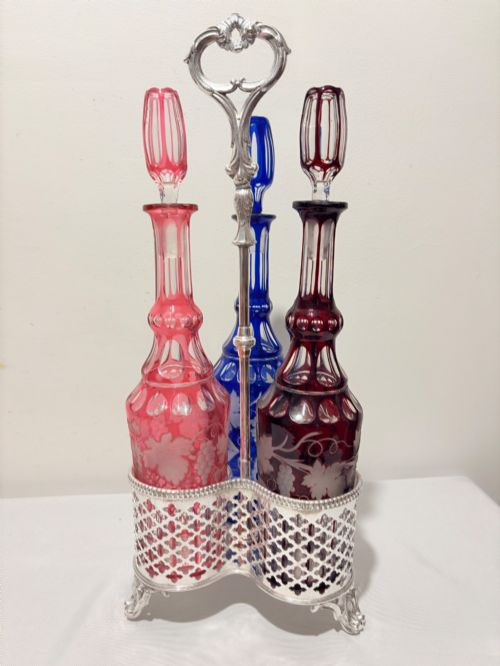
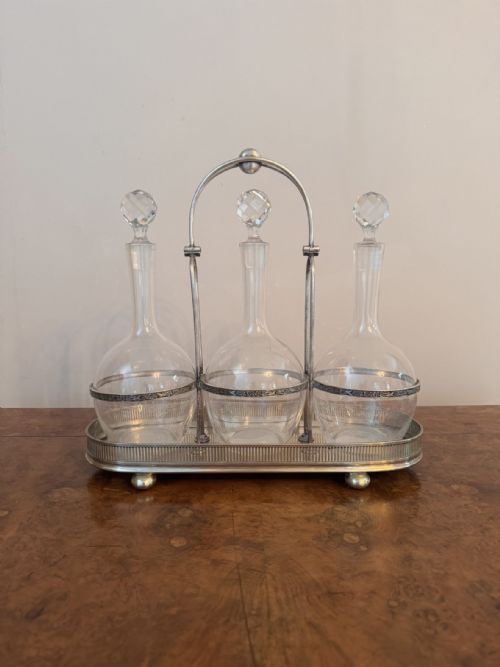
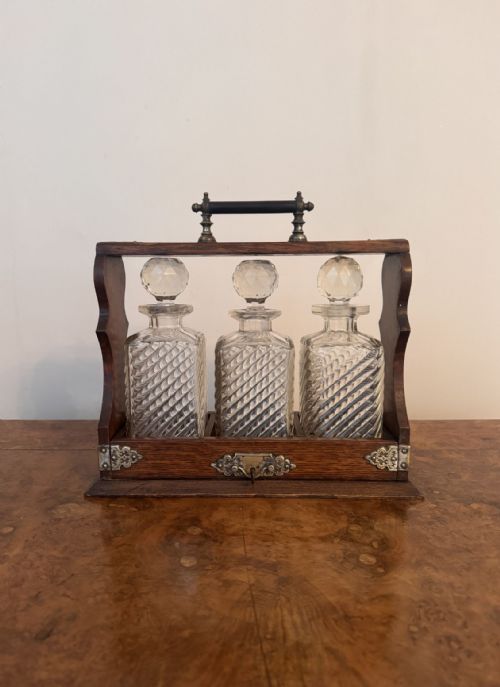
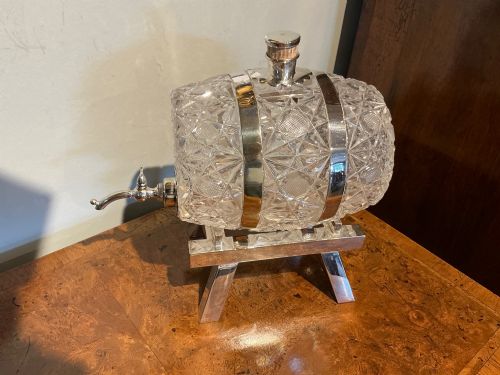


Vintage Spirit Decanter Stand
A vintage spirit decanter stand holds your bottles securely on the sideboard, combining practical hospitality with period craftsmanship.

Vintage Spirit Decanter Stand
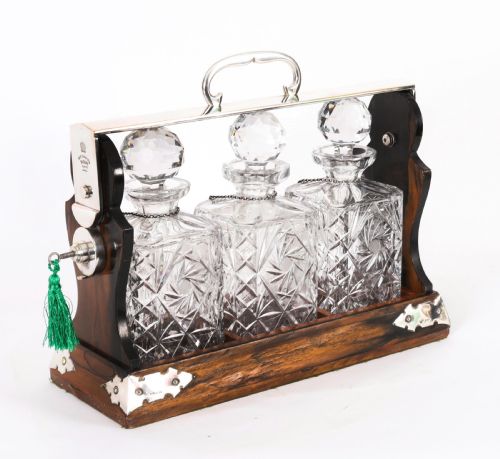
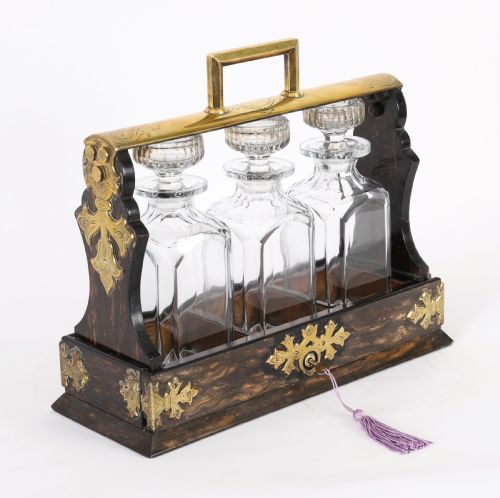
A vintage spirit decanter stand organises beverage bottles for the dining room or drawing room, appearing in forms such as open frames, cruets, and locking tantalus units. Most examples on this page date from the Victorian and Edwardian periods, stretching from the late nineteenth century into the early twentieth.
The most common formats include three-bottle frames fitted with cut glass decanters and heavy metal mounts. Alongside conventional open stands, locking tantalus designs feature a metal bar across the stoppers to secure the contents from unauthorised sampling.
How they were made
Frames and bases rely on cabinet timbers like oak and exotic coromandel wood, often paired with structural brass mounts. Metalwork frequently involves silver plate over a base metal, alongside specific historical techniques seen in Old Sheffield plate.
Vessels held within the stands consist of heavy cut glass and cut crystal, shaped with deep facets and geometric patterns. Joinery on wooden bodies incorporates marquetry stringing, while locking mechanisms demand precise metal fitting to engage the decanter necks.
Some Edwardian hosts hid cribbage boards and playing cards inside secret drawers beneath the whiskey.
What varies in quality
Differentiation across the range depends on the ambition of the materials and the prestige of the maker. Exotic timbers like coromandel and substantial hallmarked silver mounts indicate high status, whereas simpler silver-plated frames on oak occupy a standard domestic tier.
The complexity of the glasswork also dictates grade, with deeply faceted cut crystal vessels showing superior clarity and weight compared to standard moulded glass. Integrated mechanisms, such as games compendiums fitted into the base, separate utilitarian items from luxury entertaining pieces.
Betjemann·Elkington·The Goldsmith Co·Hukin and Heath
The Vintage Spirit Decanter Stand Glossary
- Silver plate
- A thin layer of silver bonded to a base metal core such as copper or white metal. It allowed nineteenth-century makers to achieve the appearance of solid silver at a lower cost.
- Old Sheffield plate
- An early form of plated metal created by fusing a sheet of silver to a copper ingot before rolling them together. This technique produces a characteristic warm lustre and occasional subtle copper bleed along edges.
- Coromandel wood
- A dense, heavily figured tropical timber prized for its dark brown colour and contrasting black stripes. It appears frequently on luxury Victorian cabinetwork.
- Marquetry
- Inlaid woodwork where contrasting veneers form decorative patterns or linear stringing across a panel. It adds refined surface detail to the wooden bases of better stands.
Vintage Spirit Decanter Stand: Frequently Asked Questions
How does a tantalus lock work?
A hinged metal bar drops across the necks of the glass decanters, secured at one end by a functional lock and key. Turning the key releases the bar, allowing the bottles to be lifted vertically from the frame.
Without the key, the stoppers remain trapped beneath the metal restraint, preventing the bottles from being removed.
What is the difference between a stand and a tantalus?
An open decanter stand holds bottles in a supportive frame without restricting access to them. The bottles lift out freely for pouring at any moment.
A tantalus adds a security bar over the stoppers, originally designed to prevent household staff from helping themselves to the master's spirits.
How do I care for silver plated mounts?
Dust the metal gently with a soft, dry cloth to remove surface particles. Avoid harsh chemical dips that strip away thin historical plating.
Keep wooden bases away from direct heat sources and excessive moisture to prevent the grain from splitting or warping.
How do I date an oak and silver plated stand?
Examine the construction methods, wood types, and any accompanying metal hallmarks. Victorian examples often feature deep oak bases and elaborate cast mounts, while Edwardian versions tend towards simpler rectilinear frames.
Patination on the timber and wear patterns on the silver plate also offer reliable clues to age.