
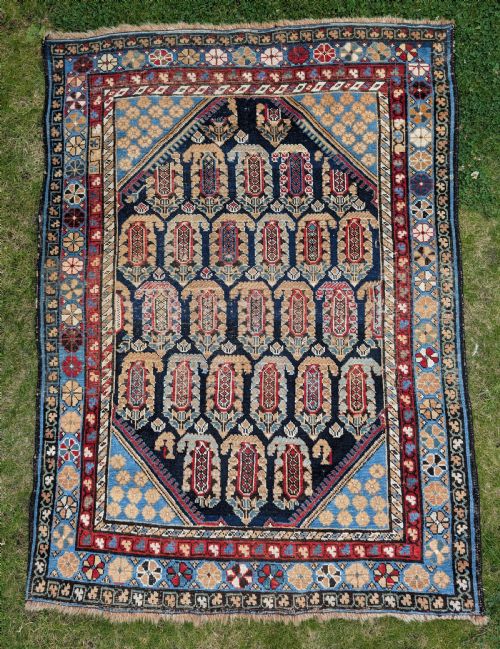
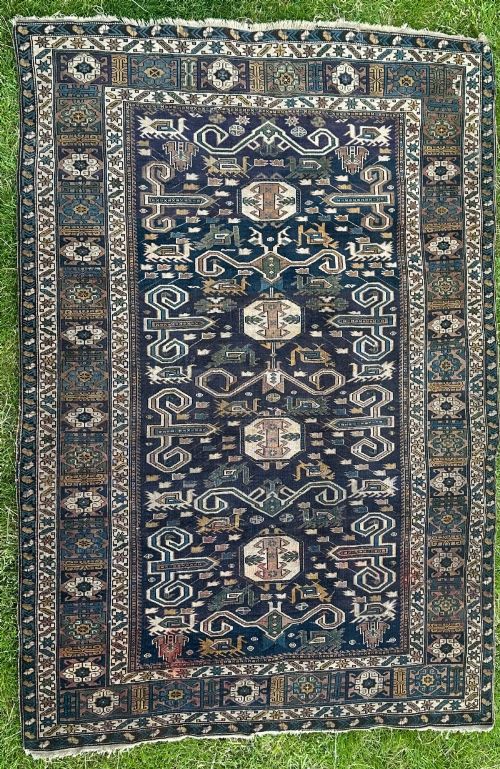
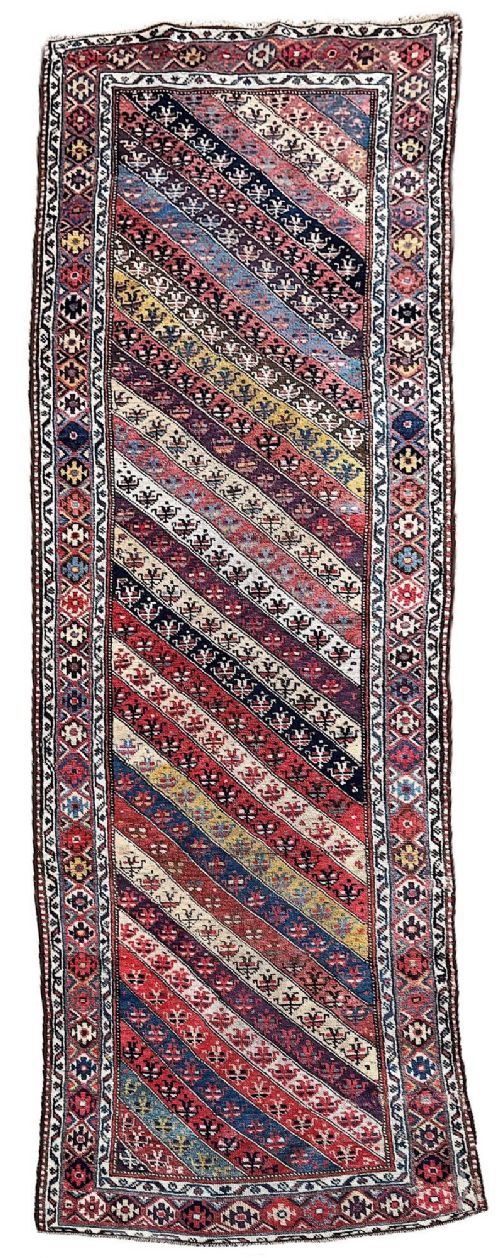
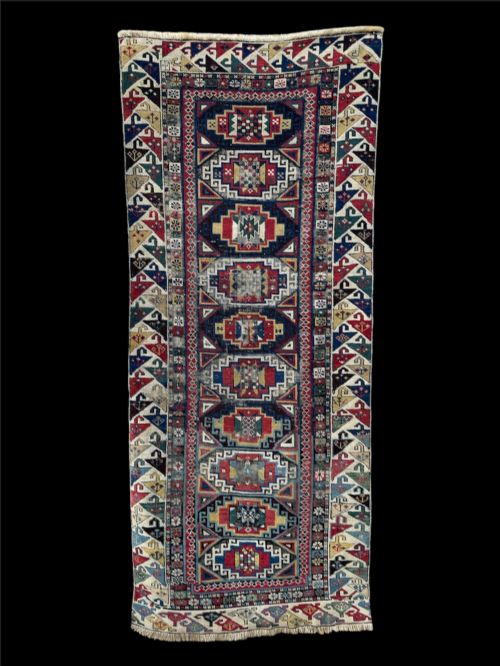


Vintage Shirvan Carpet
A vintage shirvan carpet brings bold Eastern Caucasian geometry and rich natural dyes directly onto the floor.
Vintage Shirvan Carpet
When you search for a vintage shirvan carpet, you find floor coverings originating from the Caucasus region during the late nineteenth and early twentieth centuries. These pieces encompass various formats, including runner rugs, area rugs, prayer rugs, flat-woven kilims, and saddle bags.
The selections on this page span several decades of production under Caucasian, tribal, and traditional styles. Shirvan pieces sit alongside related regional designations such as Kuba, Marasali, Talish, and Dagestan.
Buyers encounter distinct formats like narrow runners and banded kilims alongside classic village rugs. The designs draw from centuries of regional weaving traditions in the eastern Caucasus.
How They Were Made
Weavers utilised wool and hand-spun wool for the pile and structure, combined with cotton foundations in specific pieces. The materials reflect pastoral local resources from the Caucasian highlands.
Natural dyes provide the palette, creating soft faded colours and gentle variations across the surfaces. Skilled hands tied the wool yarns securely onto sturdy warps and wefts, producing durable flat-woven kilims and pile rugs.
Even horse baggage received master weaver attention, turning practical saddle bags into portable masterpieces of Caucasian geometry.
What Varies in Quality
The fidelity and complexity of the regional motifs dictate the visual strength of each textile. Sharper geometric execution and deliberate design variations separate standard village pieces from finer workshops.
The handling of natural dyes and the crispness of the wool impact the longevity and aesthetic depth of the surface. Surviving fragments and intact runners show distinct degrees of wear that reflect their working lives.
The Vintage Shirvan Carpet Glossary
- Prayer rug
- A small textile featuring a mihrab or niche design, traditionally used for personal devotion. These rugs often display concentrated floral lattices or geometric prayer arches.
- Kilim
- A flat-woven textile produced without a pile by tightly interweaving warp and weft strands. Shirvan examples frequently employ banded designs.
- Natural dyes
- Colourants derived from plants, roots, and insects rather than synthetic compounds. These dyes yield the soft faded colours seen across nineteenth-century Caucasian rugs.
- Runner
- A long, narrow carpet format designed for hallways or corridors. These pieces accommodate restricted spatial dimensions while displaying repeating border patterns.
- Kufic border
- A border ornamentation inspired by angular Kufic script, featuring geometric strapwork. This motif frequently appears on Shirvan and East Caucasian weaving.
Vintage Shirvan Carpet: Frequently Asked Questions
Where were shirvan carpets made?
These carpets originated in the Shirvan region of the Eastern Caucasus, encompassing towns and mountain villages with distinct weaving traditions.
The makers drew upon local tribal motifs and regional symbols passed down through generations.
How do I care for a vintage wool rug?
Protect the wool pile by placing a suitable underlay beneath the textile to prevent sliding and friction. Vacuum gently with the suction attachment rather than a rotating brush.
Keep the piece away from direct, prolonged sunlight to preserve the natural dyes.
What is the difference between a rug and a kilim?
A rug possesses a knotted pile that creates a plush, tactile surface of wool fibres. This construction provides depth and substantial weight underfoot.
A kilim is entirely flat-woven, omitting the pile entirely to yield a lighter, reversible textile with crisp geometric boundaries.
How do I identify a prayer rug?
Look for a distinct pointed arch or niche motif at one end of the field. This architectural element represents the prayer hall.
The central field often directs the eye toward the niche, distinguishing it from standard area rugs.
What are natural dyes?
Natural dyes are historic colourants extracted from local botanical and organic sources before the invention of synthetic aniline dyes. They produce harmonious, muted tones that age gracefully.
Over decades, these organic hues develop subtle variations across the wool yarns.