



Vintage Scottish Highland Landscape
These vintage scottish highland landscape works capture rugged terrain and lochs through oils and watercolours spanning the nineteenth and twentieth centuries.
Vintage Scottish Highland Landscape
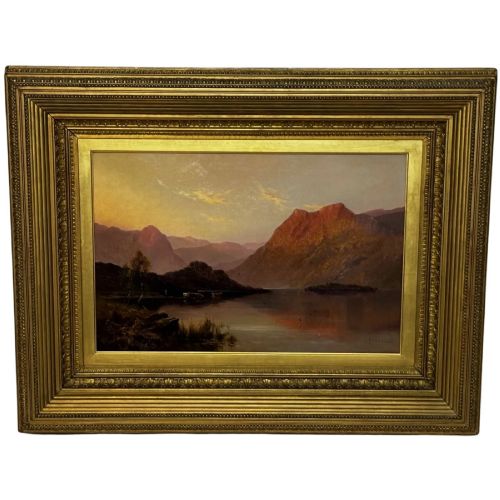
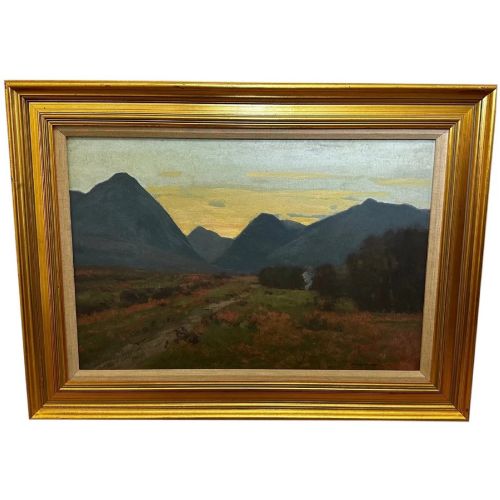
A vintage scottish highland landscape presents mountain peaks, cattle by lochs, and solitary crofts depicted by artists working from the Victorian era into the mid twentieth century. These paintings and watercolours capture the distinct atmospheric conditions of northern terrain across periods including the nineteenth century, Edwardian years, and nineteen twenties.
Most examples found here utilise oil paint on canvas or wood panel, alongside works on paper. The selection ranges from intimate panels to large framed canvases that anchor a room with traditional regional scenery.
Materials and execution
Artists relied primarily on oil paint applied to canvas, wood panel, or board, building up rich textures to render heather, rock, and water. Watercolours and gouache on paper also appear frequently, capturing softer light across moorland and loch.
Many works retain their original gilt or wood frames, which complement the traditional palettes employed by painters of the Scottish school and contemporaneous British artists.
Several Highland cattle appear to pose deliberately for the artist, unfazed by misty weather or mountainous terrain.
Distinctions in handling and depth
Quality rests on the confidence of brushwork and the artist's ability to convey atmospheric light across mountainous topography. Stronger compositions balance the expanse of sky and water with detailed foreground elements like cattle or figures.
The sensitivity of colour mixing distinguishes accomplished regional painting from standard decorative work, particularly in how shadows and shifting weather are rendered over open moorland.
Tom Campbell·George Houston·Archibald Kay·Henry Robinson Hall·William Grant Murray·Sir David Murray·George Melvin Rennie·William Miller Frazer·George Turner·Denys Garle·Robert Cleminson·Andrew Kurtis·Kenneth Holmes
The Vintage Scottish Highland Landscape Glossary
- Oil on canvas
- Pigment suspended in drying oil applied to a stretched woven fabric support. This traditional medium allowed artists to build rich impasto and deep tonal gradations.
- Wood panel
- A rigid wooden support used by painters instead of canvas. Panels frequently survive from the nineteenth and early twentieth centuries in stable condition.
- Gouache
- An opaque water-based paint that provides solid areas of colour and matte finishes. It was often utilised for detailed works on paper depicting northern scenery.
- Gilt frame
- A wooden moulding coated with gold leaf or metallic finish. These frames frequently accompany period paintings to enhance the depth of the artwork.
Vintage Scottish Highland Landscape: Frequently Asked Questions
How do I date a Scottish landscape painting?
Dating relies on stylistic clues, framing techniques, and signatures matched against artist records. Costume details on any figures present also offer reliable chronological markers.
Material supports such as panel types or canvas stamps provide further evidence to narrow down the decade of creation.
Are these works painted on location?
Many artists made initial watercolour sketches outdoors in locations like Glencoe or the Grampians before completing finished oil paintings in the studio. Field studies capture immediate weather effects.
Larger canvases were typically worked up indoors from these direct observations.
Where should I hang a large landscape?
These works suit principal reception rooms or hallways with balanced ambient lighting. Traditional gilt frames pair well with period interiors.
Keep pieces away from direct sunlight to protect oil pigments and paper works over time.
What subjects typically appear in these scenes?
Common motifs include Highland cattle standing near loch shores, rugged mountain ranges, moorland paths, and whitewashed croft houses. Moody skies and atmospheric mists recur frequently.
Human figures and hunting dogs occasionally add scale to the vast terrain.