

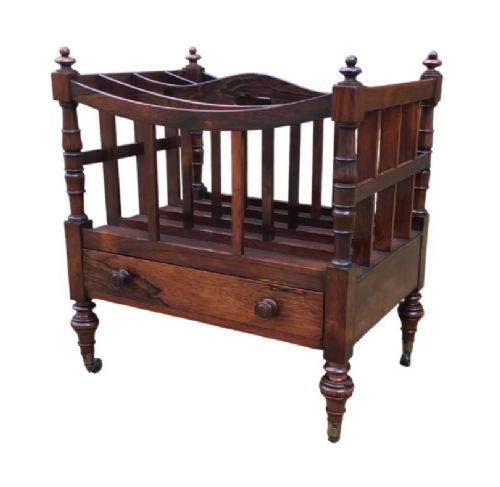


Vintage Rosewood Newspaper Rack
A vintage rosewood newspaper rack holds periodicals and sheets with timber grain and brass detail, built for the nineteenth-century parlour.
Vintage Rosewood Newspaper Rack
A vintage rosewood newspaper rack is typically encountered on this page as a canterbury or magazine stand from the Regency, Victorian, William IV, George IV, and nineteenth-century French periods. These divisions keep papers, magazines, and sheet music upright and tidy beside seating areas in the home.
The forms range from boat-shaped designs and three-division or four-division stands to foliate-carved music canterburys fitted with carrying handles. Most examples follow English or French cabinet-making traditions of the eighteen-twenties through to eighteen-eighty.
How they were made
These racks employ rich rosewood veneers and solids, prized for their deep grain patterns and dark tone. Cabinet-makers paired this dense timber with brass castors, handles, and spindle supports.
Joinery techniques include slatted or pierced divisions, turned uprights, and occasionally low drawer bases beneath the main compartments.
Vintage Rosewood Newspaper Rack Retail Price Guide 2026
Typical asking prices for vintage rosewood newspaper rack among the pieces listed under this phrase on Sellingantiques today, from the lower quarter to the upper quarter. They describe what is for sale here now, not the wider market.
Some nineteenth-century musicians relied on these wheeled stands to glide their scores smoothly across the parlour floor.
What varies in quality
Quality rests on the crispness of the turning, the richness of the rosewood grain, and the elegance of the division profiles. Finer examples show thoughtful proportion and refined brass fittings rather than heavy, plain construction.
The integration of foliate carving and the presence of an original carrying handle elevate a piece above simpler utilitarian versions.
The Vintage Rosewood Newspaper Rack Glossary
- Canterbury
- A low stand with divisions for holding sheet music, newspapers, or magazines, often fitted with castors and a carrying handle. Originating in the late eighteenth century, it remains the primary form for these racks.
- Regency
- A style period spanning roughly eighteen hundred to eighteen thirty, characterised by classical restraint, elegant curves, and dark woods like rosewood. Pieces from this era often feature precise brass inlays or turned spindle work.
- Division
- One of the upright partitions that separate the storage space within the rack, sometimes numbering three or four. These sections prevent papers from slumping.
- Foliate
- Ornamentation shaped like leaves or foliage, frequently carved into the woodwork of Victorian and Regency pieces. It adds decorative texture to the frame and handle supports.
Vintage Rosewood Newspaper Rack: Frequently Asked Questions
What is a canterbury used for?
A canterbury was originally designed to hold sheet music, folios, and newspapers in the sitting room. Today, it serves the same function for contemporary magazines and daily papers.
The compartmentalised divisions keep reading material organised and upright beside armchairs or sofas.
How do I date a rosewood rack?
Dating relies on stylistic clues such as the turnings, the shape of the divisions, and the presence of brass castors. Regency examples often display classical lines, while Victorian versions may incorporate heavier foliate carving.
Material choices like solid rosewood or veneer over secondary woods also point toward specific decades in the nineteenth century.
Where should I place it?
These racks sit naturally beside a sofa, beside a fireplace, or in a study to hold current reading matter. Their compact footprint allows them to fit easily into smaller spaces.
Keep them away from direct heat sources to protect the rosewood timber and veneer.
Can these racks hold heavy books?
They are built primarily for lightweight newspapers, magazines, and sheet music rather than heavy volumes. Storing oversized or weighty books can strain the wooden divisions and base.
Gentle daily use preserves the original joinery and slender uprights.