
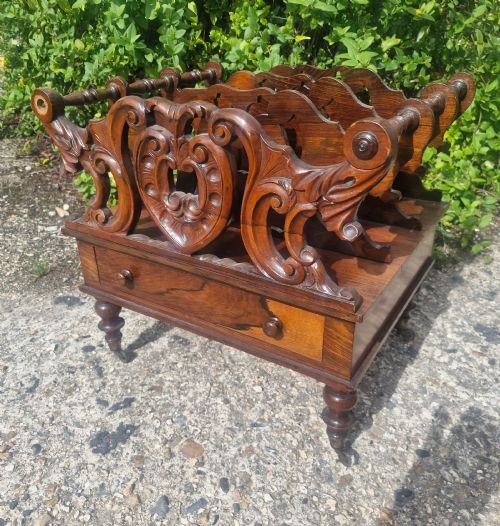
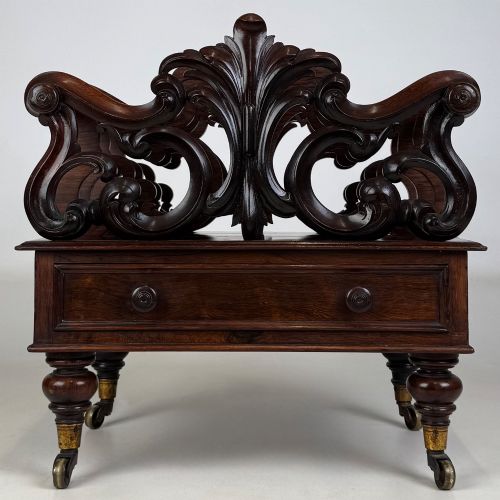


Carved Rosewood Paper Rack
These carved rosewood paper racks are substantial nineteenth-century furnishings designed to keep periodicals and folios orderly.
Carved Rosewood Paper Rack
A carved rosewood paper rack on this page typically takes the form of a Canterbury, combining compartmentalised storage for newspapers and magazines with a low stand. The pieces span the Georgian, Regency, William IV, and Victorian periods, alongside French nineteenth-century examples.
Most entries function as traditional canterburys or magazine racks, functioning as desk-side or parlour companions for paper organisation. Makers deployed dense tropical hardwoods to construct sturdy frames intended for daily domestic utility.
How they were made
Cabinetmakers constructed these frames primarily from rosewood, often incorporating brass castors and metal fittings to facilitate movement across carpeted drawing rooms. Certain iterations integrate ceramic details or secondary timbers like mahogany into the internal structure.
Carving defines the ornamentation, featuring motifs such as foliate designs and Prince of Wales feathers executed directly into the solid rosewood uprights and divisions. Joinery methods of the period relied on pegged mortise and tenon joints to withstand the weight of heavy paper.
Listings span the 19th Century, Victorian, Regency, Georgian, and 1850 periods, constructed primarily from rosewood with brass and mahogany elements.
What varies in quality
Depth and crispness of the carved ornamentation separate standard production pieces from finer examples, particularly where foliate details or specific motifs like feathers appear on the dividers. Sharp chisel work indicates a more skilled hand in the workshop.
The figure and grain of the rosewood timber itself dictate visual appeal, with richer, more uniform figuring commanding attention across the slatted partitions. Superior construction remains evident in the rigidity of the uprights and the original integration of brass castors.
The Carved Rosewood Paper Rack Glossary
- Canterbury
- A low stand with divisions for holding loose papers, music sheets, or magazines, typically featuring a carrying handle and small legs.
- Rosewood
- A dense, heavily figured dark timber favoured by nineteenth-century cabinetmakers for high-end occasional furniture.
- Foliate
- Ornamentation modelled on leaves, vines, or foliage, frequently carved in low relief upon nineteenth-century woodwork.
- Regency
- An English design period spanning the early nineteenth century, characterised by classical restraint and refined proportions.
Carved Rosewood Paper Rack: Frequently Asked Questions
What is a Canterbury?
A Canterbury is a low partitioned stand designed to hold newspapers, music sheets, and paper folios.
Originating in the eighteenth century, these pieces became staple furnishings in nineteenth-century drawing rooms for managing daily reading materials.
How were paper racks used?
They sat beside desks or armchairs to keep current periodicals, letters, and sheet music accessible yet tidy.
The vertical partitions kept papers upright and separated, preventing fragile sheets from creasing or scattering across tables.
Are these pieces strictly English?
While many examples originate from English workshops spanning the Georgian and Victorian eras, French nineteenth-century variants also appear.
Regional preferences influenced minor details in the turning of the legs and the style of the carved motifs.
How do I care for rosewood?
Rosewood benefits from stable indoor humidity and minimal exposure to direct sunlight to prevent the timber from drying.
Applying a traditional beeswax polish helps maintain the lustre of the dense grain without building up heavy residues.