
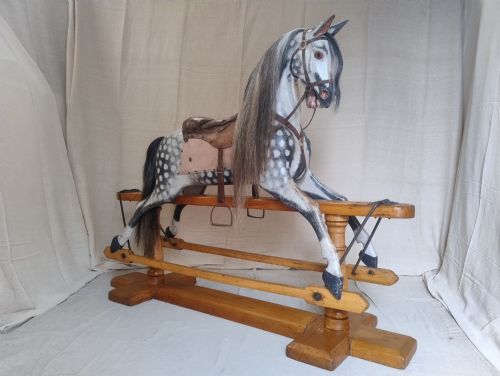


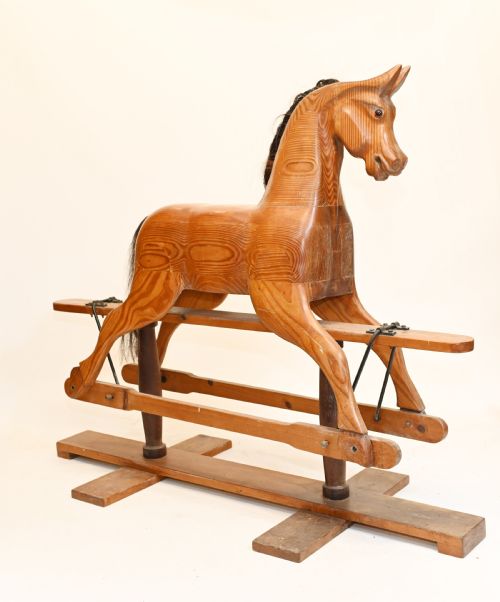

Vintage Pine Toy Horse
A vintage pine toy horse brings traditional craftsmanship and historic charm into a room, offering the enduring appeal of nineteenth and twentieth century children's playthings.
Vintage Pine Toy Horse
When you search for a vintage pine toy horse, you examine substantial carved wooden playthings designed as rocking horses across the Victorian, Edwardian and mid-twentieth century periods. These objects range from massive workshop productions down to simple folk art sculptures.
The versions you are most likely to meet on this page span the late nineteenth century through to the nineteen-fifties, taking the form of large rocking horses or decorative wooden sculptures.
Makers such as F.H. Ayres and Collinson appear among the listings alongside unassigned traditional British examples built from solid timber.
Construction and materials
Makers shaped these pieces primarily from carved pine and wood, applying surface decoration through traditional paint finishes that often survive in original condition.
Detailing frequently incorporates horsehair for manes and tails, alongside leather tack and iron or metal structural components to support the rocking mechanism.
Some horses carry the honourable scars of playworn condition, having survived generations of nursery adventures.
Assessing quality and character
Quality rests in the sculptural depth of the carving and the survival of original paint surfaces, distinguishing workshop pieces from simpler folk art objects.
Scale also dictates standing, with extra large and very large examples showing more complex internal framing and substantial timber construction.
F.H. Ayres·Collinson·Collinsons
The Vintage Pine Toy Horse Glossary
- Pine
- A softwood commonly utilised for the main body and structural frame of nineteenth and twentieth century toy horses. It provides a stable base for carved detail and paint.
- Rocking horse
- A child's toy mounted on curved rockers or a safety stand, designed for motion. These objects date across the Victorian, Edwardian and later eras.
- Folk art
- Traditional decorative objects made outside formal academic traditions, often reflecting regional styles and vernacular craftsmanship. These pieces show individual maker choices.
- Horsehair
- Natural hair utilised for the mane and tail of traditional toy horses. Surviving hair adds significant authenticity to older pieces.
Vintage Pine Toy Horse: Frequently Asked Questions
How old is a vintage pine toy horse?
These pieces date from the nineteenth century through the mid-twentieth century, encompassing Victorian, Edwardian and later decades.
Evidence in the listings shows periods ranging from the eighteen-eighties to nineteen-fifty.
What materials were used to make them?
Makers constructed these toys primarily from carved pine and solid wood, frequently adding horsehair manes and leather elements.
Iron and metal components often support the internal structure and rocking mechanism.
How do I live with a toy horse?
These large wooden sculptures suit placement in living spaces, halls or nurseries as focal decorative objects.
Their substantial scale requires adequate floor space and stable placement away from direct heat sources.