


Vintage Physics Apparatus
Vintage physics apparatus brings experimental science home through brass, glass and mahogany instruments that once demonstrated fundamental laws.
Vintage Physics Apparatus
Vintage physics apparatus comprises scientific instruments, models and scientific apparatus designed for classroom demonstration or laboratory research. These pieces range from Regency boxwood thermoscopes to mid twentieth century Van Der Graaff generators.
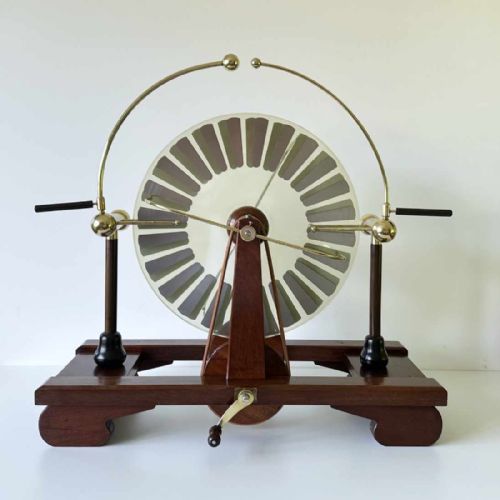
The objects available on this page reflect eras spanning Georgian, Victorian and mid-century scientific manufacture. Buyers meet items such as Wimshurst machines, induction coils, and Geissler tubes.
Makers represented include firms from London, Paris, and Germany, providing tangible links to historical scientific education and discovery. Each instrument preserves the physical manifestation of nineteenth and twentieth century experimentation.
How they were made
Makers constructed these instruments using durable materials such as brass, mahogany, wood, and iron, ensuring stability during delicate demonstrations. Glass components like vacuum tubes and scale cylinders required precise glassblowing techniques.
Finishes incorporate polished brass mountings, boxwood scales, and fitted velvet linings within protective wooden cases. Mechanical models utilise steel components alongside hand-turned wooden parts.
The listings span eight distinct periods from 1850 to 1950, utilising brass, glass, mahogany, wood, steel, perspex, iron, and velvet.
What varies in quality
Quality rests upon the precision of the mechanical engineering and the integrity of delicate glass or brass elements. Signed pieces bearing maker details command greater attention than unsigned workshop equivalents.
The sophistication of the demonstration apparatus, from simple thermoscopes to complex electrostatic generators, dictates the level of craftsmanship involved. Materials like solid mahogany bases and heavy gauge brass elevate an object above standard educational stock.
G. Adam of Paris·Watkins and Hill·Max Kohl Germany·Heinrich Daniel Ruhmkorff·William Ladd London·Physica
The Vintage Physics Apparatus Glossary
- Thermoscope
- An instrument that shows changes in temperature without necessarily measuring them on a numerical scale. Boxwood versions were common in the Regency period.
- Induction coil
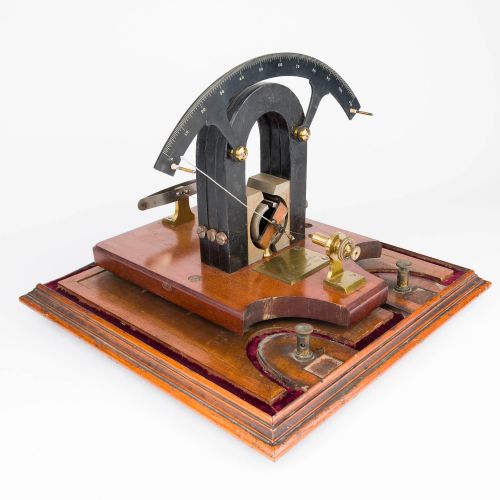
- An electrical device used to produce high-voltage alternating currents from a low-voltage direct current source. Ruhmkorff coils are notable examples.
- Geissler tube
- A sealed glass cylinder used to demonstrate electrical discharge through gases at low pressure. These often feature cross vacuum scales.
- Electrostatic machine
- A mechanical apparatus that generates static electricity through friction or induction. Large Victorian patterns utilise rotating glass plates.
- Galvanometer
- An instrument for detecting and measuring small electric currents. D’Arsonval galvanometers are typical of late nineteenth-century design.
Vintage Physics Apparatus: Frequently Asked Questions
What is vintage physics apparatus?
Vintage physics apparatus consists of scientific instruments, models and machinery used to demonstrate physical principles in schools and laboratories. These items date from the Georgian era through to the mid twentieth century.
Materials commonly include brass, glass, mahogany, and iron, reflecting the high standard of scientific instrument making of the period.
How were these scientific models used?
These instruments were utilised by educators and researchers to demonstrate electromagnetic induction, electrostatic generation, and thermodynamics to students. Many were designed for projection in lecture halls or for precise laboratory measurement.
Demonstrations often involved visible reactions, such as electrical discharges in Geissler tubes or mechanical movement in steam engine models.
How do I identify the period of an apparatus?
Dating relies on materials, maker marks, and stylistic indicators such as Victorian brass casting techniques or Regency boxwood construction. The presence of specific inventors' designs, like Ruhmkorff coils or Wimshurst machines, also helps place an item in time.
Makers frequently signed their instruments, providing a direct link to known workshops in London, Paris, and Germany.
Are these instruments still operational?
Many instruments retain their mechanical integrity, though their functional status varies due to age and the fragility of components like glass tubes. They are primarily collected and displayed as historical scientific artefacts.
Careful handling is required, particularly with delicate brass assemblies, wooden boxwood scales, and vintage glass elements.