
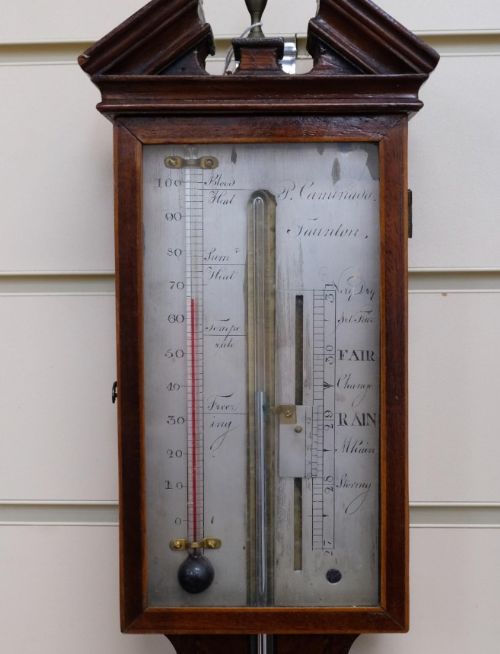
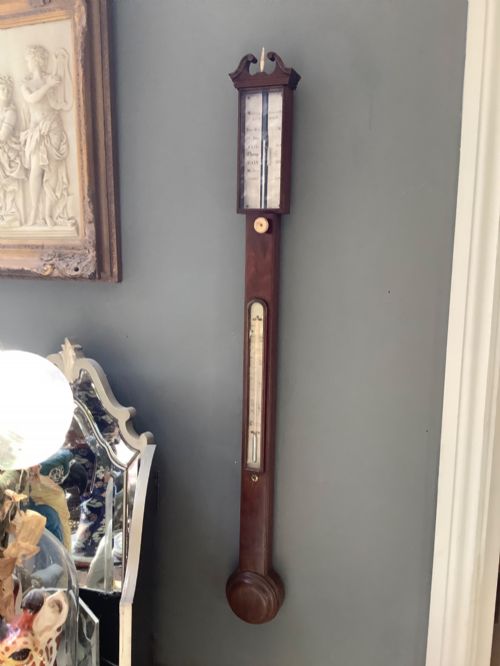


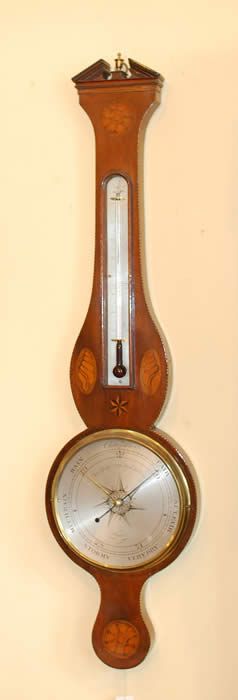


Regency Glass Thermometer
These Regency glass thermometers and weather instruments combine precision scientific capability with handsome cabinetmaking.
Regency Glass Thermometer
When you search for a regency glass thermometer, you encounter precision scientific instruments that double as domestic furnishings from the early nineteenth century. These domestic pieces appear primarily as stick barometers, wheel barometers, and thermoscopes dating from the Regency period, Georgian era, and the wider nineteenth century.
The versions most likely to meet you on this page are housed in mahogany cases, sometimes featuring flame mahogany veneers, alongside boxwood details. Makers such as Watkins & Hill, P. Caminada, and George Dollond signed these scientific works, anchoring them firmly in British provincial and London workshops of 1800 and the surrounding decades.
Materials and construction
Makers constructed the instrument bodies from dense timbers like mahogany and boxwood, shaping them into stick or wheel barometer housings. Flame mahogany veneer added decorative grain patterns to the front panels of wheel barometers.
Internal components relied on sensitive glass tubes paired with engraved silvered brass or silvered metal dials to display temperature and atmospheric changes clearly.
Makers walked miles to provincial towns like Chesham and King's Lynn, selling weather instruments door to door.
Assessing quality
Quality rests in the precision of the engraved silvered brass dials and the fineness of the cabinetwork on the mahogany cases. Signed instruments by known makers like George Dollond or Watkins & Hill demonstrate superior workshop provenance compared to unsigned examples.
The integrity of the timber housing and the preservation of the delicate glass and metal internal components dictate the standing of an instrument within its period.
The Regency Glass Thermometer Glossary
- Thermoscope
- An early scientific instrument for measuring temperature changes without a numerical scale. Boxwood examples represent this category.
- Stick barometer
- A tall, narrow wall instrument using a vertical glass tube filled with liquid to measure atmospheric pressure. Mahogany cases house these sensitive mechanisms.
- Wheel barometer
- A dial barometer where a float system turns a pointer on a circular face. These typically feature mahogany frames.
- Silvered brass
- A metal alloy treated with silver compounds to create a bright, legible surface for engraved numbers and scales. It forms the dial face of many barometers.
Regency Glass Thermometer: Frequently Asked Questions
How do these instruments work?
They use sealed glass tubes containing liquid to respond to shifts in temperature and barometric pressure. The movement translates directly onto engraved metal dials.
Changes in the atmosphere cause the liquid levels to rise or fall, registering local weather conditions in real time.
Where were they placed originally?
Owners hung them in entrance halls and parlours where guests could consult them. They served both a practical domestic purpose and a decorative role.
Their polished mahogany cases matched the fine furniture of the Georgian and Regency interior.
How do I date a piece?
Stylistic cues in the mahogany woodwork and the form of the barometer case provide initial clues to the period. The presence of maker signatures offers more precise chronology.
References to Georgian, Regency, and eighteen hundred indicate the prevailing design eras of these scientific objects.
Can I hang one on an outside wall?
These delicate nineteenth-century instruments belong strictly indoors. Exposure to outdoor weather damages the timber cases and silvered metal dials.
Stable indoor humidity preserves the glass tubes and traditional cabinetwork.