
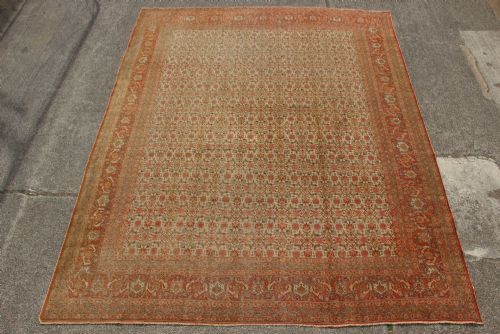
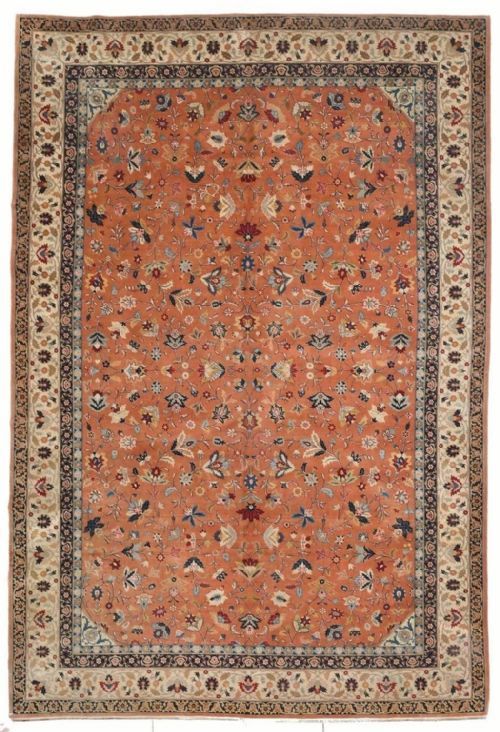
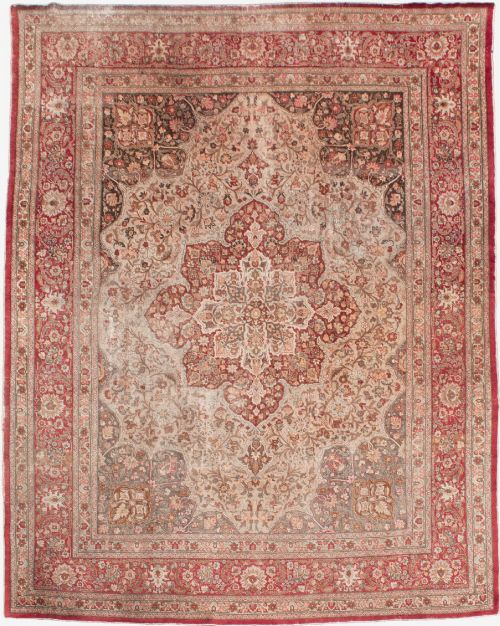


Vintage Persian Tabriz Rug
A vintage Persian Tabriz rug brings woven depth and traditional design into a room, offering durability through wool, cotton, and silk construction.
Vintage Persian Tabriz Rug
A vintage Persian Tabriz rug represents a long tradition of knotting from North-West Persia, spanning room sizes and smaller formats. Buyers examine these floor coverings for their room-scale proportions or more compact area rug dimensions.
The objects listed here include large carpets alongside smaller rugs, originating from periods reaching back through the nineteenth and early twentieth centuries. Traditional Persian styles and regional village designs define the visual output of this category.
What varies in quality
Quality rests in the precision of the weave and the handling of traditional floral motifs. Finer examples display tight knotting and clear execution of classic designs.
The choice of materials also divides the range, particularly where silk is introduced to articulate fine details within the composition.
Some carpets are so large they require an entire country house just to stretch their legs properly.
Benlian·Hajji Jalili
The Vintage Persian Tabriz Rug Glossary
- Tabriz
- A style of rug originating from the North-West Persian city known for traditional floral designs and medallion layouts. These pieces often incorporate wool and cotton.
- Herati design
- A repeating pattern featuring a central rosette enclosed by curved leaves, frequently seen across these woven surfaces. It forms a balanced, all-over field.
- Silk rug
- A textile woven with silk elements to achieve finer detail and a lustrous finish. Such pieces contrast with standard wool constructions.
- Roomsize carpet
- A larger format floor covering designed to anchor a major living space. Dimensions extend well beyond standard area rug sizes.
Vintage Persian Tabriz Rug: Frequently Asked Questions
Where were these rugs made?
These pieces originate from Tabriz in North-West Persia, a major historic centre for carpet production.
Weavers in the region followed traditional styles, producing both city carpets and regional village rugs.
What materials are used?
Construction relies primarily on wool and cotton, with occasional examples incorporating silk.
Wool forms the durable surface pile, while cotton typically serves for the underlying foundation threads.
How do I date a carpet?
Dating relies on stylistic markers, construction methods, and recorded production periods spanning the nineteenth and early twentieth centuries.
Specific design attributes help place pieces within eras such as the Qajar period or later decades.
Are these suitable for floors?
These textiles were built for domestic use, utilising sturdy wool piles that withstand regular foot traffic.
Placing an appropriate underlay beneath the carpet helps protect the cotton and wool foundation over time.