

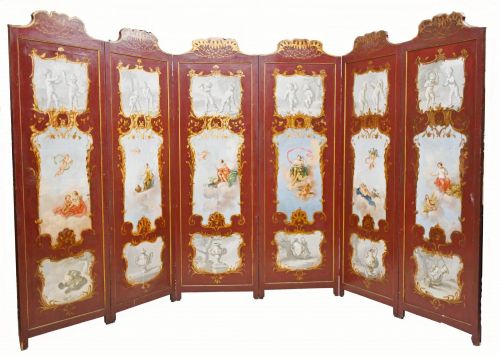
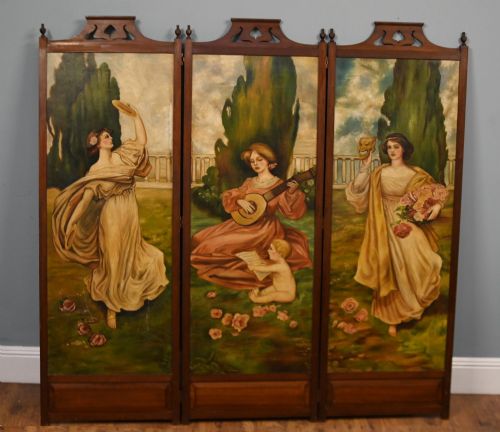
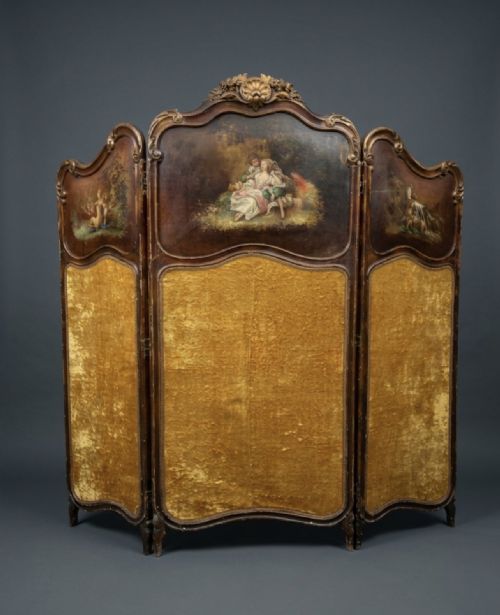

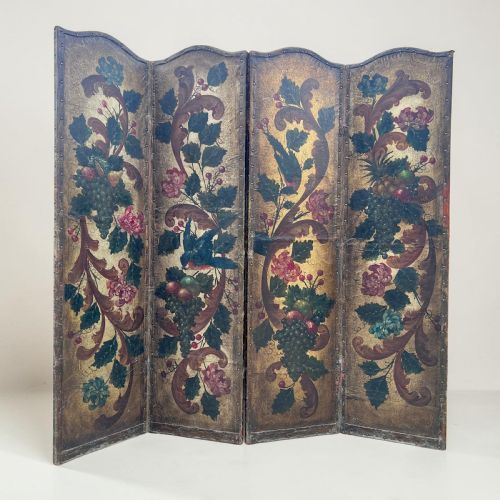


Vintage Painted Privacy Screen
A vintage painted privacy screen divides a room with hand-painted artistry, offering secluded corners and rich decorative presence.
Vintage Painted Privacy Screen
A vintage painted privacy screen brings divided space and artistic surface work together in domestic interiors. These folding panels serve as room dividers and modesty screens, shaping large rooms into intimate zones while displaying decorative scenes.
The versions most commonly met span from the late nineteenth century into the mid-twentieth century, drawing on diverse global traditions. French walnut and leather examples sit alongside Chinese lacquer, Japanese export pieces, Swedish country panels, and Indian fretwork.
Makers shaped these items as three, four, or six-fold structures hinged for easy positioning across a floor. The surface work remains the primary focus, executed in oil paint, lacquer, and hardstone mounts.
How they were made
Makers constructed the structural frames from solid timbers such as walnut and carved wood, ensuring stability across multiple hinged folds. Brass hinges allowed the panels to articulate smoothly in both directions.
Surfaces received extensive treatment in oil paint, lacquer, and applied hardstone to build up pictorial depth. Artisans combined woodwork, fretwork, and detailed brushwork to execute pastoral scenes and Chinoiserie motifs.
Vintage Painted Privacy Screen Retail Price Guide 2026
Typical asking prices for vintage painted privacy screen among the pieces listed under this phrase on Sellingantiques today, from the lower quarter to the upper quarter. They describe what is for sale here now, not the wider market.
Listings feature periods from the nineteenth century through the 1950s, utilising wood, brass, lacquer, paint, oil paint, hardstone, walnut, and carved wood.
What varies in quality
The precision of the painted detail and the handling of the narrative or pastoral scenes dictate the visual success of the piece. Finer examples display confident brushwork and harmonious colour palettes across every fold.
The structural integrity of the timber frame and the quality of the hinges determine how well the screen stands over time. Heavier materials like hardstone mounts and dense lacquer demand robust joinery to support the weight of the panels.
The Vintage Painted Privacy Screen Glossary
- Modesty screen
- A low folding screen originally designed to shield someone from draughts or direct view while seated or dressing. These items often feature painted panels.
- Chinoiserie
- European decorative art imitating Chinese artistic styles, frequently seen on lacquered and painted screens. This aesthetic dominated many export pieces.
- Hardstone
- Semi-precious stones such as jade or agate carved and applied in relief onto lacquer panels. They create tactile dimension on the surface.
- Fretwork
- Ornamental design created by cutting patterns through solid wood. This technique appears on Indian and regional folding screens.
- Lacquer
- A durable resin finish applied in multiple layers and polished to a smooth sheen. It forms the dark background for many Asian export screens.
Vintage Painted Privacy Screen: Frequently Asked Questions
How do I place a screen?
Position the screen angled across a corner or parallel to a wall to create a distinct functional zone. Ensure the hinges are set so the panels support each other safely.
Allow adequate clearance around the folding sections to prevent strain on the wood and painted surfaces during adjustment.
How do I clean the panels?
Dust the wood and painted surfaces gently with a dry, soft cloth on a regular basis. Avoid harsh chemical cleaners that can damage fragile lacquer or oil paint.
Keep the screen away from direct sunlight and strong heat sources to protect the pigments and prevent timber warping.
How do I date a screen?
Examine the timber species, hinge construction, and painting style to establish the period of manufacture. Victorian and Edwardian pieces often display specific revival motifs and traditional joinery.
Compare the materials, such as walnut frames or specific lacquer techniques, with documented examples from the same stylistic tradition.
Are these screens stable?
Multi-fold screens rely on the zig-zag arrangement of their panels to stand upright safely on a flat floor. Fully extended straight lines reduce stability and risk tipping.
Heavy materials like hardstone and thick lacquer require robust wooden frames and secure hinges to maintain balance across the structure.