
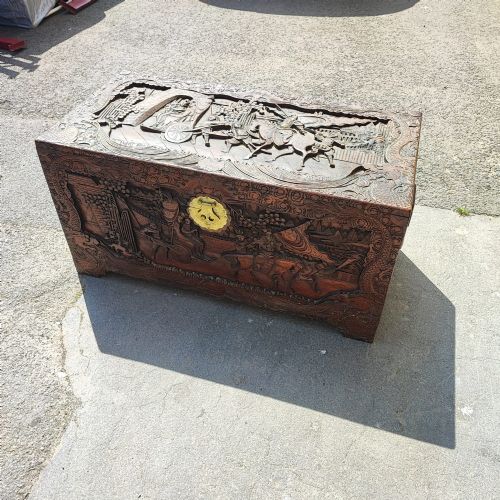


Vintage Oriental Wooden Trunk
A vintage oriental wooden trunk brings heavy camphorwood, brass hardware and carved panels into a room as durable storage.
Vintage Oriental Wooden Trunk
A vintage oriental wooden trunk is typically encountered as a camphorwood, teak, or hardwood storage chest, blanket box, or luggage piece dating from the nineteenth century through the 1930s. The listings on this page show items spanning periods from the Victorian and Edwardian eras up to the 1930s, encompassing styles such as Chinese Export, Anglo-Indian, Zanzibar, Japanese Meiji, and Victorian Campaign.
Buyers seeking a vintage oriental wooden trunk will find forms ranging from plain brass-bound camphor chests to heavily carved boxes and specialised regional pieces like Tansu chests. The materials recorded across these objects include camphor wood, hardwood, teak, rosewood, brass, iron, bone, and lacquer.
Such trunks function practically as storage chests and blanket boxes, while certain examples double as occasional tables. The geographical origins span China, India, East Africa, and Japan, reflecting trade routes and colonial influences of the period.
Materials and construction
These trunks rely heavily on aromatic timbers such as camphorwood and dense tropical hardwoods like teak and rosewood, chosen for their resilience and durability. Joinery is paired with structural metalwork, utilising brass hardware, corner straps, and binding irons to reinforce the corners and edges for travel.
Surface decoration involves hand carving, painted finishes, lacquer work, and occasionally bone inlay. Carved panels frequently depict traditional foliage or figural motifs, while brass-bound constructions employ stud work and lock plates secured directly into the timber.
Materials documented across these pieces include camphor wood, teak, rosewood, brass, iron, bone, and lacquer.
Judging the work
Quality in these trunks is evident in the depth and sharpness of the hand carving on the wood and the substance of the metal mounts. Pieces with intact, original brass hardware and substantial timber thickness stand apart from later or simpler utility boxes.
The choice of primary wood also dictates standard, with fragrant camphorwood and dense East African teak commanding attention for their grain and stability. Finer execution shows in tight joinery, unwarped lids, and well-fitted internal trays or compartments.
The Vintage Oriental Wooden Trunk Glossary
- Camphorwood
- A durable, aromatic timber commonly used for storage trunks because its natural scent deters insects. It forms the primary material for the majority of these chests.
- Zanzibar Chest
- A distinctive regional trunk originating from East Africa and trading ports, characterised by heavy brass studding, strapwork, and often constructed from teak or rosewood.
- Tansu
- A traditional Japanese mobile storage chest built from wood with iron hardware, designed for domestic organisation rather than maritime travel.
- Brass-Bound
- A method of reinforcing trunk edges, corners, and lids with strips and brackets of brass to withstand the rigours of transit.
- Chinese Export
- Items produced in China specifically for Western markets during the nineteenth and early twentieth centuries, blending local craftsmanship with European tastes.
Vintage Oriental Wooden Trunk: Frequently Asked Questions
What were vintage oriental wooden trunks used for originally?
These trunks served primarily as luggage chests and blanket boxes for travellers and merchants navigating maritime trade routes during the nineteenth and early twentieth centuries. Their dense timber construction protected contents from moisture and insects during long voyages.
Over time, many transitioned into domestic storage pieces housed in bedrooms and living spaces. Their sturdy flat lids also allowed them to function as occasional tables or surface display areas within colonial and Victorian homes.
How do I care for a camphorwood chest?
Camphorwood benefits from being kept away from direct heat sources and strong sunlight, which can dry out the natural oils and warp the timber. Dusting with a dry or slightly damp cloth maintains the surface without introducing excess moisture.
Because the wood is naturally aromatic, avoid applying synthetic polishes or heavy oils that interfere with the grain. Allowing the interior to air out periodically preserves the characteristic scent of the wood.
How do I tell a Zanzibar chest from a Chinese camphor trunk?
Zanzibar chests are defined by dense brass studding, geometric strapwork, and heavy corner brackets applied to teak or rosewood bodies. They reflect East African coastal trade influences and structural traditions.
Chinese camphor trunks rely more on carved figural or floral panels, recessed brass lock plates, and lighter framing. The timber itself is visibly paler and carries the distinct camphor aroma absent in tropical hardwoods.
Can I use these trunks as coffee tables?
Their flat, sturdy tops and substantial dimensions make these chests suitable for placement in front of seating as a low table. They provide concealed storage for blankets and books while serving a dual purpose in the room.
When positioning a trunk this way, ensure the hinges and lid supports remain stable so the surface bears weight safely. Placing protective felt pads underneath items placed on the brass hardware prevents scratching.