


Vintage Mechanical Music Box
These vintage mechanical music box examples bring together intricate brass movements and wooden cases to fill a room with precise, historic melodies.

Vintage Mechanical Music Box
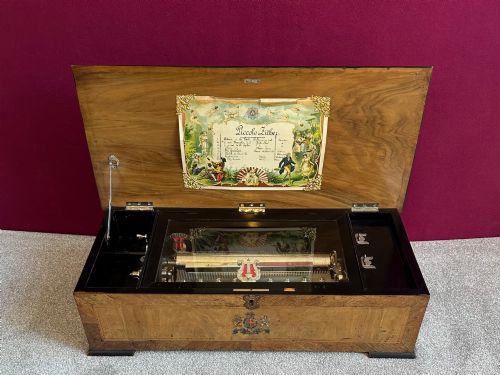
A vintage mechanical music box encompasses traditional cylinder models alongside disc-playing polyphons and intricate automaton bird boxes. These objects originate predominantly from Swiss and German makers spanning the Victorian era into the mid-twentieth century.
Buyers will most frequently encounter nineteenth-century Swiss cylinder boxes housed in rosewood or walnut, often featuring multiple airs and sometimes bells. Alongside these are specialised table-top gramophones, singing bird boxes, and disc players originating from later periods.
Materials and construction
Cases rely on hardwoods such as walnut, rosewood, and ebonised wood, frequently decorated with marquetry inlay or fitted with glass panels to reveal the action. Internal components combine precision-turned brass combs and steel cylinders or metal discs that translate mechanical rotation into layered sound.
Specialised pieces incorporate sterling silver, enamel, and feathered automata mechanisms to recreate lifelike bird song inside small metal enclosures.
Listings feature Victorian, Edwardian, and mid-century eras, utilising materials such as brass, steel, sterling silver, rosewood, and walnut.
Distinctions in craftsmanship
Quality rests upon the acoustic clarity of the comb and the complexity of the arrangement, such as multi-air cylinders, visible bells, or interchangeable discs. Master workshops produced robust gear trains and finely tuned pins that sustain pitch and rhythm over extended playing times.
Cabinetry execution further separates standard items from exceptional pieces, visible in the precision of the marquetry inlay, the weight of the timber case, and the integration of protective glass lids.
Karl Griesbaum·Langdorff And Fils·Lochmanns·B A Bremond·Nicole Freres·LeCoultre
The Vintage Mechanical Music Box Glossary
- Cylinder
- The rotating brass cylinder pinned with small staples that pluck the tuned teeth of the metal comb to produce music. This is the primary sound-generating mechanism in traditional Swiss boxes.
- Air
- A distinct tune or musical piece that the mechanical box is pinned to play during one full rotation of the cylinder or sequence. Multi-air boxes cycle through several melodies in turn.
- Comb
- The flat piece of tuned steel with multiple teeth that vibrate when struck by the pins on a rotating cylinder. Each tooth corresponds to a specific musical note.
- Polyphon
- A brand of disc-playing music box that uses interchangeable stamped metal discs rather than pinned cylinders to produce sound. These large instruments often feature dual combs for richer orchestration.
- Automaton
- A mechanical figure or device designed to perform a set of movements, such as a singing bird moving its beak and wings inside a decorated metal cage or box.
Vintage Mechanical Music Box: Frequently Asked Questions
How do cylinder music boxes work?
A hand-wound spring powers a gear train that turns a pinned brass cylinder at a regulated speed. The tiny pins strike specific teeth on a steel comb to generate harmonious notes.
Changing the air involves shifting the cylinder horizontally so a new set of pins engages with the comb teeth.
What is the difference between cylinders and discs?
Cylinder boxes play a fixed repertoire of tunes pinned permanently onto the brass barrel during manufacture. They represent traditional nineteenth-century craftsmanship.
Disc players like polyphons allow the owner to swap flat metal sheets in and out, changing the musical selection easily.
How should I care for a mechanical music box?
Keep the instrument away from direct sunlight, extreme temperature shifts, and high humidity to protect the wooden veneers and delicate internal steel components. Wind the movement gently and avoid forcing the mechanism if resistance occurs.
Allow specialist technicians to handle internal repairs or lubrication rather than attempting adjustments yourself.
How do I identify the period of a box?
Examine the timber case style, typography on tune sheets, and construction methods of the brass movement. Victorian pieces often display detailed rosewood inlay and handwritten song lists.
Later twentieth-century examples frequently shift towards plain walnut, synchronous electric players, or German metal casing.