
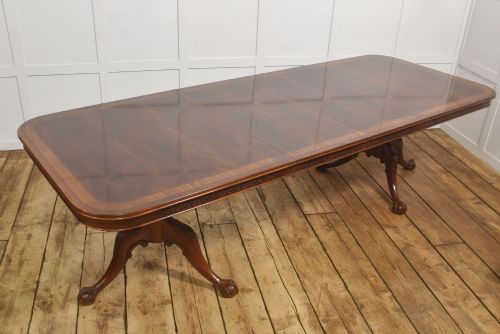
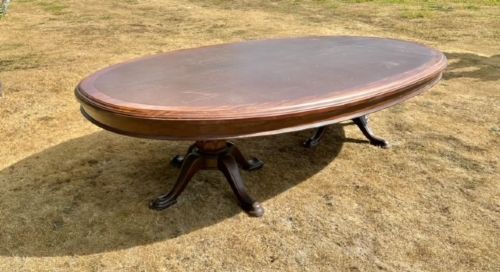
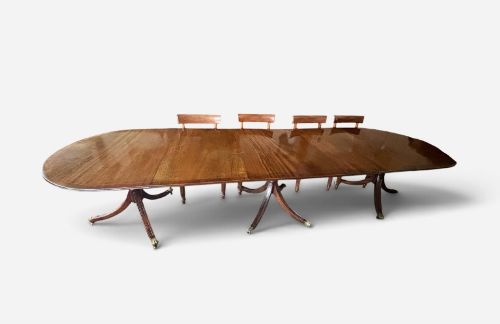
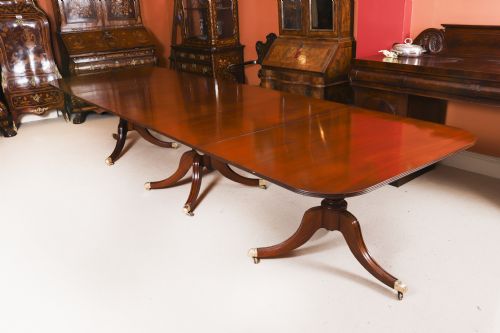


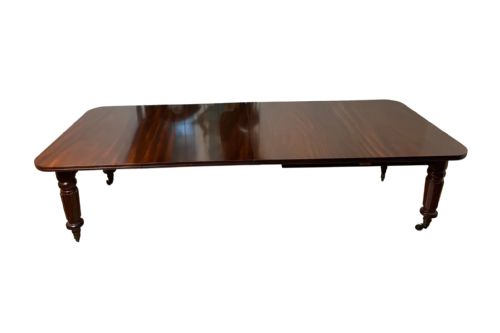

Vintage Mahogany Boardroom Table
A vintage mahogany boardroom table is a substantial timber piece built for formal meetings, offering grand scale and rich grain.
Vintage Mahogany Boardroom Table
A vintage mahogany boardroom table provides the grand scale and enduring presence needed for large gatherings, drawing on centuries of cabinet-making traditions. When you search for a vintage mahogany boardroom table, you encounter substantial timber furniture originating from the Georgian, Regency, William IV, Victorian, and Edwardian periods.
The examples gathered here span large dining tables, extending formats, and triple pillar designs adapted for collaborative spaces. These pieces combine functional size with rich timber surfaces, often incorporating clever leaf mechanisms to alter their length.
Most entries reflect revival movements like the Chippendale Revival and Regency Revival, alongside authentic 19th-century workshop output. Such tables anchor a room through sheer physical mass and dark, polished grain.
How they were made
Cabinet makers built these tables using solid mahogany and figured timber veneers, frequently accented with satinwood inlay. The underlying construction relies on heavy timber frames designed to support multiple extension leaves without sagging.
Metal components typically consist of brass castors and fittings, allowing heavy pillar tables to move smoothly across floors. Leather inserts occasionally appear on specialised surfaces, while glass and brass clock elements accompany related boardroom items.
Several tables here are so long they require a small committee just to decide which end passes the salt.
What varies in quality
Quality rests in the selection of the mahogany timber, with figured grain and plum pudding variations commanding greater visual depth. The finesse of the carving on pillar supports and table edges distinguishes standard workshop output from finer cabinet work.
The precision of extending mechanisms and the stability of pillar junctions determine how well a large table functions in daily use. Period integrity, from original brass castors to authentic timber patination, sets finer examples apart from later revivals.
Whytock and Reid·Thomas Treherne·Gillows
The Vintage Mahogany Boardroom Table Glossary
- Mahogany
- A durable tropical hardwood prized for its deep reddish-brown colour and smooth finishing qualities. It forms the primary structural and visual basis for these tables.
- Regency
- An English design period spanning the early 19th century, known for classical restraint and architectural lines. Pieces from this era often feature pillar and claw supports.
- Extending table
- A table designed with internal runners and removable leaves to accommodate varying numbers of diners or guests. This mechanism allows a large format to adapt to different room sizes.
- Pillar and claw
- A pedestal base consisting of a central wooden column supported by branching legs, frequently terminating in brass castors. This design frees up legroom around the perimeter of the table.
Vintage Mahogany Boardroom Table: Frequently Asked Questions
How many people do these tables seat?
Many of these pieces accommodate twelve or more guests, aided by extension leaves and long pillar designs.
Their substantial length makes them well-suited for large dining rooms and professional meeting spaces alike.
What is plum pudding mahogany?
It is a distinct grain variation featuring small, mottled circular markings that resemble the fruit in a pudding.
This unusual figure occurs naturally in the timber and is prized by collectors for its decorative impact.
How do I care for the timber surface?
Maintain the mahogany by keeping it away from direct heat sources and applying appropriate beeswax polishes periodically.
Avoid excessive moisture to protect the polished finish and the underlying wood veneers.
How are extension leaves stored?
Extension leaves generally operate via wooden runners built into the main frame of the table.
Additional leaves are often stored separately when not in use to reduce the table length for everyday settings.