

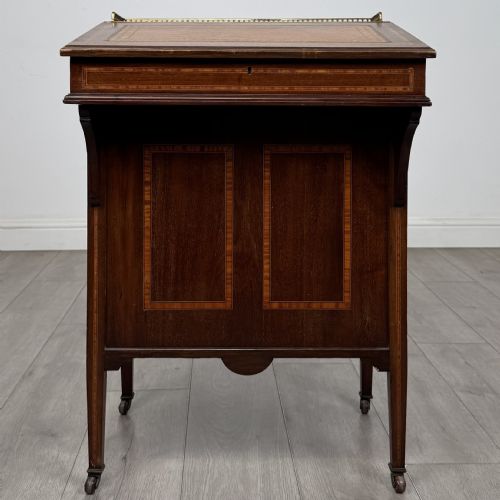


Vintage Leather Davenport
A vintage leather davenport is a compact writing desk offering sloping leather surfaces and hidden drawers, combining practical workspace with striking timber craftsmanship.
Vintage Leather Davenport
When searching for a vintage leather davenport, you encounter writing desks principally from the Victorian and Edwardian eras alongside nineteenth-century examples. These pieces typically feature a sloping writing surface lined with leather, set above a pedestal base containing drawers.
The selection includes specific forms such as mahogany and rosewood davenports, often designated as writing desks. Makers like Gillows and Hampton & Sons appear among the broader mix of nineteenth-century craftsmanship on offer.
Design variations span Early Victorian, William IV, and Regency styles, alongside Edwardian inlaid pieces. Walnut and oak iterations also appear, occasionally featuring burr maple linings and brass handles.
Materials and construction methods
Construction relies heavily on dense hardwoods such as mahogany, rosewood, and walnut, providing a sturdy carcase for daily use. Satinwood inlay and burr maple linings demonstrate decorative carpentry techniques applied to secondary and interior surfaces.
Leather forms the inset writing surface on the sloping desk lids, while brass handles and hardware provide functional closure and lifting points for the drawers.
Vintage Leather Davenport Retail Price Guide 2026
Typical asking prices for vintage leather davenport among the pieces listed under this phrase on Sellingantiques today, from the lower quarter to the upper quarter. They describe what is for sale here now, not the wider market.
Some nineteenth-century writing desks conceal burr maple interiors behind sturdy exterior timber.
Judging the standard of execution
Quality separates through the choice of timber figure, such as richly grained rosewood or finely figured mahogany, and the precision of satinwood inlay. The integration of secondary woods like burr maple inside the drawers indicates superior workshop standards.
Cabinetmaking distinction shows in the tight tolerances of moving parts, the weight of cast brass handles, and the hand-dyed quality of the leather writing inserts.
Gillows·Hampton & Sons of Pall Mall
The Vintage Leather Davenport Glossary
- Davenport
- A compact pedestal desk featuring a sloping, leather-lined writing lid and a bank of side drawers. This form originated in the late eighteenth century and remained popular through the Victorian period.
- Inlay
- A decorative technique where contrasting woods, such as satinwood, are inserted into recesses in the primary timber. This method creates geometric or floral patterns across the surface.
- Pedestal base
- The supporting structure beneath the desk top, housing a series of functional drawers. It provides stability and enclosed storage.
- Rosewood
- A dense, heavily figured dark timber used in fine nineteenth-century cabinetmaking. Its distinct grain patterns make it desirable for formal writing furniture.
- Secondary wood
- The internal timber used for drawer linings and carcase backs, such as burr maple. Its quality often reflects the overall standard of the piece.
Vintage Leather Davenport: Frequently Asked Questions
What is a davenport desk?
A davenport is a small writing desk with a sloping leather-topped lid that lifts for storage. Beneath the writing slope sits a pedestal base containing a set of functional drawers.
These pieces were designed for domestic use in drawing rooms or boudoirs, offering a dedicated writing surface that took up minimal floor space.
How do I date a davenport?
Dating relies on stylistic markers from periods like the Regency, William IV, Victorian, and Edwardian eras. Mahogany and rosewood construction with brass hardware typically points to the nineteenth century.
Later Edwardian examples often incorporate lighter satinwood inlay work. Examining the secondary timbers inside the drawers also helps confirm the period of manufacture.
What woods were used?
Cabinetmakers utilised dense hardwoods including mahogany, rosewood, walnut, and oak for the main structure. Decorative elements frequently involved satinwood inlay and burr maple for interior drawer linings.
These materials were chosen for their durability and polished appearance, reflecting the aesthetic preferences of nineteenth-century workshops.
Are these desks practical for daily use?
The sloping leather writing surface provides a comfortable angle for correspondence and contemporary desk tasks. Built-in pedestal drawers offer practical enclosed storage for stationery and small items.
Their compact footprint allows them to fit easily into smaller rooms while retaining traditional workspace utility.