


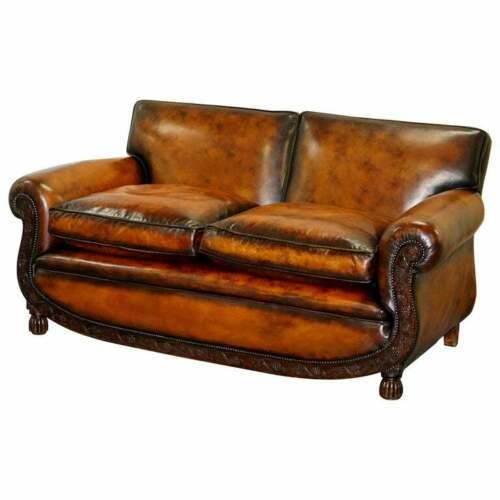


Hand Dyed Leather Couch
A hand dyed leather couch brings rich colour and deep comfort to a room, drawing on decades of traditional British seating craft.
Hand Dyed Leather Couch
A hand dyed leather couch centres on classic seating forms from the nineteenth and early twentieth centuries, notably the traditional Chesterfield and the wing back sofa. These pieces span the Victorian, Edwardian and 1930s periods, offering generous proportions and deep buttoning.
The collection showcases substantial seating options, ranging from standard two-seater and club sofas to expansive four-seater knoll drop arm designs and large serpentine fronted models. Makers such as Hampton & Sons of Pall Mall represent the historical output found within these traditional English country house styles.
Buyers encounter surfaces finished in various tones, from rich whiskey and brown shades to distinctive amethyst leather, often applied during restoration work or bespoke commissions using raw hides. Each variation reflects the enduring appeal of heavy timber frames paired with patinated hide.
Construction and materials
Traditional frames utilise sturdy hardwoods such as mahogany and general timber to build a robust skeletal structure capable of supporting heavy daily use. Metal components like brass often appear in detailing and structural hardware.
Internal padding relies on traditional stuffing methods, including horsehair gilling and fully loose coil springing, which provide firm support and resilience. Hides are finished with hand-applied dyes to achieve deep colour saturation across the leather surface.
Hand Dyed Leather Couch Retail Price Guide 2026
Typical asking prices for hand dyed leather couch among the pieces listed under this phrase on Sellingantiques today, from the lower quarter to the upper quarter. They describe what is for sale here now, not the wider market.
Markers of quality
Quality rests upon the integrity of the underlying hardwood frame and the depth of the timber work, particularly evident in hand carved floral details on Victorian models. Superior construction involves meticulous joinery that maintains rigidity across larger frames like four-seater drop arm sofas.
The standard of upholstery work dictates the longevity and comfort of the piece, distinguished by the precision of tufting and the density of internal horsehair and coil padding. Leather treatment also separates standard examples from finer pieces, where hand dyeing creates nuanced colour variation and supple texture.
Hampton & Sons of Pall Mall
The Hand Dyed Leather Couch Glossary
- Chesterfield
- A traditional style of sofa characterised by rolled arms and a back of the same height, typically featuring deep button tufting. This form remains a staple of English seating design.
- Knoll drop arm
- A sofa design incorporating adjustable or folding arms held by wooden mechanisms or straps. This allows the seating area to transform into a daybed or day lounge.
- Horsehair gilling
- A traditional upholstery filling material derived from animal hair used to stuff and shape seat cushions and backs. It provides firm, breathable support.
- Serpentine front
- A curved front rail on a sofa or cabinet that undulates with a convex centre flanked by concave curves. This shaping adds architectural movement to the piece.
- Raw leather
- Untreated hide prepared for custom dyeing and finishing rather than arriving pre-finished from the tannery. This allows bespoke colour matching to specific interior palettes.
Hand Dyed Leather Couch: Frequently Asked Questions
How do I care for a hand dyed leather couch?
Keep the leather nourished with specialist balms and protect the hide from direct sunlight to preserve the depth of the hand applied dye.
Regular dusting with a soft cloth prevents dirt accumulation in the button tufts and creases of the upholstery.
What periods do these sofas come from?
The available pieces span the Victorian and Edwardian eras through to the 1930s, reflecting traditional English craftsmanship.
Earlier nineteenth-century examples often feature heavier timber frames and detailed hand carving on the exposed woodwork.
Are these sofas suitable for daily use?
Traditional construction methods using hardwood frames and coil springing ensure these large seating pieces withstand everyday wear.
Natural leather develops a softer patina over time, improving the character of the hide with regular use.
How can I tell a Victorian sofa apart?
Victorian examples frequently display denser wood framing, such as mahogany, alongside intricate hand carved floral motifs on the wooden trim.
Proportions tend to be deep and substantial, often incorporating serpentine front rails and traditional button tufting.