
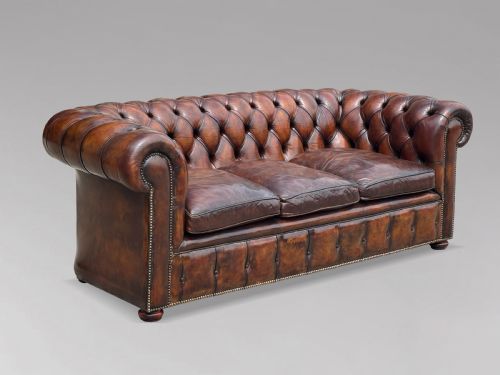


Brass Studded Leather Couch
A brass studded leather couch brings deep-buttoned character to a room, offering the heavy presence of nineteenth-century seating.
Brass Studded Leather Couch
A brass studded leather couch sits firmly in the tradition of heavy seating, most commonly seen here as traditional Chesterfields or settees originating from the Victorian period down to the nineteen-thirties. These pieces typically take the form of deep-buttoned three-seater sofas, two-seat button back sofas, or highback settees framed in mahogany and other hardwoods. A buyer searching for a brass studded leather couch will encounter examples featuring distinctive details such as drop arms, moustache backs, or wing backs.
The materials and styles span from Regency and George II style frames to nineteen-thirties club sofas. Alongside standard browns and reds, pieces appear in unusual shades including hand-dyed amethyst leather. The construction relies on traditional frames built from timber, hardwood, and metal, finished with the characteristic brass studding along the borders.
Materials and construction
Construction centres on a sturdy internal frame built from timber, mahogany, and other hardwoods, providing the necessary weight and structure for deep seating. The frames support traditional stuffing methods, with individual listings recording horsehair gilling and fully loose coil adoring to achieve the characteristic firmness and resilience.
Upholstery relies on high-grade leather, often hand-dyed in various shades of brown or red, secured and outlined with individual brass studs driven by hand along the seams and scrollwork. Wooden elements include carved frames in styles ranging from Regency to George II, combining structural timber with supple animal hide.
Listings span from the Regency era through Victorian and Edwardian periods up to nineteen-thirty, using leather, hardwood, mahogany, and brass.
Distinctions in quality
Quality rests upon the integrity of the underlying hardwood frame and the authenticity of the period construction methods, such as original coil springs and horsehair stuffing. Pieces that retain their structural soundness without heavy modern intervention sit at a different level from those requiring extensive rebuilding.
The finish of the leather and the execution of the brass stud work dictate the visual success of the piece. Hand-dyed hides with depth of colour and carefully applied metalwork distinguish superior examples from standard commercial upholstery.
Howard & Sons
The Brass Studded Leather Couch Glossary
- Chesterfield
- A traditional style of sofa characterised by deep buttoning, rolled arms of the same height as the back, and leather upholstery. This form remains the dominant shape found among these listings.
- Moustache back
- A decorative curving shape along the top rail of a sofa resembling nineteenth-century facial hair. This stylistic flourish appears on specific club-style seating.
- Knoll drop arm
- A sofa mechanism allowing one or both arms to be lowered or adjusted via wooden or metal ratchets. This practical addition provides versatility in lounging.
- Horsehair gilling
- A traditional stuffing material utilised beneath the leather upholstery to create firm and durable padding. It offers structural support distinct from modern foam fillings.
- George II style
- An architectural furniture style revived in later periods, featuring robust proportions and carved wooden details. Pieces in this style often incorporate heavy frames and dark timber.
Brass Studded Leather Couch: Frequently Asked Questions
What is a brass studded leather couch?
A brass studded leather couch is a heavy upholstered seating piece, typically a Chesterfield or settee, defined by leather hides secured with metal stud work. These items draw on nineteenth and early twentieth-century British designs.
They utilise hardwood frames and traditional fillings such as horsehair, providing a substantial centrepiece for a study or drawing room.
How do I care for antique leather?
Antique leather requires regular conditioning to prevent the hide from drying out and cracking over time. Keeping the material away from direct sunlight and heat sources preserves the hand-dyed finish.
Gentle cleaning with appropriate balms maintains the suppleness of the leather without disturbing the original patina or the surrounding brass studs.
How old is a Victorian Chesterfield?
A Victorian Chesterfield dates from the reign of Queen Victoria, spanning the mid-nineteenth century up to nineteen-01. These pieces are identified by their robust timber frames and traditional button-backed upholstery.
Later variations extend into the nineteen-twenties and nineteen-thirties, retaining similar deep-buttoned forms while introducing different dye colours and frame treatments.