

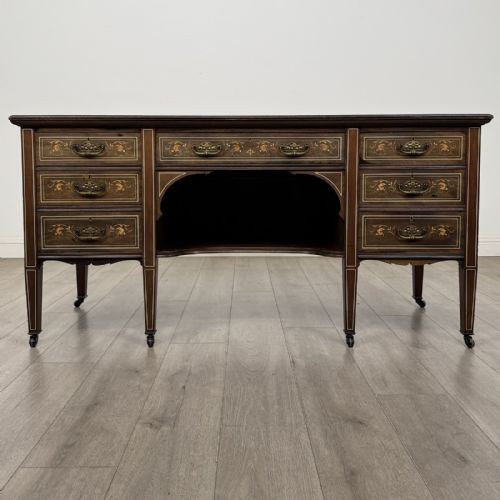
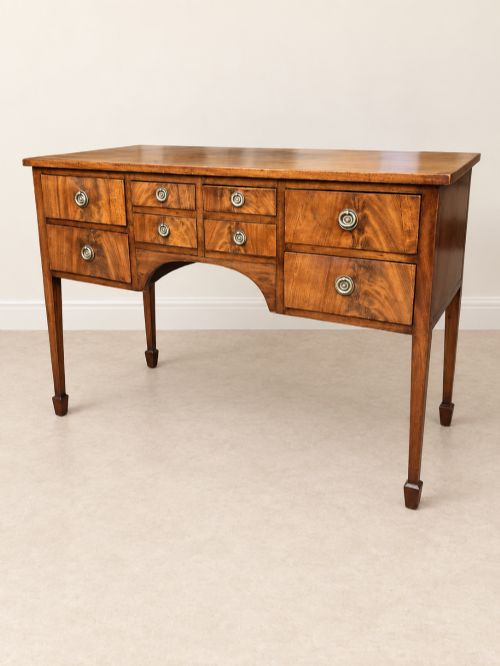
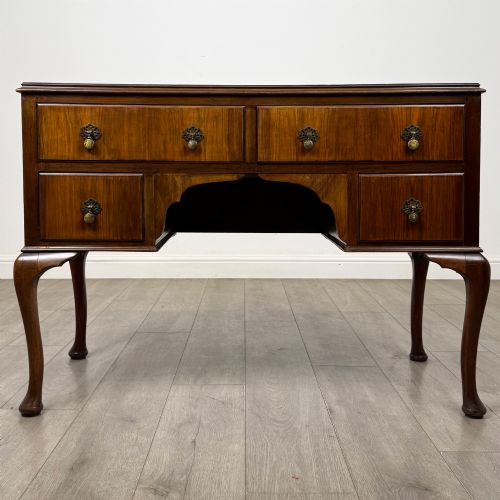
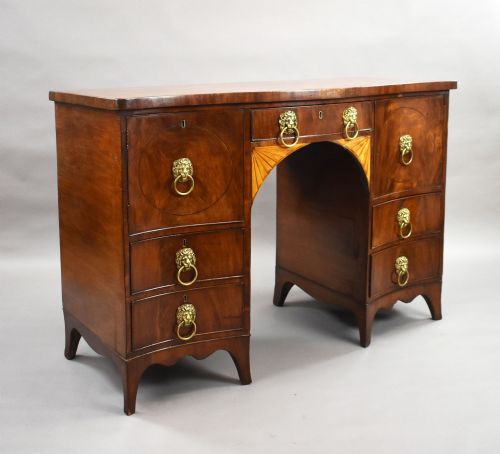
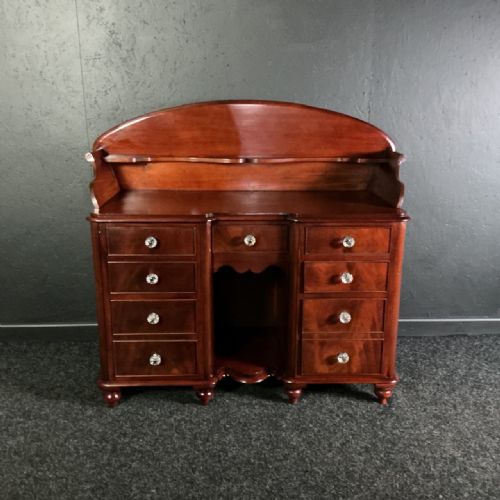


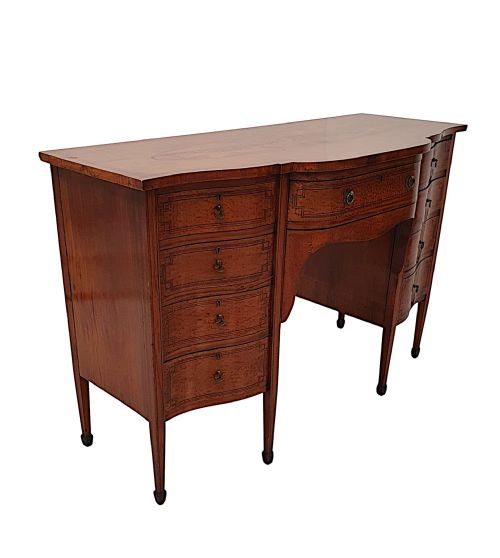

Vintage Kneehole Sideboard
These vintage kneehole sideboard pieces bring practical storage and classic form into a room, offering the proportion and timber that serious buyers seek.
Vintage Kneehole Sideboard
A vintage kneehole sideboard combines the enclosed storage of a traditional dining room sideboard with the central recess of a desk. When you search for a vintage kneehole sideboard, you encounter forms that span the Georgian, Regency, Victorian, and Edwardian periods.
The inventory demonstrates that these pieces often overlap in function and description with writing tables, kneehole desks, and dressing tables. Examples range from compact mahogany bow fronts to larger inlaid serpentine forms and painted country dressers.
Makers and workshops across the eighteenth, nineteenth, and early twentieth centuries adapted the central recess for writing or seating. Buyers meet both formal mahogany designs and lighter satinwood or painted pine variations on this page.
How They Were Made
Cabinetmakers constructed these pieces primarily using solid mahogany, walnut, and satinwood, often enhanced by flame mahogany veneers and boxwood stringing. Secondary timbers such as pine appear in country pieces and drawer linings.
Drawer construction relies on hand-cut dovetailing, while decorative surfaces utilise matched veneer grains and fine inlay work. Brass hardware, including drop handles and backplates, secures the drawers and doors across Georgian and later revival examples.
Vintage Kneehole Sideboard Retail Price Guide 2026
Typical asking prices for vintage kneehole sideboard among the pieces listed under this phrase on Sellingantiques today, from the lower quarter to the upper quarter. They describe what is for sale here now, not the wider market.
A painted pine dog kennel dresser sits quietly among the formal mahogany, proving that utility and canine comfort once shared the same drawer.
What Varies in Quality
Quality rests upon the selection and matching of timber veneers, particularly on curved serpentine and bow fronts where grain direction demands precision. Superior pieces display continuous figure across drawer fronts and crisp execution of inlaid boxwood lines.
The structural integrity of the central kneehole recess and the original condition of brass furniture indicate the workshop standards behind the piece. Refined carving, well-fitted drawers, and intact period hardware separate standard production from finer cabinet work.
Étienne Kohlmann·John Gregory London
The Vintage Kneehole Sideboard Glossary
- Kneehole
- A central recessed space beneath a desk or sideboard designed to accommodate the legs of a seated person. This architectural feature defines the form and often conceals a small drawer above.
- Serpentine
- A curved furniture front characterised by a convex centre flanked by two concave ends. This contour requires advanced woodworking skill to shape and veneer.
- Bow front
- A convex curved front that projects outward in a smooth arc. It gained popularity during the Georgian period and softens the corners of a room.
- Stringing
- Thin inlay lines of contrasting wood, such as boxwood, set flush into the surface of a panel or drawer front. It creates a refined border and highlights the primary timber.
- Secretaire
- A cabinet or sideboard incorporating a pull-down writing drawer fitted with small compartments and pigeonholes. It merges storage with a writing surface.
Vintage Kneehole Sideboard: Frequently Asked Questions
How were kneehole sideboards used?
These pieces served multiple domestic functions depending on their room of origin and internal fittings. They provided surface space for serving food or writing letters while offering concealed drawer storage.
In domestic settings, the central kneehole allowed a person to sit comfortably while writing or attending to personal administration.
How do I identify a Georgian piece?
Georgian pieces rely on solid timber construction, hand-cut dovetails, and restrained proportions. The timber choice is typically dense mahogany with minimal, precise inlay.
Hardware on these earlier pieces consists of cast brass handles secured with handmade nuts. Secondary woods inside drawers are usually oak or pine.
Where does satinwood appear?
Satinwood appears principally on pieces from the Edwardian period and later revivals. It provides a pale, lustrous golden surface used for veneers and crossbanding.
Cabinetmakers often paired satinwood with darker inlay lines to create high-contrast decorative panels.