
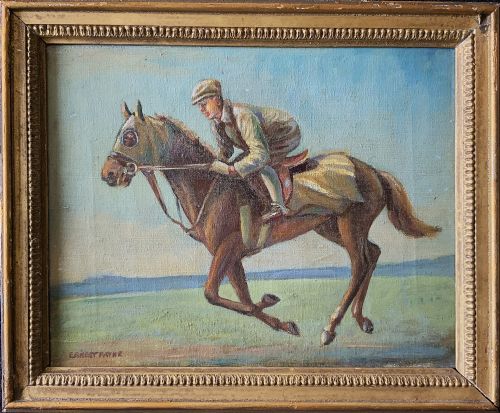


Vintage Jockey Portrait
A vintage jockey portrait captures the thrilling world of nineteenth and twentieth century horse racing through oil paintings and framed prints.
Vintage Jockey Portrait
A vintage jockey portrait focuses on the celebrated racehorses and riders of the nineteenth and twentieth centuries, capturing a distinct sporting heritage. When searching for a vintage jockey portrait, collectors encounter works ranging from detailed oil paintings on canvas to framed antique prints.
The pieces available on this page reflect Victorian equestrian traditions alongside Edwardian sporting art. Subjects include named thoroughbreds with their jockeys up, documented races, and historical studies by notable painters.
How they were made
These works primarily utilise oil paint on canvas or paper, capturing the texture of racing silks and the musculature of thoroughbred horses. Many examples retain their original wooden frames, including gilded wood and giltwood surrounds that complement the traditional equestrian subject matter.
Print techniques are also represented alongside original oils, offering detailed depictions through antique print formats mounted under glass.
Several portraits carefully record the specific colours of Lord Glanely and other historic racing patrons.
What varies in quality
The historical documentation adds value, particularly when the horse, jockey, race, and owner are explicitly identified by contemporary inscriptions or archival records.
Ernest Payne·Alfred Wheeler·Isaac Cullin·Snaffles·Frank Giggs
The Vintage Jockey Portrait Glossary
- Equestrian Realism
- An artistic style focused on the accurate depiction of horses, riders, and racing scenes without romantic exaggeration. This approach defines many Victorian sporting works.
- Jockey Up
- A term indicating that the rider is mounted on the horse ready for the race. It frequently appears in titles denoting the specific partnership of horse and rider.
- Giltwood
- Wood carved and covered with a thin layer of gold leaf or gold paint. This material forms the traditional framing for many nineteenth-century oil paintings.
- Sporting Art
- Artwork dedicated to the depiction of sports, animals, and field pursuits. This category encompasses horse racing portraits, steeplechase scenes, and equine studies.
Vintage Jockey Portrait: Frequently Asked Questions
What periods do these portraits come from?
The pieces span the nineteenth and early twentieth centuries, encompassing Victorian and Edwardian eras. This timeframe covers the height of British sporting art production.
Dated works in the collection range from the eighteen-eighties through to nineteen-thirty, reflecting shifting artistic approaches to equestrian subjects.
Are these works original paintings or prints?
The selection includes both original oil paintings on canvas and framed antique prints. Each medium offers a distinct visual record of historic racing figures.
Oil paintings provide textured brushwork by named artists, whilst prints offer accessible historical documentation of famous racehorses and their riders.
How do I identify the jockey or horse in a portrait?
Many portraits include contemporary inscriptions on the canvas, mount, or frame detailing the names of the horse, jockey, and owner. Specific races and courses are often noted.
Artists frequently recorded famous partnerships, such as specific Derby winners or royal thoroughbreds, allowing for straightforward historical identification.
What framing is typical for these portraits?
Traditional frames include wood, gilded wood, and giltwood mouldings designed to complement nineteenth-century fine art. Many pieces retain their period frames under glass where appropriate for prints.
The framing style generally matches the era of the artwork, helping to preserve the painting or print.