


Vintage Indian Mirror
These vintage indian mirror pieces bring rich hand-carved woodwork and intricate inlay into any room, offering a distinctive focal point for modern interiors.
Vintage Indian Mirror
When you search for vintage indian mirror, you find a collection spanning wall mirrors, dressing mirrors, and wall sconces created in various regional traditions. The pieces range from North Indian items to specific Hoshiarpur works originating across the nineteenth and early twentieth centuries, alongside Regency and Victorian examples influenced by cross-cultural exchange.
The most common forms on this page are wall mirrors and mirror frames, often featuring carved wooden surrounds or paired sconce formats. Makers utilised dense timbers and fitted them with glass and mirror glass plates, creating functional objects that doubled as decorative wall art.
Origins vary between Anglo-Indian commissions made for British expatriates and traditional regional items intended for domestic use. The designs incorporate Anglo-Indian, Ottoman Revival, Regency, and Victorian styles, showing how local craftsmanship adapted to changing tastes over the decades.
How they were made
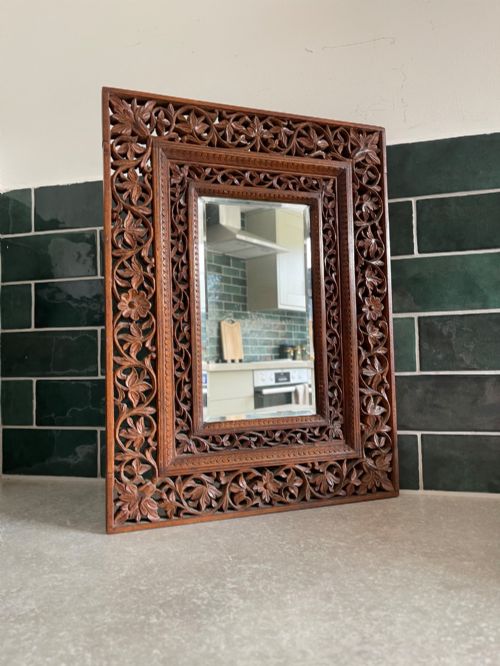
The construction relies on hardwoods such as teak, rosewood, shisham, padouk, walnut, and mahogany, chosen for their stability and grain. Artisans shaped these timbers through intricate carving, fretwork, and joinery to build sturdy frames capable of supporting heavy glass.
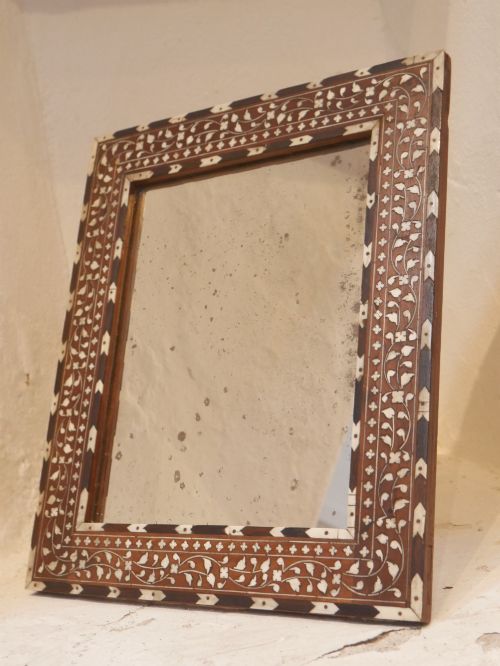
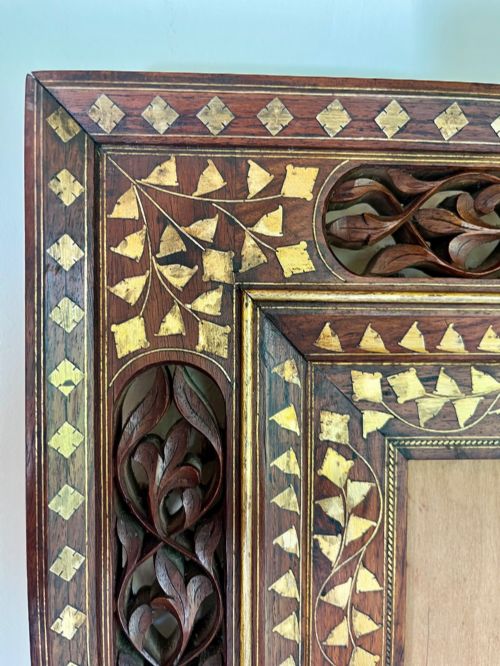
Surface decoration frequently involves inlay work utilising bone, ivory, and brass wire or sheet to form geometric and floral patterns. These contrasting materials are set flush into the dark wooden surfaces by hand, requiring precise fitting.
Surviving pairs of wall sconces offer matching reflections that have stared at the same room for well over a century.
What varies in quality
Quality rests in the depth and precision of the hand-carving across the wooden frame, where sharper relief and cleaner lines indicate greater skill by the artisan. Simpler frames rely on plain moulded surfaces, whereas higher-grade examples feature dense, continuous foliage or figural motifs.
The complexity of the inlay work also dictates the standard of the piece, particularly where brass, bone, or ivory segments are tightly fitted without gaps. Complete and intricate patterns running across the entire border demonstrate higher workshop standards than sparse or interrupted decoration.
The Vintage Indian Mirror Glossary
- Hoshiarpur
- A town in Punjab renowned for its wood-carving and inlay traditions. Pieces from this centre typically feature dense surface decoration.
- Inlay
- A technique where contrasting materials like brass or bone are embedded into depressions within a wood base. This creates flat, decorative patterns across the frame.
- Sconce
- A wall-mounted bracket holding a mirror or light fixture. Pairs of these often flank larger furniture or architectural elements.
- Padouk
- A durable tropical hardwood with a reddish brown colour used in cabinetmaking. It provides a stable dark ground for detailed carving.
Vintage Indian Mirror: Frequently Asked Questions
How do I hang a heavy carved mirror?
These frames often carry significant weight due to dense timbers and glass plates. Ensure your wall fixings engage directly with structural studs or use heavy-duty wall anchors rated for the specific load.
Check the integrity of the original wooden frame and hanging loops on the reverse before mounting. Professional framing support may be required for larger proportions.
What is Anglo-Indian furniture?
Anglo-Indian pieces combine traditional Indian crafting techniques with European forms ordered during the colonial period. They reflect a blend of local materials and Western furniture requirements.
These items were produced for export or for British residents in India, resulting in distinct stylistic crossovers like Regency dressing mirrors with carved oriental details.
Are the mirror plates original?
Mirror glass plates can be original to the piece or replaced later during their long lifespan. Examine the edges and silvering for signs of age, foxing, or oxidation that match the period of the frame.
Replacement glass is common in antique mirrors due to breakage or deterioration over time. Both original and replaced plates appear across these listings.