


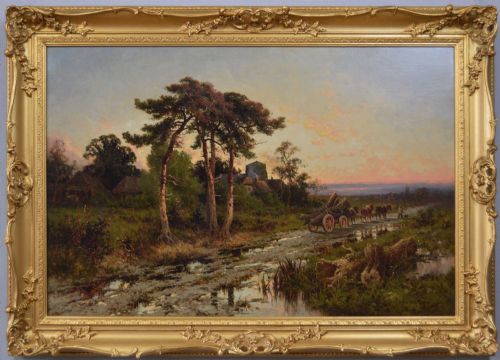


Vintage Horse Cart Painting
A vintage horse cart painting captures the quiet rhythm of rural work, bringing the enduring character of the countryside directly onto your wall.
Vintage Horse Cart Painting
A vintage horse cart painting typically centres on rural scenes involving farm carts, hay wagons, and coastal haulage depicted during the nineteenth and early twentieth centuries. These works record agricultural labour and rural transport through landscape watercolours and oil paintings on canvas or paper.
Buyers encountering this group will frequently find framed watercolours and oil paintings originating from British and French artists working in Impressionist, Realist, and Pastoral traditions. Alongside flat works, the selection occasionally encompasses physical wooden scale models of historical horse-drawn carriages and carts.
The subjects range widely from Yorkshire coastal scenes and West Country villages to harvest fields and timber-loading episodes. Works span specific production dates from the early nineteenth century through to the interwar period of the 1930s.
Materials and methods
Artists relied primarily on oil paint applied to canvas or watercolour pigment worked onto paper, supported by traditional wooden frames often finished in giltwood. Painters built up their compositions using layered pigments to capture atmospheric coastal sunsets and earthy pastoral tones.
Three-dimensional pieces were constructed from handcrafted wood to form detailed scale models of eighteenth-century farm carts and nineteenth-century traps. These tactile constructions demonstrate traditional carpentry techniques applied to miniature agricultural transport.
One recorded model celebrates the humble farm cart in solid wood, proving that even a humble hay wagon deserves its own portrait in miniature.
Judging the range
Quality separates along the strength of draughtsmanship and the artist's command of atmospheric light, particularly in how figures and working horses are integrated into the wider landscape. Superior examples display confident brushwork and a balanced composition that anchors the cart firmly within the rural setting.
The condition of the paper, canvas, and original framing substantially influences the visual integrity of each piece. Works that retain their fresh pigment without excessive fading or damp damage preserve the original tonal harmony intended by the painter.
James William Booth·Léon Joseph Voirin·John Augustus Atkinson·George Hamilton Constantine·Herbert Royle·Frederick William Jackson·Walter Duncan·George Turner·Frank Saltfleet·Henry H Parker·William Kay Blacklock·Alfred George Stevens·Fred Lawson·John Baragwanath King·Reginald Mills·Robert Thorne Waite·JE Hood·Lois Wilton
The Vintage Horse Cart Painting Glossary
- Watercolour
- A painting method in which the pigments are suspended in a water-based solution, typically applied to paper. This medium allows for transparent washes of colour that capture soft light and atmospheric skies.
- Oil on Canvas
- A technique utilising pigments bound in a drying oil, spread across a stretched fabric surface. This combination provides rich depth of colour and enduring tactile texture.
- Giltwood
- Wood that has been treated with a thin layer of gold leaf or metallic gilding. It provides a bright, reflective border to traditional picture frames.
- Pastoral
- An artistic style depicting the idealized aspects of rural life and agricultural labour. These scenes emphasise harmony between humans, animals, and the natural landscape.
- Gouache
- An opaque water-based paint that includes a white pigment filler, producing a heavier and more solid colour application than traditional watercolour.
Vintage Horse Cart Painting: Frequently Asked Questions
What periods do these paintings cover?
The available works span from the early nineteenth century through the Edwardian era and into the 1930s. They capture changing artistic styles across the Victorian and Georgian periods.
Most pieces concentrate on the later nineteenth and early twentieth centuries, reflecting the height of British and French realist painting traditions.
How should I display a watercolour painting?
Watercolours require careful placement away from direct sunlight to prevent the delicate pigments and paper from fading over time. Glazing with protective glass helps shield the artwork from environmental moisture and atmospheric dust.
Choosing a spot with stable indoor humidity ensures the paper remains flat and securely framed within its original or period housing.
What subjects appear most frequently?
Common motifs include hay carts during harvest time, timber hauling, coastal seaweed gathering, and figures crossing rural fords. These themes document everyday agricultural tasks and rural transportation before mechanisation.
Artists frequently set these working carts against recognizable regional backdrops such as Yorkshire, Cornwall, and Arundel.
Are all the items two-dimensional paintings?
While the majority of the selection consists of oil paintings and watercolours on paper or canvas, the category also includes handcrafted wooden scale models. These physical replicas depict historical horse-drawn farm carts and nineteenth-century traps.
Both the flat artworks and the models share a focused interest in historical rural transport.